Max Planck Institute for Polymer Research, Ackermannweg 10, 55128, Mainz, Germany.
Max Planck Institute for Medical Research, Jahnstraße 29, 69120, Heidelberg, Germany.
Chemistry. 2020 Aug 6;26(44):9859-9863. doi: 10.1002/chem.202001238. Epub 2020 Jun 3.
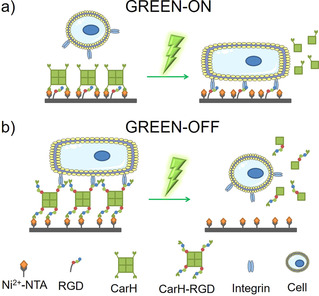
Spatiotemporal control of integrin-mediated cell adhesions to extracellular matrix regulates cell behavior with has numerous implications for biotechnological applications. In this work, two approaches for regulating cell adhesions in space and time with high precision are reported, both of which utilize green light. In the first design, CarH, which is a tetramer in the dark, is used to mask cRGD adhesion-peptides on a surface. Upon green light illumination, the CarH tetramer dissociates into its monomers, revealing the adhesion peptide so that cells can adhere. In the second design, the RGD motif is incorporated into the CarH protein tetramer such that cells can adhere to surfaces functionalized with this protein. The cell adhesions can be disrupted with green light, due to the disassembly of the CarH-RGD protein. Both designs allow for photoregulation with noninvasive visible light and open new possibilities to investigate the dynamical regulation of cell adhesions in cell biology.
细胞外基质中整合素介导的细胞黏附的时空控制调节细胞行为,这对生物技术应用有重要意义。在这项工作中,报道了两种利用绿光高精度时空调节细胞黏附的方法,它们都利用了绿光。在第一个设计中,CarH 是在黑暗中形成四聚体的,用于掩蔽表面上的 cRGD 黏附肽。在绿光照射下,CarH 四聚体解离成单体,暴露出黏附肽,使细胞能够黏附。在第二个设计中,RGD 基序被整合到 CarH 蛋白四聚体中,使细胞能够黏附到用这种蛋白功能化的表面上。由于 CarH-RGD 蛋白的解体,细胞黏附可以被绿光破坏。这两种设计都允许用非侵入性可见光进行光调控,并为研究细胞生物学中细胞黏附的动态调控开辟了新的可能性。