Kramer Markus M, Lataster Levin, Weber Wilfried, Radziwill Gerald
Faculty of Biology and Signalling Research Centres BIOSS and CIBSS, University of Freiburg, 79104 Freiburg, Germany.
SGBM-Spemann Graduate School of Biology and Medicine, University of Freiburg, 79104 Freiburg, Germany.
Int J Mol Sci. 2021 May 18;22(10):5300. doi: 10.3390/ijms22105300.
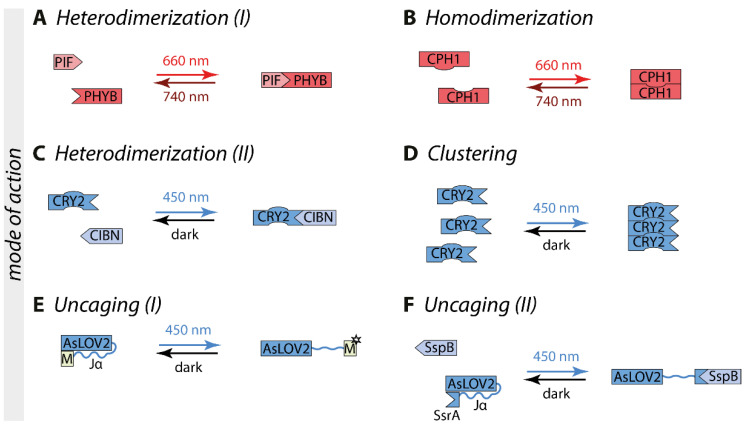
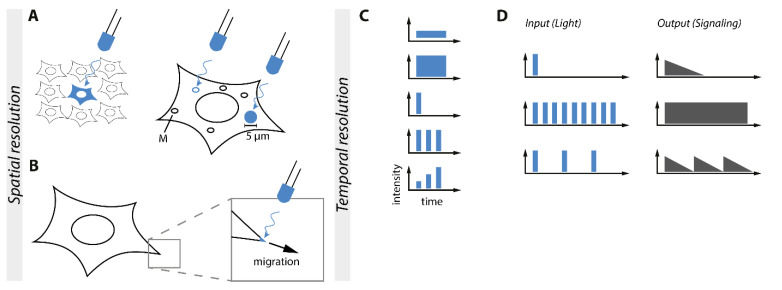
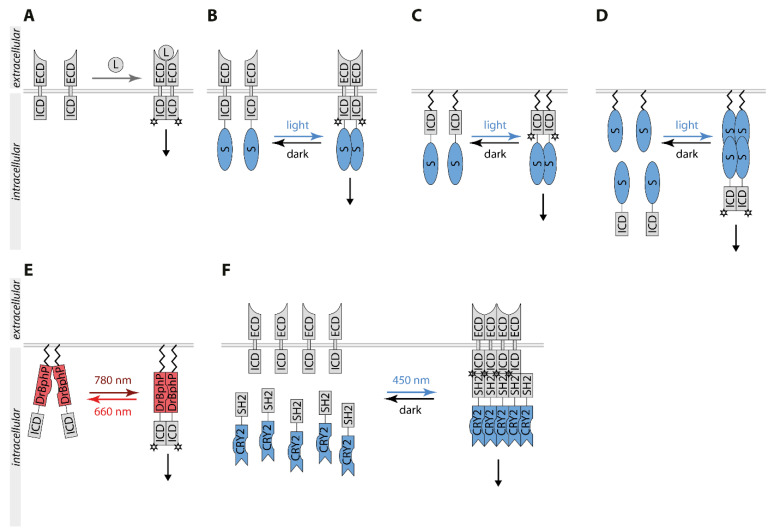
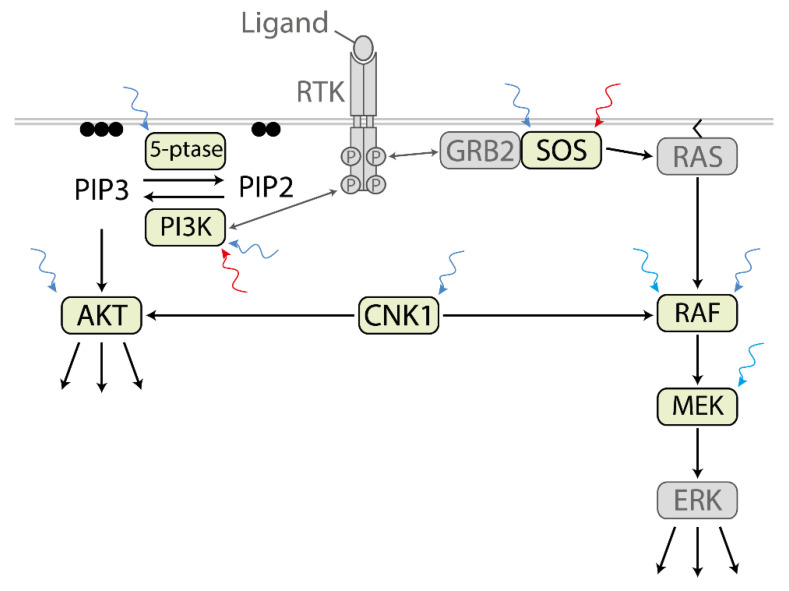
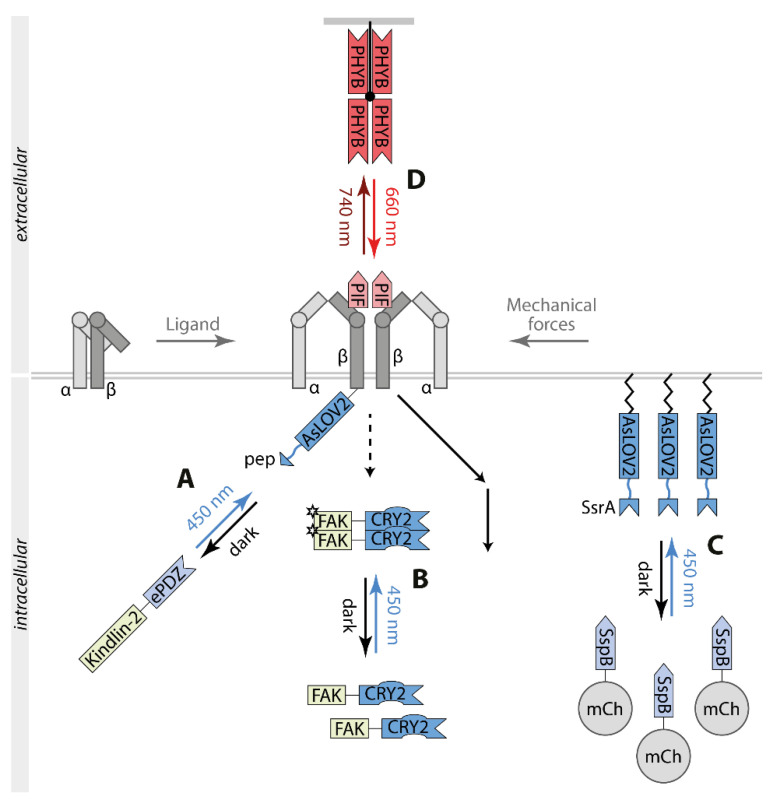
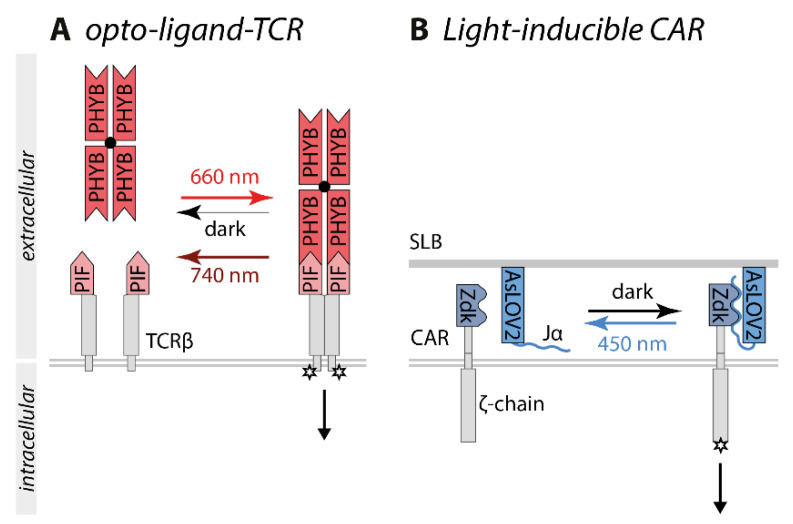
Biological signals are sensed by their respective receptors and are transduced and processed by a sophisticated intracellular signaling network leading to a signal-specific cellular response. Thereby, the response to the signal depends on the strength, the frequency, and the duration of the stimulus as well as on the subcellular signal progression. Optogenetic tools are based on genetically encoded light-sensing proteins facilitating the precise spatiotemporal control of signal transduction pathways and cell fate decisions in the absence of natural ligands. In this review, we provide an overview of optogenetic approaches connecting light-regulated protein-protein interaction or caging/uncaging events with steering the function of signaling proteins. We briefly discuss the most common optogenetic switches and their mode of action. The main part deals with the engineering and application of optogenetic tools for the control of transmembrane receptors including receptor tyrosine kinases, the T cell receptor and integrins, and their effector proteins. We also address the hallmarks of optogenetics, the spatial and temporal control of signaling events.
生物信号由其各自的受体感知,并通过复杂的细胞内信号网络进行转导和处理,从而导致信号特异性的细胞反应。因此,对信号的反应取决于刺激的强度、频率和持续时间以及亚细胞信号的进展情况。光遗传学工具基于基因编码的光感应蛋白,可在没有天然配体的情况下促进信号转导途径和细胞命运决定的精确时空控制。在本综述中,我们概述了将光调节的蛋白质-蛋白质相互作用或笼化/解笼化事件与调控信号蛋白功能联系起来的光遗传学方法。我们简要讨论了最常见的光遗传学开关及其作用模式。主要部分涉及用于控制跨膜受体(包括受体酪氨酸激酶、T细胞受体和整合素)及其效应蛋白的光遗传学工具的工程和应用。我们还讨论了光遗传学的标志,即信号事件的空间和时间控制。