Department of Biostatistics, Epidemiology, and Informatics, Center for Pharmacoepidemiology Research and Training, Center for Clinical Epidemiology and Biostatistics, University of Pennsylvania Perelman School of Medicine, Philadelphia, Pennsylvania, USA.
Department of Medicine, University of Pennsylvania Perelman School of Medicine, Philadelphia, Pennsylvania, USA.
Clin Pharmacol Ther. 2020 Aug;108(2):377-386. doi: 10.1002/cpt.1845. Epub 2020 May 16.
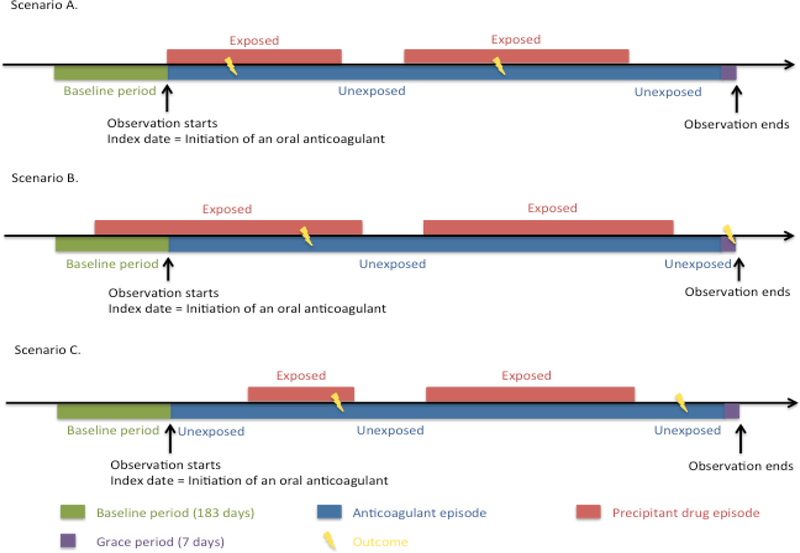
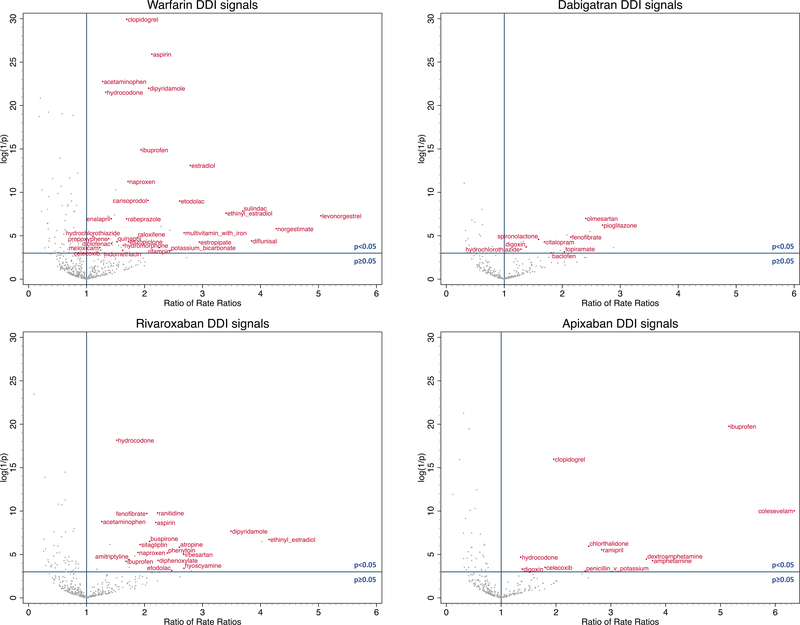
Drug-drug interactions (DDIs) with oral anticoagulants may lead to under-anticoagulation and increased risk of thromboembolism. Although warfarin is susceptible to numerous DDIs, few studies have examined DDIs resulting in thromboembolism or those involving direct-acting oral anticoagulants (DOACs). We aimed to identify medications that increase the rate of hospitalization for thromboembolic events when taken concomitantly with oral anticoagulants. We conducted a high-throughput pharmacoepidemiologic screening study using Optum Clinformatics Data Mart, 2000-2016. We performed self-controlled case series studies among adult users of oral anticoagulants (warfarin, dabigatran, rivaroxaban, apixaban, and edoxaban) with at least one hospitalization for a thromboembolic event. Among eligible patients, we identified all oral medications frequently co-prescribed with oral anticoagulants as potential interacting precipitants. Conditional Poisson regression was used to estimate rate ratios comparing precipitant exposed vs. unexposed time for each anticoagulant-precipitant pair. To minimize within-person confounding by indication for the precipitant, we used pravastatin as a negative control object drug. Multiple estimation was adjusted using semi-Bayes shrinkage. We screened 1,622 oral anticoagulant-precipitant drug pairs and identified 226 (14%) drug pairs associated with statistically significantly elevated risk of thromboembolism. Using pravastatin as the negative control object drug, this list was reduced to 69 potential DDI signals for thromboembolism, 33 (48%) of which were not documented in the DDI knowledge databases Lexicomp and/or Micromedex. There were more DDI signals associated with warfarin than DOACs. This study reproduced several previously documented oral anticoagulant DDIs and identified potential DDI signals that deserve to be examined in future etiologic studies.
药物-药物相互作用(DDI)与口服抗凝剂可能导致抗凝不足和血栓栓塞风险增加。虽然华法林易发生许多 DDI,但很少有研究探讨导致血栓栓塞的 DDI 或涉及直接作用的口服抗凝剂(DOAC)的 DDI。我们旨在确定与口服抗凝剂同时使用时会增加血栓栓塞事件住院率的药物。我们使用 Optum Clinformatics Data Mart,2000-2016 年进行了高通量药物流行病学筛查研究。我们在接受口服抗凝剂(华法林、达比加群、利伐沙班、阿哌沙班和依度沙班)治疗且至少有一次血栓栓塞事件住院的成年患者中进行了自身对照病例系列研究。在合格患者中,我们确定了与口服抗凝剂经常共同开处方的所有口服药物,作为潜在的相互作用引发剂。条件泊松回归用于估计比较每个抗凝剂-引发剂对暴露和未暴露时间的比率。为了最大限度地减少由引发剂指示的个体内混杂,我们使用普伐他汀作为阴性对照药物。使用半贝叶斯收缩法对多次估计进行调整。我们筛选了 1622 个口服抗凝剂-引发剂药物对,并确定了 226 对(14%)与血栓栓塞风险显著升高相关的药物对。使用普伐他汀作为阴性对照药物,该列表减少到 69 个潜在的血栓栓塞 DDI 信号,其中 33 个(48%)未在 Lexicomp 和/或 Micromedex DDI 知识库中记录。与 DOAC 相比,与华法林相关的 DDI 信号更多。本研究再现了一些先前记录的口服抗凝剂 DDI,并确定了值得在未来病因研究中进一步研究的潜在 DDI 信号。