School of Healthcare Sciences, College of Biomedical and Life Sciences, Cardiff University, Cardiff, UK.
Blackpool Teaching Hospitals NHS Foundation Trust, Blackpool, UK.
Anaesthesia. 2020 Aug;75(8):1096-1104. doi: 10.1111/anae.15082. Epub 2020 Apr 28.
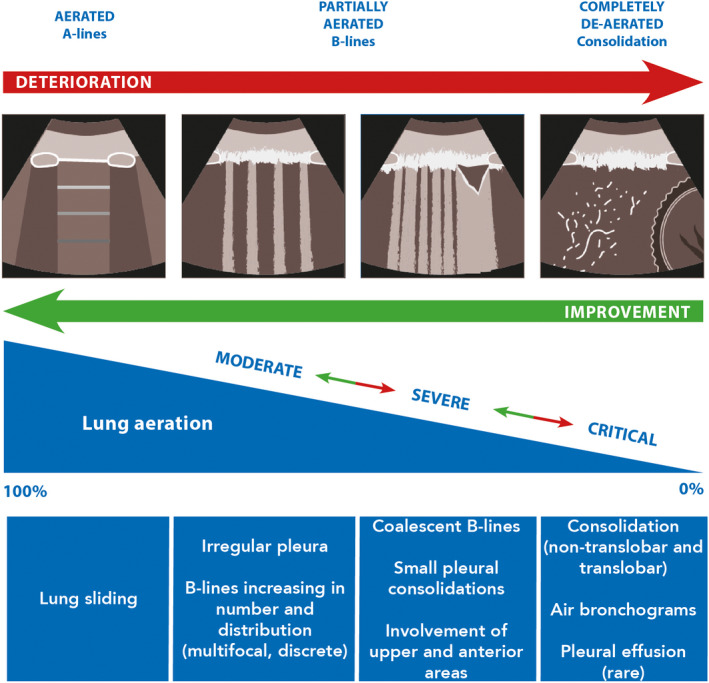
Ultrasound imaging of the lung and associated tissues may play an important role in the management of patients with COVID-19-associated lung injury. Compared with other monitoring modalities, such as auscultation or radiographic imaging, we argue lung ultrasound has high diagnostic accuracy, is ergonomically favourable and has fewer infection control implications. By informing the initiation, escalation, titration and weaning of respiratory support, lung ultrasound can be integrated into COVID-19 care pathways for patients with respiratory failure. Given the unprecedented pressure on healthcare services currently, supporting and educating clinicians is a key enabler of the wider implementation of lung ultrasound. This narrative review provides a summary of evidence and clinical guidance for the use and interpretation of lung ultrasound for patients with moderate, severe and critical COVID-19-associated lung injury. Mechanisms by which the potential lung ultrasound workforce can be deployed are explored, including a pragmatic approach to training, governance, imaging, interpretation of images and implementation of lung ultrasound into routine clinical practice.
肺部和相关组织的超声成像在管理 COVID-19 相关肺损伤患者方面可能发挥着重要作用。与听诊或放射影像学等其他监测方式相比,我们认为肺部超声具有较高的诊断准确性、符合人体工程学且感染控制方面的影响较小。通过为呼吸支持的启动、升级、滴定和撤机提供信息,肺部超声可被整合到 COVID-19 呼吸衰竭患者的护理路径中。鉴于当前医疗保健服务面临前所未有的压力,支持和教育临床医生是广泛实施肺部超声的关键推动因素。本叙述性综述提供了用于中度、重度和危重新冠肺炎相关肺损伤患者的肺部超声使用和解读的证据和临床指南总结。还探讨了如何部署潜在的肺部超声工作人员,包括培训、治理、成像、图像解读以及将肺部超声纳入常规临床实践的务实方法。