School of Biology, Faculty of Biological Sciences, University of Leeds, Leeds LS2 9JT, UK.
School of Biology, Faculty of Biological Sciences, University of Leeds, Leeds LS2 9JT, UK.
Curr Biol. 2020 May 18;30(10):1801-1808.e5. doi: 10.1016/j.cub.2020.02.087. Epub 2020 Apr 9.
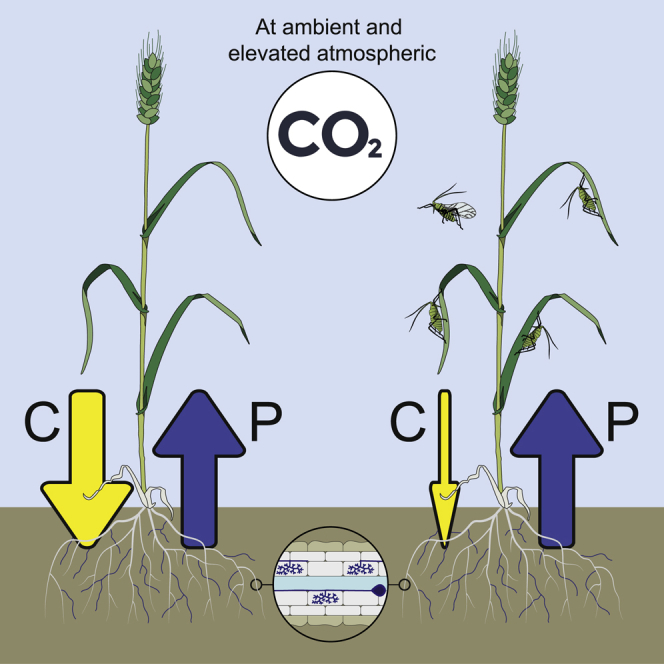
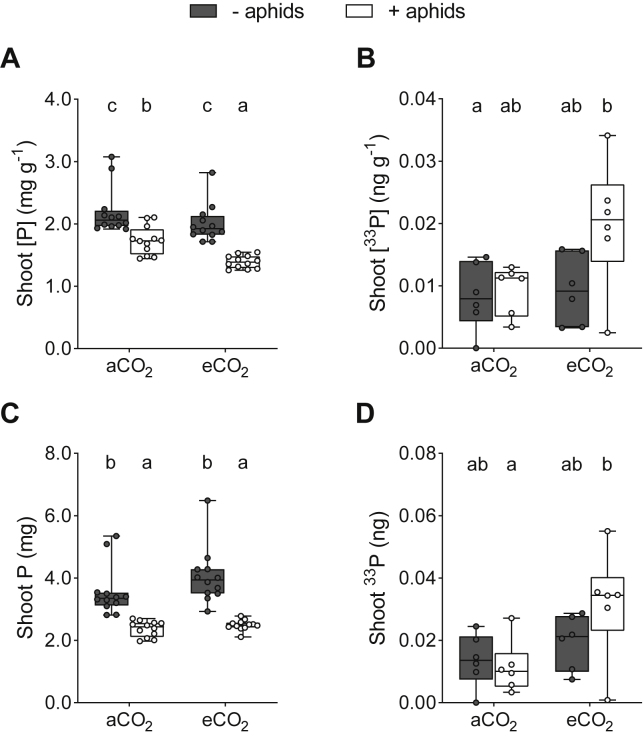
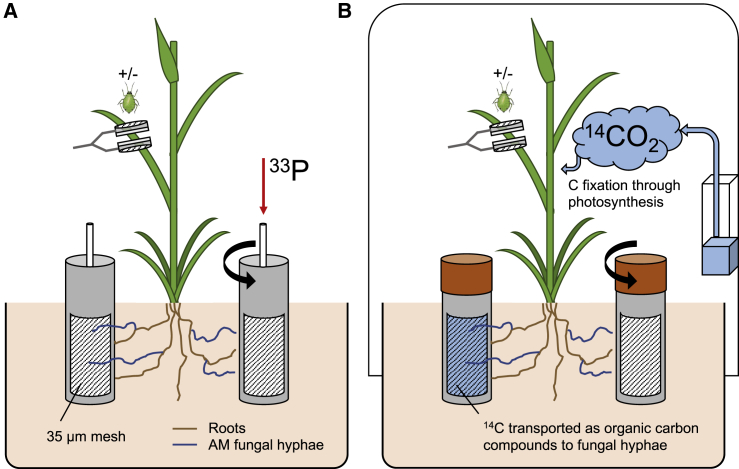
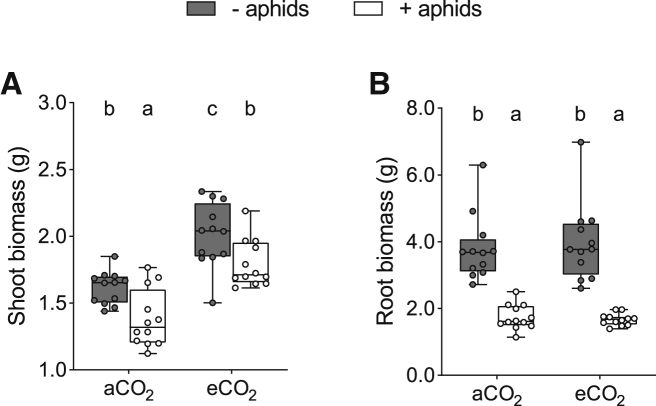
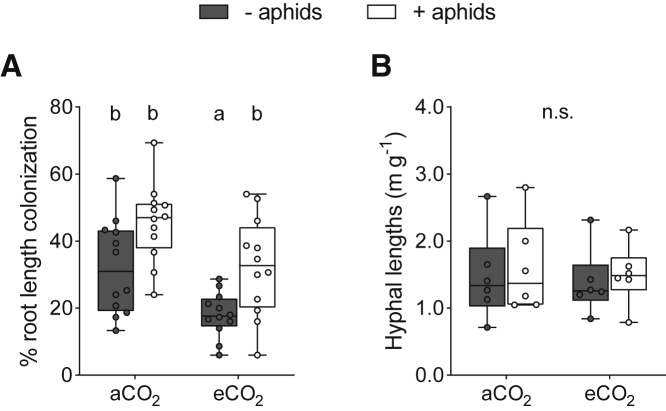
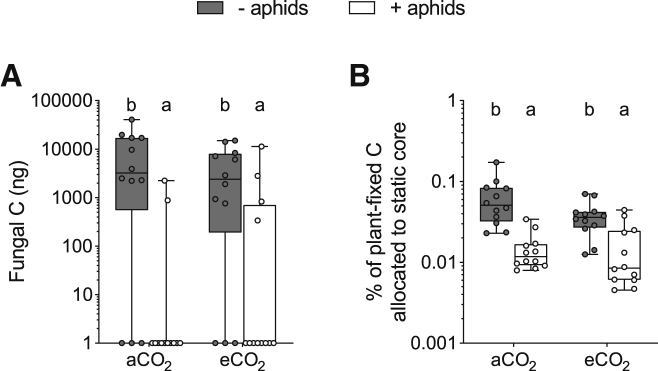
Associations formed between plants and arbuscular mycorrhizal (AM) fungi are characterized by the bi-directional exchange of fungal-acquired soil nutrients for plant-fixed organic carbon compounds. Mycorrhizal-acquired nutrient assimilation by plants may be symmetrically linked to carbon (C) transfer from plant to fungus or governed by sink-source dynamics. Abiotic factors, including atmospheric CO concentration ([CO]), can affect the relative cost of resources traded between mutualists, thereby influencing symbiotic function. Whether biotic factors, such as insect herbivores that represent external sinks for plant C, impact mycorrhizal function remains unstudied. By supplying P to an AM fungus (Rhizophagus irregularis) and CO to wheat, we tested the impact of increasing C sink strength (i.e., aphid herbivory) and increasing C source strength (i.e., elevated [CO]) on resource exchange between mycorrhizal symbionts. Allocation of plant C to the AM fungus decreased dramatically following exposure to the bird cherry-oat aphid (Rhopalosiphum padi), with high [CO] failing to alleviate the aphid-induced decline in plant C allocated to the AM fungus. Mycorrhizal-mediated uptake of P by plants was maintained regardless of aphid presence or elevated [CO], meaning insect herbivory drove asymmetry in carbon for nutrient exchange between symbionts. Here, we provide direct evidence that external biotic C sinks can limit plant C allocation to an AM fungus without hindering mycorrhizal-acquired nutrient uptake. Our findings highlight the context dependency of resource exchange between plants and AM fungi and suggest biotic factors-individually and in combination with abiotic factors-should be considered as powerful regulators of symbiotic function.
植物与丛枝菌根(AM)真菌形成的共生关系的特征是真菌获得的土壤养分与植物固定的有机碳化合物的双向交换。植物对菌根获得的养分的同化可能与从植物到真菌的碳(C)转移对称相关,或者受源库动态的控制。非生物因素,包括大气 CO2 浓度 ([CO2]),可以影响共生体之间交换资源的相对成本,从而影响共生功能。生物因素,如代表植物 C 的外部汇的昆虫食草动物,是否会影响菌根功能仍未得到研究。通过向 AM 真菌(Rhizophagus irregularis)提供 P 和向小麦提供 CO2,我们测试了增加 C 汇强度(即蚜虫取食)和增加 C 源强度(即升高 [CO2])对菌根共生体之间资源交换的影响。暴露于鸟樱桃燕麦蚜虫(Rhopalosiphum padi)后,植物 C 向 AM 真菌的分配急剧下降,而高 [CO2] 未能缓解蚜虫诱导的植物 C 向 AM 真菌的分配减少。无论是否存在蚜虫或升高 [CO2],植物对 P 的菌根介导吸收都得到维持,这意味着昆虫食草动物驱动了共生体之间碳为养分交换的不对称性。在这里,我们提供了直接证据,表明外部生物 C 汇可以限制植物 C 向 AM 真菌的分配,而不会阻碍菌根获得的养分吸收。我们的研究结果强调了植物和 AM 真菌之间资源交换的上下文依赖性,并表明生物因素——单独和与非生物因素结合——应该被视为共生功能的有力调节因素。