Mol Marianne F, Runhaar Jos, Bos P Koen, Dorleijn Desirée M J, Vis Marijn, Gussekloo Jacobijn, Bindels Patrick J E, Bierma-Zeinstra Sita M A
Department of General Practice, Erasmus MC University Medical Center Rotterdam, PO-box 2040, 3000, CA, Rotterdam, The Netherlands.
Department of Orthopaedic Surgery, Erasmus MC University Medical Center Rotterdam, Rotterdam, The Netherlands.
BMC Musculoskelet Disord. 2020 Apr 11;21(1):225. doi: 10.1186/s12891-020-03255-9.
The knee is symptomatically the most frequent affected joint in osteoarthritis and, in the Netherlands and other Western countries, is mainly managed by general practitioners (GPs). An intra-articular glucocorticoid injection is recommended in (inter) national guidelines for patients with knee osteoarthritis as an option for a flare of knee pain and/or for those who are not responding well to pain medication. An innovative approach that could replace the intra-articular injection is an intramuscular gluteal glucocorticoid injection. An intramuscular injection is easier to perform than an intra-articular injection with lesser risk of severe local adverse reactions. We hypothesize that intramuscular gluteal glucocorticoid injection is non-inferior in reducing knee pain compared to intra-articular glucocorticoid injection, with potentially a longer lasting effect than intra-articular injection.
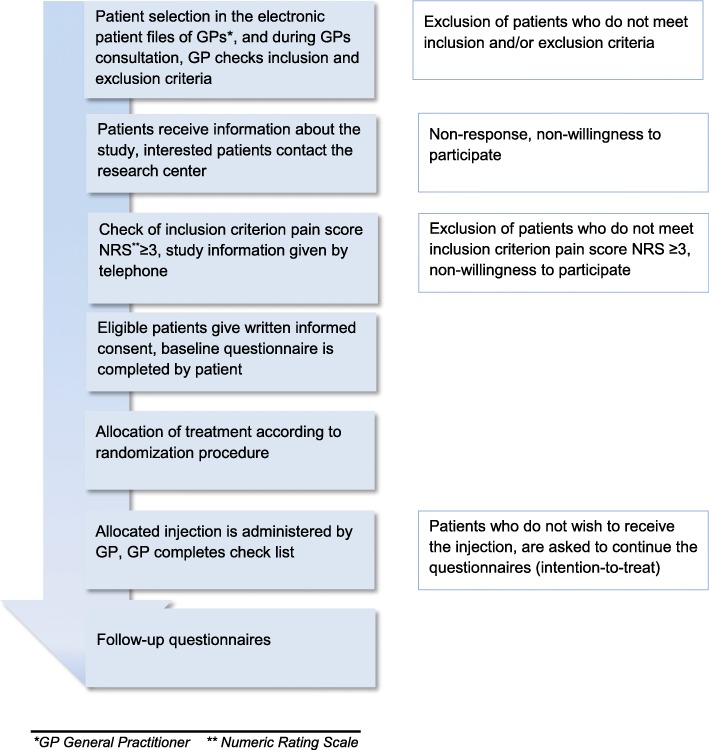
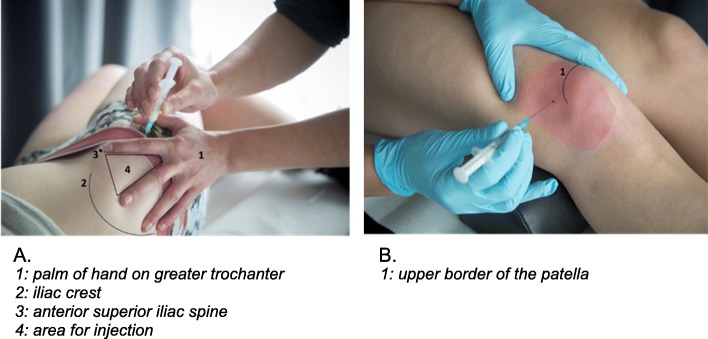
METHODS/DESIGN: The study will be a pragmatic randomized controlled non-inferiority trial with two parallel groups. A total of 140 patients aged 45 years and older with knee osteoarthritis who contacted their general practitioner and have persistent knee pain (score ≥ 3 on 0-10 numerical rating scale; 0 = no knee pain) will be included. Patients will be randomly allocated (1:1) to an injection of 40 mg triamcinolone acetonide intra-articular in the knee joint or intramuscular in the ipsilateral ventrogluteal area. The effect of treatment will be evaluated by questionnaires at 2, 4, 8, 12, and 24 weeks after injection. The primary outcome is patients' reported severity of knee pain measured with the pain subscale of the Knee injury and Osteoarthritis Outcome Score 4 weeks after injection. Statistical analysis will be based on both the per-protocol and the intention-to-treat principle.
This study will evaluate non-inferiority of intramuscular glucocorticoid injection compared to intra-articular glucocorticoid injection for knee osteoarthritis symptoms.
This trial is registered in the Dutch Trial Registry (number NTR6968) at 2018-01-22 (https://www.trialregister.nl/trial/6784). Issue date: 1 October 2019.
Erasmus MC University Medical Center Rotterdam. PO-box 2040. 3000 CA Rotterdam. The Netherlands.
在骨关节炎中,膝关节是症状上最常受累的关节,在荷兰和其他西方国家,主要由全科医生(GP)进行管理。国际指南推荐对膝关节骨关节炎患者进行关节内糖皮质激素注射,作为膝关节疼痛发作的一种选择,以及对那些对止痛药物反应不佳的患者的治疗方法。一种可以替代关节内注射的创新方法是臀肌内糖皮质激素注射。肌内注射比关节内注射更容易操作,严重局部不良反应的风险更小。我们假设,与关节内糖皮质激素注射相比,臀肌内糖皮质激素注射在减轻膝关节疼痛方面不劣于关节内注射,且可能具有比关节内注射更持久的效果。
方法/设计:本研究将是一项实用的随机对照非劣效性试验,分为两个平行组。总共140名年龄在45岁及以上的膝关节骨关节炎患者,他们联系了全科医生且有持续的膝关节疼痛(在0-10数字评分量表上得分≥3;0=无膝关节疼痛)将被纳入。患者将被随机分配(1:1)接受膝关节内注射40mg曲安奈德或同侧臀中肌区域肌内注射。治疗效果将在注射后2、4、8、12和24周通过问卷调查进行评估。主要结局是注射后4周用膝关节损伤和骨关节炎结局评分的疼痛子量表测量的患者报告的膝关节疼痛严重程度。统计分析将基于符合方案原则和意向性治疗原则。
本研究将评估肌内糖皮质激素注射与关节内糖皮质激素注射相比对膝关节骨关节炎症状的非劣效性。
本试验于2018年1月22日在荷兰试验注册中心注册(编号NTR6968)(https://www.trialregister.nl/trial/6784)。发布日期:2019年10月1日。
鹿特丹伊拉斯姆斯大学医学中心。荷兰鹿特丹邮政信箱2040。3000 CA鹿特丹。