Nilsson H, Stranne J, Hugosson J, Wessman C, Steineck G, Bjartell A, Carlsson S, Thorsteinsdottir T, Tyritzis S I, Lantz A, Wiklund P, Haglind E
Department of Surgery, Institute of Clinical Sciences, SSORG, Scandinavian Surgical Outcomes Research Group, Sahlgrenska Academy, University of Gothenburg, Gothenburg, Sweden.
Department of Surgery, Region Västra Götaland, Sahlgrenska University Hospital, Gothenburg, Sweden.
Hernia. 2022 Feb;26(1):157-164. doi: 10.1007/s10029-020-02178-7. Epub 2020 Apr 11.
In addition to incisional hernia, inguinal hernia is a recognized complication to radical retropubic prostatectomy. To compare the risk of developing inguinal and incisional hernias after open radical prostatectomy compared to robot-assisted laparoscopic prostatectomy.
Patients planned for prostatectomy were enrolled in the prospective, controlled LAPPRO trial between September 2008 and November 2011 at 14 hospitals in Sweden. Information regarding patient characteristics, operative techniques and occurrence of postoperative inguinal and incisional hernia were retrieved using six clinical record forms and four validated questionnaires.
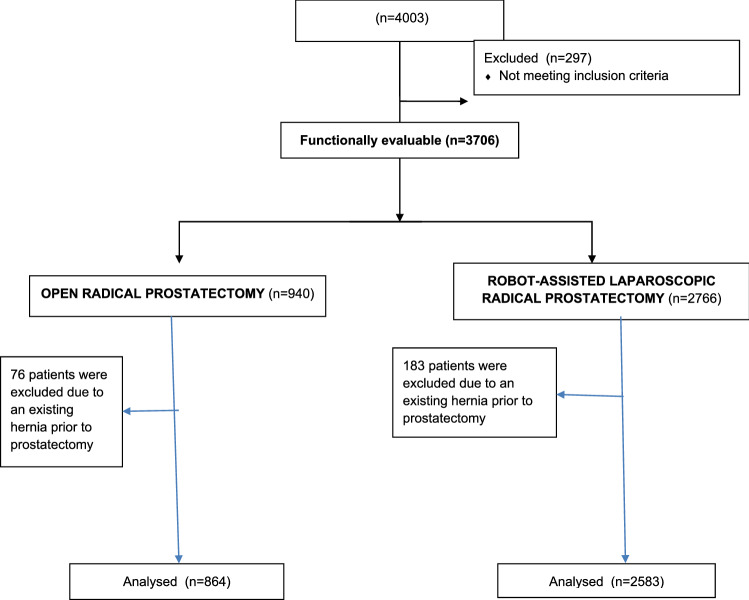
3447 patients operated with radical prostatectomy were analyzed. Within 24 months, 262 patients developed an inguinal hernia, 189 (7.3%) after robot-assisted laparoscopic prostatectomy and 73 (8.4%) after open radical prostatectomy. The relative risk of having an inguinal hernia after robot-assisted laparoscopic prostatectomy was 18% lower compared to open radical retropubic prostatectomy, a non-significant difference. Risk factors for developing an inguinal hernia after prostatectomy were increased age, low BMI and previous hernia repair. The incidence of incisional hernia was low regardless of surgical technique. Limitations are the non-randomised setting.
We found no difference in incidence of inguinal hernia after open retropubic and robot-assisted laparoscopic radical prostatectomy. The low incidence of incisional hernia after both procedures did not allow for statistical analysis. Risk factors for developing an inguinal hernia after prostatectomy were increased age and BMI.
除切口疝外,腹股沟疝是耻骨后根治性前列腺切除术公认的并发症。比较开放性根治性前列腺切除术与机器人辅助腹腔镜前列腺切除术后发生腹股沟疝和切口疝的风险。
2008年9月至2011年11月期间,计划接受前列腺切除术的患者在瑞典14家医院参加了前瞻性对照LAPPRO试验。使用6份临床记录表格和4份经过验证的问卷收集患者特征、手术技术以及术后腹股沟疝和切口疝发生情况的信息。
对3447例行根治性前列腺切除术的患者进行了分析。在24个月内,262例患者发生腹股沟疝,其中机器人辅助腹腔镜前列腺切除术后189例(7.3%),开放性根治性前列腺切除术后73例(8.4%)。与开放性耻骨后根治性前列腺切除术相比,机器人辅助腹腔镜前列腺切除术后发生腹股沟疝的相对风险低18%,差异无统计学意义。前列腺切除术后发生腹股沟疝的危险因素包括年龄增加、低体重指数和既往疝修补术。无论采用何种手术技术,切口疝的发生率都很低。局限性在于该研究为非随机设计。
我们发现开放性耻骨后根治性前列腺切除术和机器人辅助腹腔镜根治性前列腺切除术后腹股沟疝的发生率没有差异。两种手术术后切口疝的发生率都很低,无法进行统计学分析。前列腺切除术后发生腹股沟疝的危险因素是年龄增加和体重指数降低。