From the Department of Neurosurgery, University of Michigan, Ann Arbor (X.T., J.C., R.F.K., G.X., Y.H.).
Department of Neurosurgery, The 2nd Affiliated Hospital, Zhejiang University, Hangzhou, China (X.T., J.C.).
Stroke. 2020 May;51(5):1578-1586. doi: 10.1161/STROKEAHA.119.028672. Epub 2020 Apr 13.
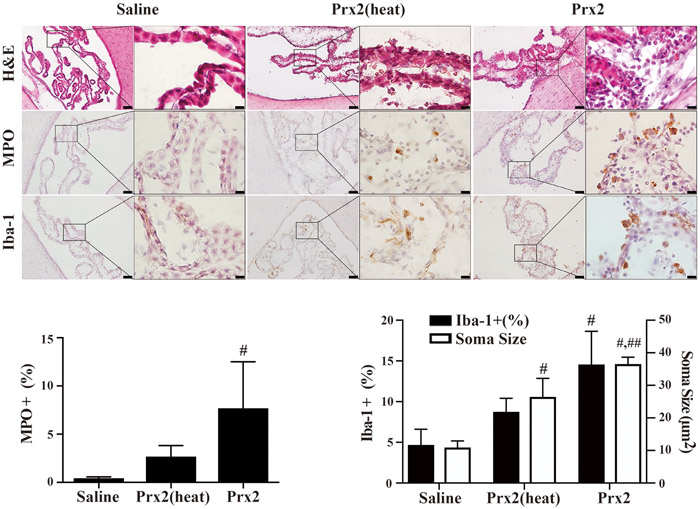
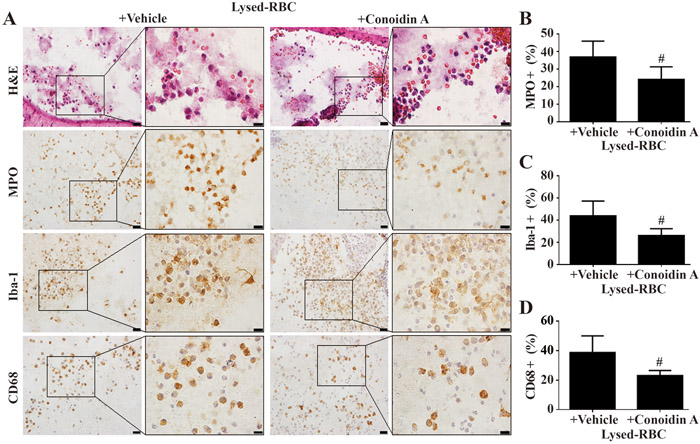
Background and Purpose- Our recent study demonstrated that release of Prx2 (peroxiredoxin 2) from red blood cells (RBCs) is involved in the inflammatory response and brain injury after intracerebral hemorrhage. The current study investigated the role of extracellular Prx2 in hydrocephalus development after experimental intraventricular hemorrhage. Methods- There were 4 parts in this study. First, Sprague-Dawley rats received an intraventricular injection of lysed RBC or saline and were euthanized at 1 hour for Prx2 measurements. Second, rats received an intraventricular injection of Prx2, deactivated Prx2, or saline. Third, lysed RBC was coinjected with conoidin A, a Prx2 inhibitor, or vehicle. Fourth, rats received Prx2 injection and were treated with minocycline or saline (i.p.). The effects of Prx2 and the inhibitors were examined using magnetic resonance imaging assessing ventriculomegaly, histology assessing ventricular wall damage, and immunohistochemistry to assess inflammation, particularly at the choroid plexus. Results- Intraventricular injection of lysed RBC resulted in increased brain Prx2 and hydrocephalus. Intraventricular injection of Prx2 alone caused hydrocephalus, ventricular wall damage, activation of choroid plexus epiplexus cells (macrophages), and an accumulation of neutrophils. Conoidin A attenuated lysed RBC-induced injury. Systemic minocycline treatment reduced the epiplexus cell activation and hydrocephalus induced by Prx2. Conclusions- Prx2 contributed to the intraventricular hemorrhage-induced hydrocephalus, probably by inducing inflammatory responses in choroid plexus and ventricular wall damage.
背景与目的- 我们最近的研究表明,过氧化物酶 2(Prx2)从红细胞(RBC)中的释放参与了脑出血后的炎症反应和脑损伤。本研究旨在探讨细胞外 Prx2 在实验性脑室出血后脑积水发展中的作用。方法- 本研究共分为 4 部分。首先,Sprague-Dawley 大鼠接受裂解 RBC 或生理盐水的脑室注射,并在 1 小时处死以测量 Prx2。其次,大鼠接受 Prx2、失活 Prx2 或生理盐水的脑室注射。第三,裂解 RBC 与 Prx2 抑制剂 conoidin A 或载体共注射。第四,大鼠接受 Prx2 注射并接受米诺环素或生理盐水(腹腔内注射)治疗。通过磁共振成像评估脑室扩大、组织学评估室壁损伤以及免疫组织化学评估炎症(特别是脉络丛)来检查 Prx2 和抑制剂的作用。结果- 裂解 RBC 的脑室注射导致脑内 Prx2 增加和脑积水。单独脑室注射 Prx2 可引起脑积水、室壁损伤、脉络丛上皮下细胞(巨噬细胞)激活和中性粒细胞积聚。conoidin A 减轻了裂解 RBC 诱导的损伤。系统给予米诺环素治疗可减少 Prx2 诱导的上皮下细胞激活和脑积水。结论- Prx2 可能通过诱导脉络丛和室壁损伤中的炎症反应,导致脑室出血引起的脑积水。