Wan Yu-Jui Yvonne, Sheng Lili
Department of Medical Pathology and Laboratory Medicine, University of California, Davis, Sacramento, CA, USA.
Liver Res. 2018 Dec;2(4):180-185. doi: 10.1016/j.livres.2018.09.008. Epub 2018 Sep 23.
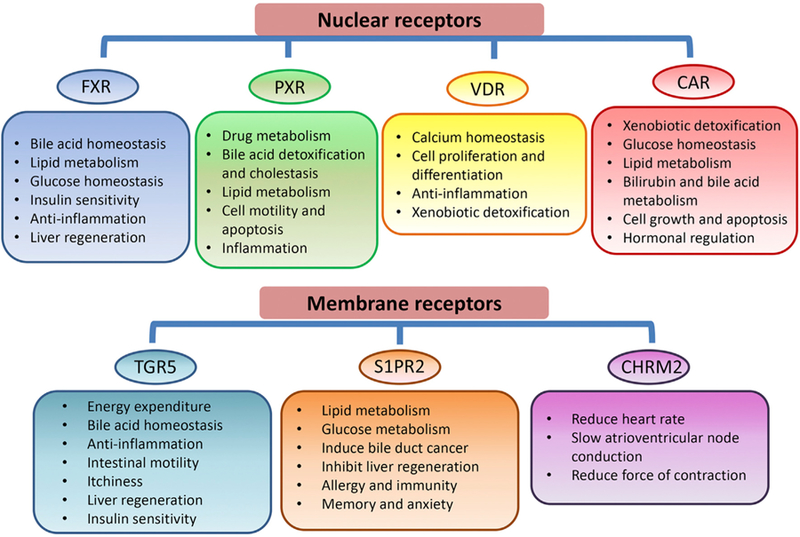
Many receptors can be activated by bile acids (BAs) and their derivatives. These include nuclear receptors farnesoid X receptor (FXR), pregnane X receptor (PXR), and vitamin D receptor (VDR), as well as membrane receptors Takeda G protein receptor 5 (TGR5), sphingosine-1-phosphate receptor 2 (S1PR2), and cholinergic receptor muscarinic 2 (CHRM2). All of them are implicated in the development of metabolic and immunological diseases in response to endobiotic and xenobiotic exposure. Because epigenetic regulation is critical for organisms to adapt to constant environmental changes, this review article summarizes epigenetic regulation as well as post-transcriptional modification of bile acid receptors. In addition, the focus of this review is on the liver and digestive tract although these receptors may have effects on other organs. Those regulatory mechanisms are implicated in the disease process and critically important in uncovering innovative strategy for prevention and treatment of metabolic and immunological diseases.
许多受体可被胆汁酸(BAs)及其衍生物激活。这些受体包括核受体法尼醇X受体(FXR)、孕烷X受体(PXR)和维生素D受体(VDR),以及膜受体武田G蛋白受体5(TGR5)、鞘氨醇-1-磷酸受体2(S1PR2)和毒蕈碱型胆碱能受体2(CHRM2)。它们都与内源性和外源性暴露后代谢性和免疫性疾病的发生发展有关。由于表观遗传调控对于生物体适应不断变化的环境至关重要,因此本文综述了胆汁酸受体的表观遗传调控以及转录后修饰。此外,尽管这些受体可能对其他器官有影响,但本文重点关注肝脏和消化道。这些调控机制与疾病过程相关,对于揭示代谢性和免疫性疾病的预防和治疗创新策略至关重要。