Ticho Alexander L, Malhotra Pooja, Dudeja Pradeep K, Gill Ravinder K, Alrefai Waddah A
Department of Physiology and Biophysics, College of Medicine, University of Illinois at Chicago.
Division of Gastroenterology & Hepatology, Department of Medicine, College of Medicine, University of Illinois at Chicago.
Liver Res. 2019 Mar;3(1):31-39. doi: 10.1016/j.livres.2019.01.001. Epub 2019 Jan 14.
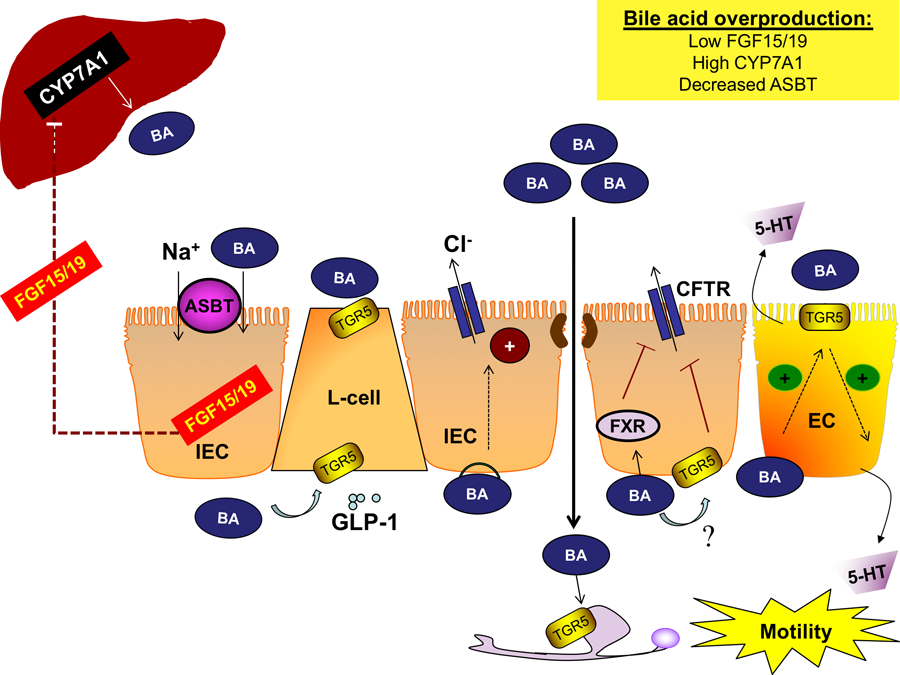
Bile acids modulate several gastrointestinal functions including electrolyte secretion and absorption, gastric emptying, and small intestinal and colonic motility. High concentrations of bile acids lead to diarrhea and are implicated in the development of esophageal, gastric and colonic cancer. Alterations in bile acid homeostasis are also implicated in the pathophysiology of irritable bowel syndrome (IBS) and inflammatory bowel disease (IBD). Our understanding of the mechanisms underlying these effects of bile acids on gut functions has been greatly enhanced by the discovery of bile acid receptors, including the nuclear receptors: farnesoid X receptor (FXR), vitamin D receptor (VDR), pregnane X receptor (PXR), and constitutive androstane receptor (CAR); and the G protein-coupled receptors: Takeda G protein-coupled receptor (TGR5), sphingosine-1-phosphate receptor 2 (S1PR2), and muscarinic acetylcholine receptor M3 (M3R).. For example, various studies provided evidence demonstrating the anti-inflammatory effects FXR and TGR5 activation in models of intestinal inflammation. In addition, TGR5 activation in enteric neurons was recently shown to increase colonic motility, which may lead to bile acid-induced diarrhea. Interestingly, TGR5 induces the secretion of glucagon-like peptide-1 (GLP-1) from L-cells to enhance insulin secretion and modulate glucose metabolism. Because of the importance of these receptors, agonists of TGR5 and intestine-specific FXR agonists are currently being tested as an option for the treatment of diabetes mellitus and primary bile acid diarrhea, respectively. This review summarizes current knowledge of the functional roles of bile acid receptors in the gastrointestinal tract.
胆汁酸可调节多种胃肠功能,包括电解质的分泌与吸收、胃排空以及小肠和结肠的蠕动。高浓度胆汁酸会导致腹泻,并与食管癌、胃癌和结肠癌的发生有关。胆汁酸稳态的改变也与肠易激综合征(IBS)和炎症性肠病(IBD)的病理生理学有关。胆汁酸受体的发现极大地增进了我们对胆汁酸影响肠道功能潜在机制的理解,这些受体包括核受体:法尼醇X受体(FXR)、维生素D受体(VDR)、孕烷X受体(PXR)和组成型雄甾烷受体(CAR);以及G蛋白偶联受体:武田G蛋白偶联受体(TGR5)、鞘氨醇-1-磷酸受体2(S1PR2)和毒蕈碱型乙酰胆碱受体M3(M3R)。例如,多项研究提供的证据表明,在肠道炎症模型中FXR和TGR5激活具有抗炎作用。此外,最近有研究表明,肠神经元中TGR5的激活会增加结肠蠕动,这可能导致胆汁酸诱导的腹泻。有趣的是,TGR5可诱导L细胞分泌胰高血糖素样肽-1(GLP-1),以增强胰岛素分泌并调节葡萄糖代谢。鉴于这些受体的重要性,目前正在对TGR5激动剂和肠道特异性FXR激动剂进行测试,分别作为治疗糖尿病和原发性胆汁酸腹泻的一种选择。本综述总结了目前关于胆汁酸受体在胃肠道中功能作用的知识。