Department of Neurology, Chang Gung Memorial Hospital-Kaohsiung Medical Center, Chang Gung University College of Medicine, Kaohsiung, Taiwan.
Department of Biological Science, National Sun Yat-sen University, Kaohsiung, Taiwan.
Biomed Res Int. 2020 Mar 19;2020:2923907. doi: 10.1155/2020/2923907. eCollection 2020.
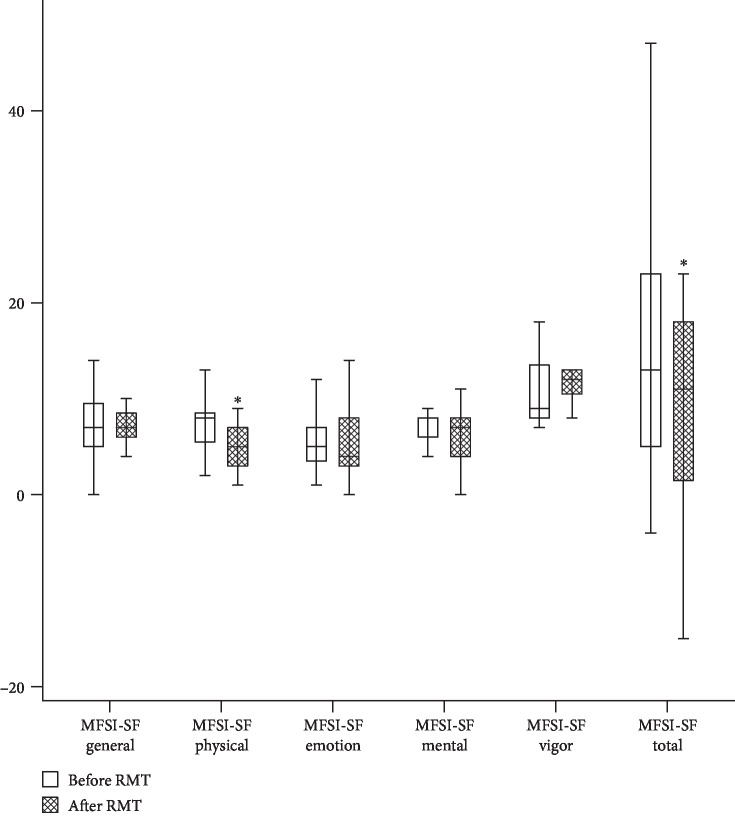
Myasthenia gravis (MG) is an immune-mediated disorder characterized by muscle fatigue and fluctuating weakness. Impairment in respiratory strength and endurance has been described in patients with generalized MG. We tested the hypothesis that respiratory muscle training (RMT) can improve functional outcomes and reduce fatigue in patients with MG.
Eighteen patients with mild to moderate MG participated in this study. The training group underwent home-based RMT three times a week for 12 weeks. Sixteen patients with MG without RMT were enrolled as a disease control group. Lung function, autonomic testing, Multidimensional Fatigue Symptom Inventory-Short Form (MFSI-SF), and functional outcome measurement by using quantitative myasthenia gravis (QMG) score and myasthenia gravis composite (MGC) scale were measured before and after the 12-week RMT.
The 12-week RMT significantly increased forced vital capacity (FVC) from 77.9 ± 12.6% to 83.8 ± 17.7% ( = 0.03), forced expiratory volume in one second (FEV1) from 75.2 ± 18.3% to 83.3 ± 19.0% ( = 0.03), forced expiratory volume in one second (FEV1) from 75.2 ± 18.3% to 83.3 ± 19.0% ( = 0.03), forced expiratory volume in one second (FEV1) from 75.2 ± 18.3% to 83.3 ± 19.0% ( = 0.03), forced expiratory volume in one second (FEV1) from 75.2 ± 18.3% to 83.3 ± 19.0% ( = 0.03), forced expiratory volume in one second (FEV1) from 75.2 ± 18.3% to 83.3 ± 19.0% ( = 0.03), forced expiratory volume in one second (FEV1) from 75.2 ± 18.3% to 83.3 ± 19.0% (.
The home-based RMT is an effective pulmonary function training for MG patients. The RMT can not only improve short-term outcomes but also reduce fatigue in patients with mild to moderate generalized MG.
重症肌无力(MG)是一种免疫介导的疾病,其特征为肌肉疲劳和波动性无力。在全身性 MG 患者中已描述了呼吸力量和耐力的损害。我们检验了呼吸肌训练(RMT)可以改善功能结局并减轻 MG 患者疲劳的假设。
18 名轻度至中度 MG 患者参加了这项研究。训练组每周在家中进行 3 次 RMT,持续 12 周。16 名未接受 RMT 的 MG 患者作为疾病对照组入组。在 12 周的 RMT 前后,测量了肺功能、自主神经测试、多维疲劳症状量表简表(MFSI-SF)以及使用定量重症肌无力(QMG)评分和重症肌无力综合量表(MGC)量表进行的功能结局测量。
12 周的 RMT 可显著增加用力肺活量(FVC)从 77.9±12.6%至 83.8±17.7%( = 0.03),从 75.2±18.3%至 83.3±19.0%( = 0.03),从 75.2±18.3%至 83.3±19.0%( = 0.03),从 75.2±18.3%至 83.3±19.0%( = 0.03),从 75.2±18.3%至 83.3±19.0%( = 0.03),从 75.2±18.3%至 83.3±19.0%( = 0.03)。
基于家庭的 RMT 是一种有效的 MG 患者肺功能训练方法。RMT 不仅可以改善短期结局,还可以减轻轻度至中度全身性 MG 患者的疲劳。