Wang Zhuo, Kang Jihui, Lian Jiayan, Huang Leilei, Xie Wenlin, Zhao Dongliang, Ma Huisi, Lin Zhongwei
Department of Pathology, The First Affiliated Hospital, Sun Yat-sen University, Guangzhou 510080, China.
Department of Pathology, The Seventh Affiliated Hospital, Sun Yat-sen University, Shenzhen 518000, China.
Biomed Res Int. 2020 Mar 19;2020:5264265. doi: 10.1155/2020/5264265. eCollection 2020.
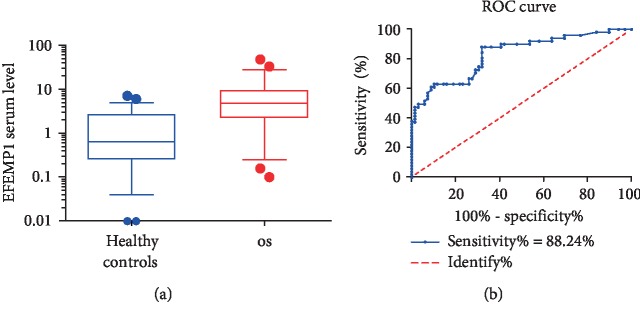
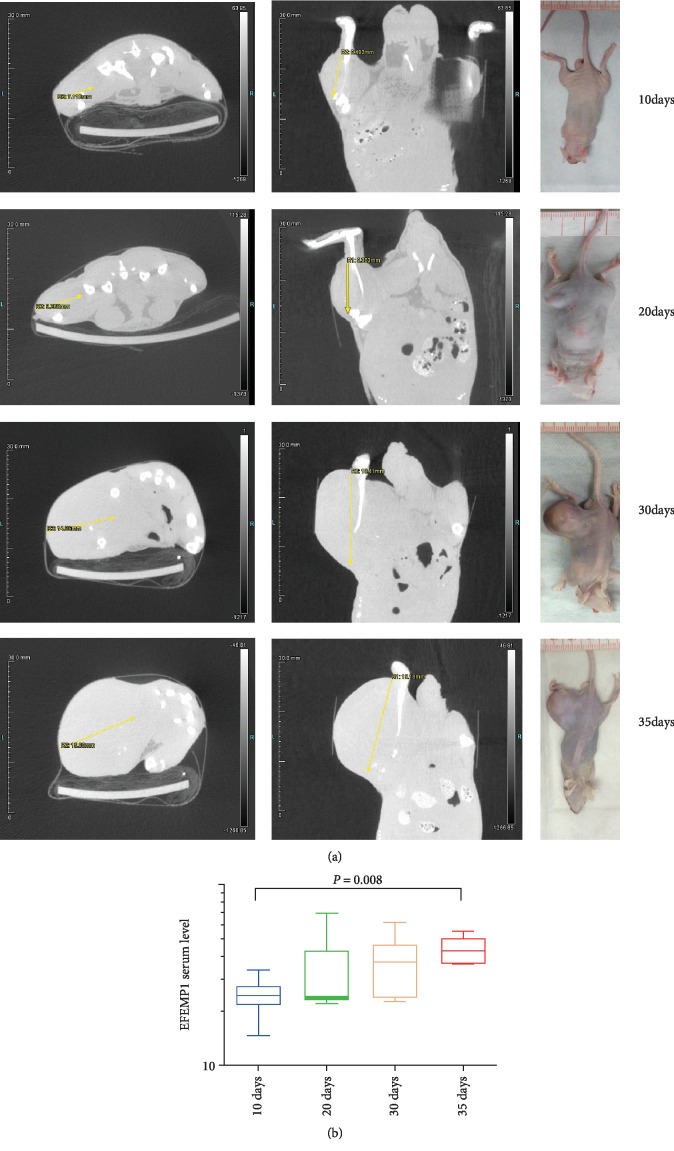
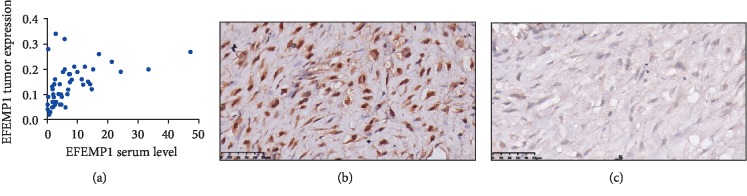
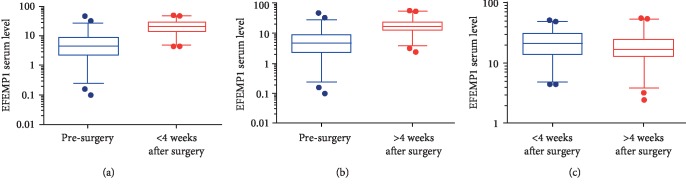
Osteosarcoma (OS) is the most common primary bone malignancy. Our previous study revealed an association between the level of epidermal growth factor-containing fibulin-like extracellular matrix protein 1 (EFEMP1) and the invasion, metastasis, and poor prognosis of OS. However, the exact correlation between the serum EFEMP1 level and OS diagnosis and progression was unclear. This study is aimed at determining the value of the serum EFEMP1 level in the diagnosis and prognosis of OS. Fifty-one consecutive OS patients were prospectively registered in this study. The serum EFEMP1 levels were measured using ELISA at diagnosis, after neoadjuvant chemotherapy, and before and after surgical treatment. Sixty-nine healthy subjects in the control group, nine patients with chondrosarcoma, and 12 patients with giant cell tumor of the bone were also enrolled in this study. Surgical orthotopic implantation was used to generate a mouse OS model, and the correlation between the circulating EFEMP1 levels and tumor progression was examined. Then, OS patients had significantly higher mean serum EFEMP1 levels (7.61 ng/ml) than the control subjects (1.47 ng/ml). The serum EFEMP1 levels were correlated with the Enneking staging system ( = 0.32, = 0.021) and lung metastasis ( = 0.50, < 0.001). There was also a correlation between the serum EFEMP1 level and EFEMP1 expression in the respective OS samples ( = 0.49, < 0.001). Additionally, patients with either chondrosarcoma or giant cell tumor of the bone had significantly higher serum EFEMP1 levels than OS patients. Surgical and chemotherapeutic treatment led to an increase in the serum EFEMP1 levels. Then, the destruction of bone tissues might be one of the factors about the EFEMP1 levels. In the mouse OS model, the serum EFEMP1 level was correlated with tumor progression. Our results suggested that serum EFEMP1 levels might be used to distinguish OS patients from healthy controls and as an indicator for OS lung metastasis. Serum EFEMP1 levels could serve as a new and assisted biomarker for the auxiliary diagnosis and prognosis of OS.
骨肉瘤(OS)是最常见的原发性骨恶性肿瘤。我们之前的研究揭示了含表皮生长因子的纤连蛋白样细胞外基质蛋白1(EFEMP1)水平与骨肉瘤的侵袭、转移及不良预后之间存在关联。然而,血清EFEMP1水平与骨肉瘤诊断及进展的确切相关性尚不清楚。本研究旨在确定血清EFEMP1水平在骨肉瘤诊断和预后中的价值。本研究前瞻性登记了51例连续的骨肉瘤患者。在诊断时、新辅助化疗后以及手术治疗前后,采用酶联免疫吸附测定法(ELISA)检测血清EFEMP1水平。本研究还纳入了69名健康对照者、9例软骨肉瘤患者和12例骨巨细胞瘤患者。采用手术原位植入法建立小鼠骨肉瘤模型,并检测循环EFEMP1水平与肿瘤进展之间的相关性。结果显示,骨肉瘤患者的平均血清EFEMP1水平(7.61 ng/ml)显著高于对照者(1.47 ng/ml)。血清EFEMP1水平与Enneking分期系统相关(r = 0.32,P = 0.021),与肺转移相关(r = 0.50,P < 0.001)。血清EFEMP1水平与相应骨肉瘤样本中的EFEMP1表达也存在相关性(r = 0.49,P < 0.001)。此外,软骨肉瘤或骨巨细胞瘤患者的血清EFEMP1水平显著高于骨肉瘤患者。手术和化疗导致血清EFEMP1水平升高。因此,骨组织破坏可能是影响EFEMP1水平的因素之一。在小鼠骨肉瘤模型中,血清EFEMP1水平与肿瘤进展相关。我们的结果表明,血清EFEMP1水平可用于区分骨肉瘤患者与健康对照者,并作为骨肉瘤肺转移的指标。血清EFEMP1水平可作为骨肉瘤辅助诊断和预后的一种新的辅助生物标志物。