Shen Hao, Zhang Ling, Zhou Jiajie, Chen Zhongjun, Yang Guanghua, Liao Yixiang, Zhu Min
Department of Urology, The Second Clinical Medical College, Yangtze University, Jingzhou, Hubei, China (mainland).
Department of Pathology, The Second Clinical Medical College, Yangtze University, Jingzhou, Hubei, China (mainland).
Med Sci Monit. 2017 Jan 13;23:216-222. doi: 10.12659/msm.898809.
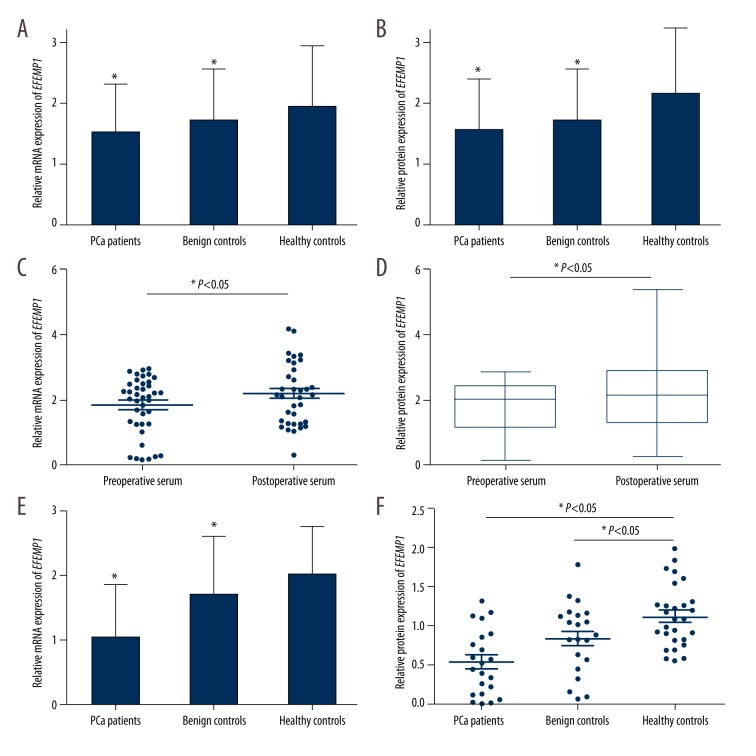
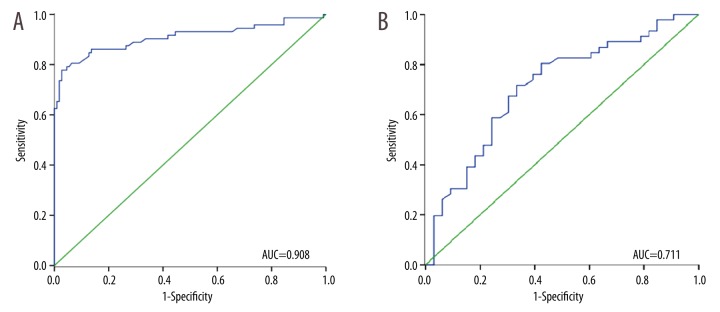
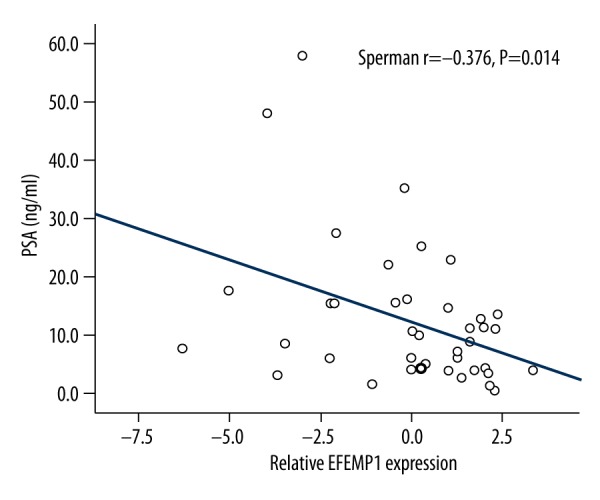
BACKGROUND The aim of this study was to detect the expression of epidermal growth factor-containing fibulin-like extracellular matrix protein 1 (EFEMP1) and estimate its diagnostic value in prostate cancer (PCa). MATERIAL AND METHODS EFEMP1 expression in serum and urine of patients with PCa, benign controls and healthy controls at mRNA and protein level were measured by quantitative reverse transcription polymerase chain reaction (qRT-PCR) and enzyme-linked immunosorbent assay (ELISA) analysis, respectively. The chi-square test was used to analyze the relationship between EFEMP1 expression and clinical factors of patients with PCa. A receiver operating characteristic (ROC) curve was established to evaluate the potential values of EFEMP1 for the diagnosis of PCa. RESULTS The relative expression of EFEMP1 was significantly decreased in patients with PCa compared with that in the benign controls and healthy individuals, both at mRNA and protein levels (P<0.05). In the postoperative serum, the EFEMP1 expression was significantly higher than that in preoperative serum at 2 levels. Urine EFEMP1 expression was also down-regulated in patients with PCa compared to that in the other 2 control groups. The low expression of EFEMP1 was obviously affected by Gleason's score, serum PSA, pathological stage, and lymph node metastasis. Moreover, there was a significant inverse correlation between EFEMP1 expression and PSA levels. The ROC curve revealed that EFEMP1 distinguished PCa patients from healthy controls, with a high AUC of 0.908, corresponding with high sensitivity and specificity, which was significantly higher than the PSA value. CONCLUSIONS Serum EFEMP1 is down-regulated and involved in the progression of PCa. It may serve as a useful diagnostic biomarker, with better diagnostic accuracy than PSA in PCa.
背景 本研究旨在检测含表皮生长因子的纤连蛋白样细胞外基质蛋白1(EFEMP1)的表达,并评估其在前列腺癌(PCa)中的诊断价值。
材料与方法 分别采用定量逆转录聚合酶链反应(qRT-PCR)和酶联免疫吸附测定(ELISA)分析,检测PCa患者、良性对照组和健康对照组血清及尿液中EFEMP1在mRNA和蛋白水平的表达。采用卡方检验分析EFEMP1表达与PCa患者临床因素之间的关系。建立受试者工作特征(ROC)曲线,以评估EFEMP1对PCa诊断的潜在价值。
结果 与良性对照组和健康个体相比,PCa患者中EFEMP1的相对表达在mRNA和蛋白水平均显著降低(P<0.05)。术后血清中,EFEMP1表达在两个水平上均显著高于术前血清。与其他两个对照组相比,PCa患者尿液中EFEMP1表达也下调。EFEMP1的低表达明显受Gleason评分、血清前列腺特异抗原(PSA)、病理分期和淋巴结转移的影响。此外,EFEMP1表达与PSA水平之间存在显著的负相关。ROC曲线显示,EFEMP1能够区分PCa患者与健康对照组,曲线下面积(AUC)为0.908,具有较高的敏感性和特异性,显著高于PSA值。
结论 血清EFEMP1表达下调并参与PCa的进展。它可能作为一种有用的诊断生物标志物,在PCa诊断中具有比PSA更高的诊断准确性。