Luterstein Elaine, Cao Minsong, Lamb James M, Raldow Ann, Low Daniel, Steinberg Michael L, Lee Percy
Department of Radiation Oncology, David Geffen School of Medicine at UCLA, Los Angeles, California.
Adv Radiat Oncol. 2019 Oct 10;5(2):189-195. doi: 10.1016/j.adro.2019.09.008. eCollection 2020 Mar-Apr.
Previous studies have shown that stereotactic ablative radiation therapy (SABR) increases local control for cholangiocarcinoma, but gastrointestinal toxicity resulting from this treatment approach remains a concern. SABR using magnetic resonance-guided radiation therapy (MRgRT) may improve the therapeutic ratio of treatment for cholangiocarcinoma patients given the radiosensitivity of neighboring gastrointestinal organs.
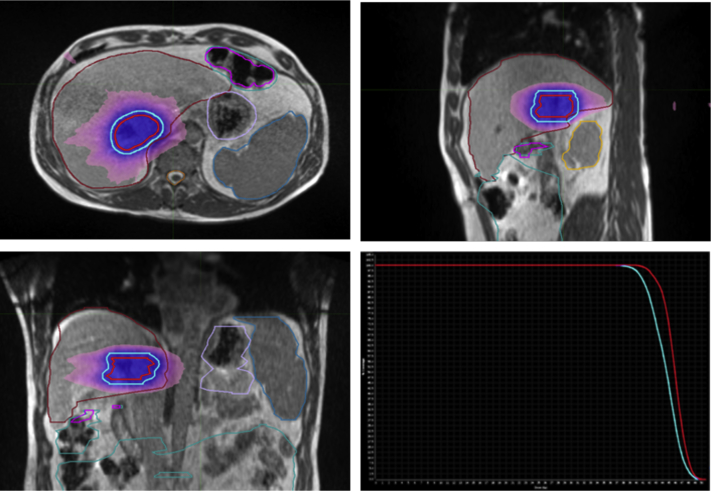
Seventeen consecutive patients with unresectable locally advanced cholangiocarcinoma were treated with SABR using MRgRT between May 2015 and August 2017, subsequent to our previously reported series of patients treated using a standard Linac with cone beam computed tomography. Twelve patients presented with extrahepatic cholangiocarcinoma and 5 patients with intrahepatic tumors. MRgRT-based SABR was administered at a median dose of 40 Gy in 5 fractions.
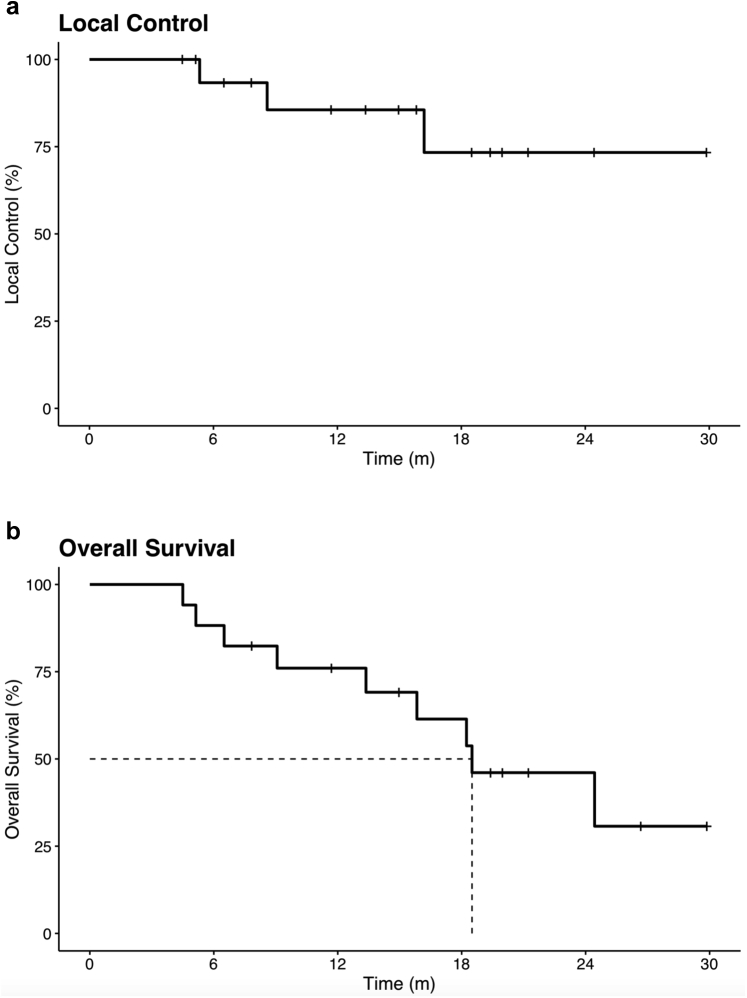
The median overall survival (OS) was 18.5 months, with a 1-year OS of 76% and 2-year OS of 46.1%. Three of the 17 patients progressed locally, yielding a 1-year local control of 85.6% and a 2-year local control of 73.3%. Although 12 of 17 patients experienced an acute grade 1 toxicity, none experienced acute grade 2 toxicities. One patient had an acute grade 3 duodenal ulcer with perforation (6%), and one patient had a late radiation-related toxicity grade 2 gastritis/colitis.
Our findings demonstrate diminished toxicity and excellent overall survival and local control. The clinical outcomes and safety profile of SABR delivered with MRgRT suggest that MRgRT is a promising treatment approach for treating cholangiocarcinoma.
既往研究表明,立体定向消融放疗(SABR)可提高胆管癌的局部控制率,但这种治疗方法导致的胃肠道毒性仍是一个问题。鉴于邻近胃肠道器官的放射敏感性,使用磁共振引导放疗(MRgRT)的SABR可能会提高胆管癌患者的治疗比。
2015年5月至2017年8月期间,对17例连续的不可切除局部晚期胆管癌患者采用MRgRT进行SABR治疗,此前我们报道了一系列使用标准直线加速器结合锥形束计算机断层扫描治疗的患者。12例患者为肝外胆管癌,5例患者为肝内肿瘤。基于MRgRT的SABR中位剂量为40 Gy,分5次给予。
中位总生存期(OS)为18.5个月,1年总生存率为76%,2年总生存率为46.1%。17例患者中有3例出现局部进展,1年局部控制率为85.6%,2年局部控制率为73.3%。虽然17例患者中有12例经历了1级急性毒性反应,但无一例经历2级急性毒性反应。1例患者发生3级急性十二指肠溃疡穿孔(6%),1例患者发生2级晚期放射性胃炎/结肠炎。
我们的研究结果表明毒性降低,总生存期和局部控制良好。MRgRT进行SABR的临床结果和安全性表明,MRgRT是一种有前景的胆管癌治疗方法。