Zhuo Min, Jiang Ming-Yan, Song Rui, Mothi Suraj Sarvode, Bellou Sirine, Polding Laura C, Li Jiahua, Cho Andrew, Hsiao Li-Li
Renal Division, Department of Internal Medicine, Beth Israel Deaconess Medical Center, Harvard Medical School, Boston, Massachusetts, USA.
Renal Division, Department of Internal Medicine, Brigham and Women's Hospital, Harvard Medical School, Boston, Massachusetts, USA.
Kidney Int Rep. 2019 Dec 27;5(4):475-484. doi: 10.1016/j.ekir.2019.12.011. eCollection 2020 Apr.
Albuminuria is a sign of kidney disease and associated with adverse outcomes. However, most individuals with albuminuria are unaware of it. The Kidney Disease Screening and Awareness Program (KDSAP) aims for early detection and raising awareness of albuminuria, targeting underserved populations in communities. This study will assess the prevalence and awareness of albuminuria and identify associated risk factors among KDSAP participants.
KDSAP participants ≥18 years old without a history of dialysis or kidney transplant were included. Albuminuria was identified by dipstick urinalysis. Individuals with albuminuria who answered to either of the following 2 questions were defined as being aware: (i) Have you ever had protein in the urine? (ii) Do you have kidney disease?
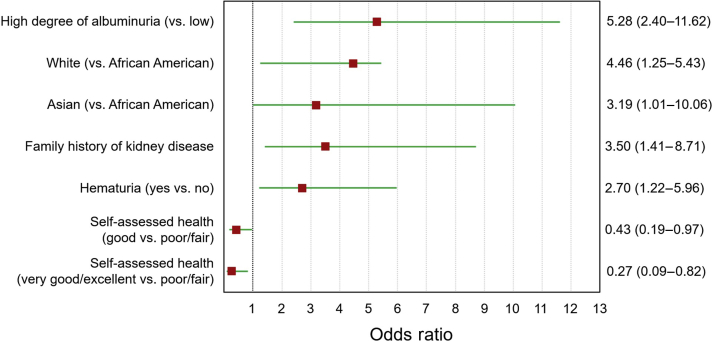
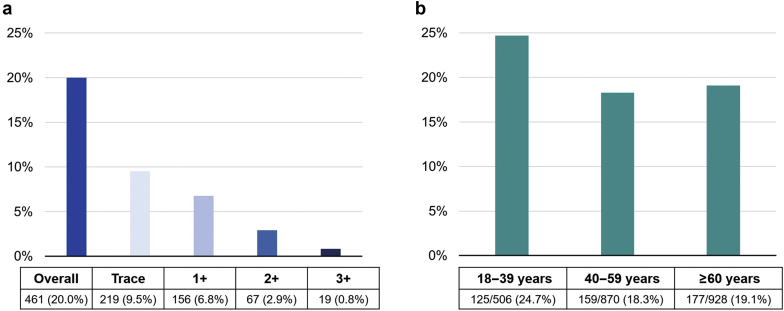
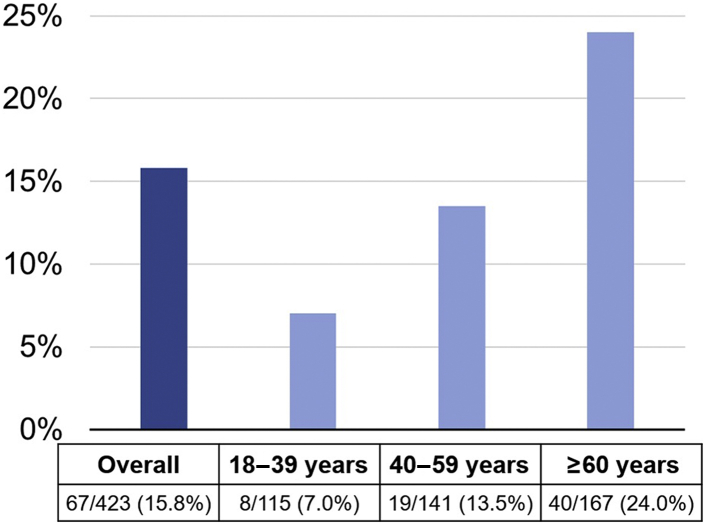
Among 2304 participants, 461 (20.0%) had albuminuria: 16.3% with trace or 1+ (low degree) and 3.7% with 2+ or more (high degree). Correlating factors of albuminuria included young age, male sex, African American descent, self-reported diabetes, hypertension, family history of kidney disease, and smoking. Overall albuminuria awareness was 15.8%, but awareness inversely correlated to younger age groups: 7.0% for ages 18-39 years, 13.5% for ages 40-59 years, and 24.0% for ages ≥60 years ( < 0.001). A high degree of albuminuria (vs. low, odds ratio: 5.04, < 0.001) and concurrent hematuria (odds ratio: 2.12, =0.024) were both associated with higher awareness; conversely, risk factors for low awareness included African American and better self-assessments of health.
There was a high albuminuria prevalence among KDSAP participants, yet low awareness. KDSAP can potentially be a useful model for detecting albuminuria and raising awareness in communities.
蛋白尿是肾脏疾病的一个迹象,与不良后果相关。然而,大多数有蛋白尿的个体并未意识到这一点。肾脏疾病筛查与认知项目(KDSAP)旨在早期发现并提高对蛋白尿的认知,目标是社区中服务不足的人群。本研究将评估KDSAP参与者中蛋白尿的患病率和认知情况,并确定相关危险因素。
纳入年龄≥18岁且无透析或肾移植病史的KDSAP参与者。通过尿试纸条分析确定蛋白尿。回答以下两个问题中任意一个的有蛋白尿个体被定义为知晓:(i)你曾有过尿蛋白吗?(ii)你有肾脏疾病吗?
在2304名参与者中,461人(20.0%)有蛋白尿:16.3%为微量或1+(低度),3.7%为2+或更高(高度)。蛋白尿的相关因素包括年轻、男性、非裔美国人血统、自我报告的糖尿病、高血压、肾脏疾病家族史和吸烟。总体蛋白尿知晓率为15.8%,但知晓率与较年轻年龄组呈负相关:18 - 39岁年龄组为7.0%,40 - 59岁年龄组为13.5%,≥60岁年龄组为24.0%(P<0.001)。高度蛋白尿(与低度相比,比值比:5.04,P<0.001)和并发血尿(比值比:2.12,P = 0.024)均与更高的知晓率相关;相反,知晓率低的危险因素包括非裔美国人和对健康状况的自我评估较好。
KDSAP参与者中蛋白尿患病率高,但知晓率低。KDSAP可能是在社区中检测蛋白尿并提高认知的有用模式。