Laboratory of Virology, Wageningen University & Research, Wageningen, the Netherlands.
Laboratory of Entomology, Wageningen University & Research, Wageningen, the Netherlands.
PLoS Negl Trop Dis. 2020 Apr 13;14(4):e0008217. doi: 10.1371/journal.pntd.0008217. eCollection 2020 Apr.
The Asian bush mosquito Aedes japonicus is invading Europe and was first discovered in Lelystad, the Netherlands in 2013, where it has established a permanent population. In this study, we investigated the vector competence of Ae. japonicus from the Netherlands for the emerging Zika virus (ZIKV) and zoonotic Usutu virus (USUV). ZIKV causes severe congenital microcephaly and Guillain-Barré syndrome in humans. USUV is closely related to West Nile virus, has recently spread throughout Europe and is causing mass mortality of birds. USUV infection in humans can result in clinical manifestations ranging from mild disease to severe neurological impairments.
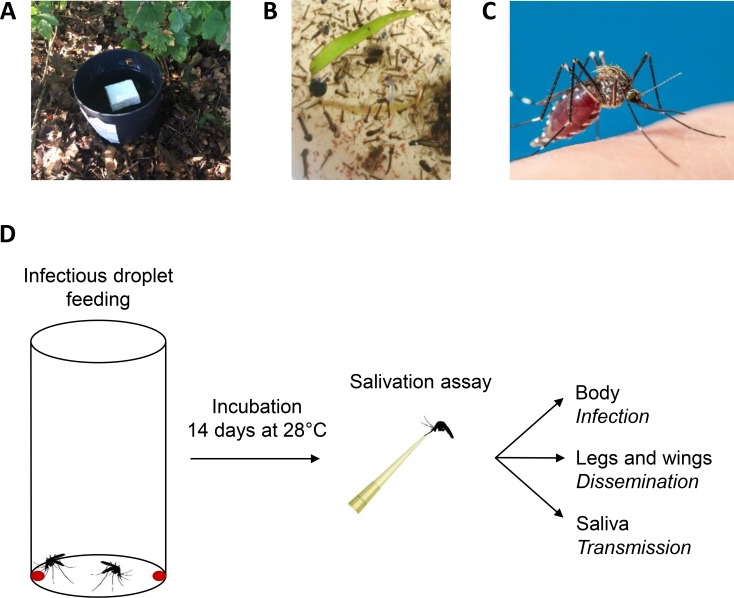
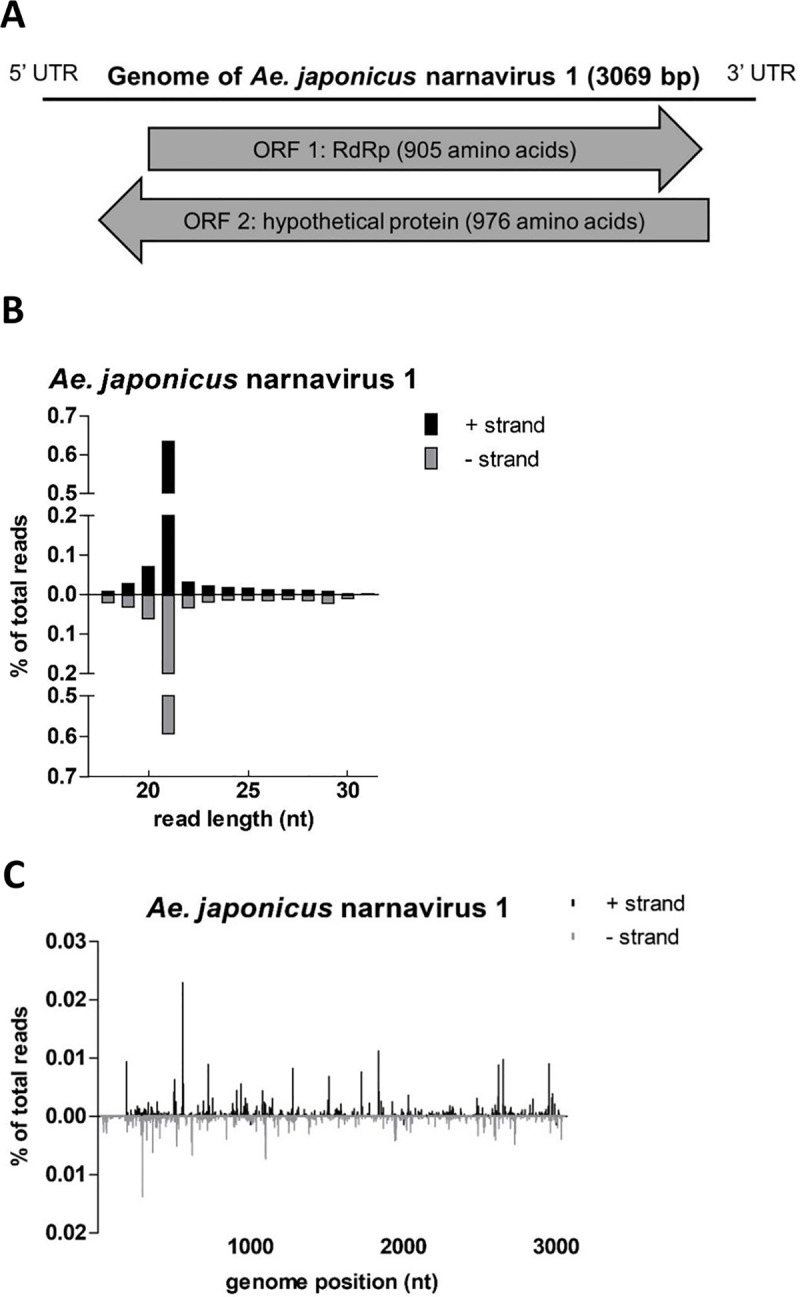
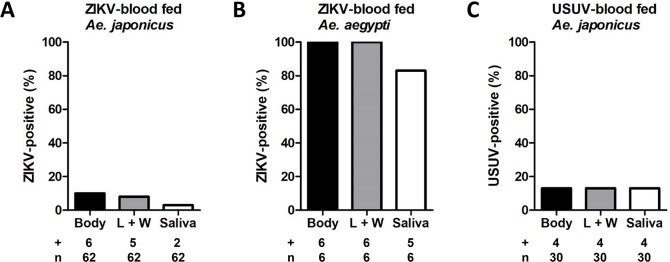
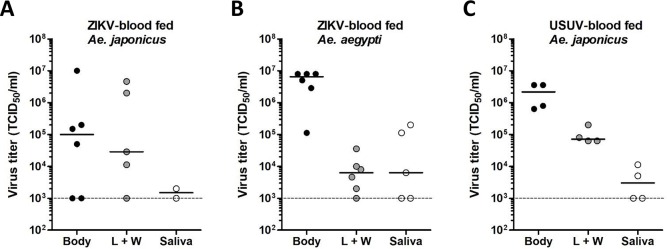
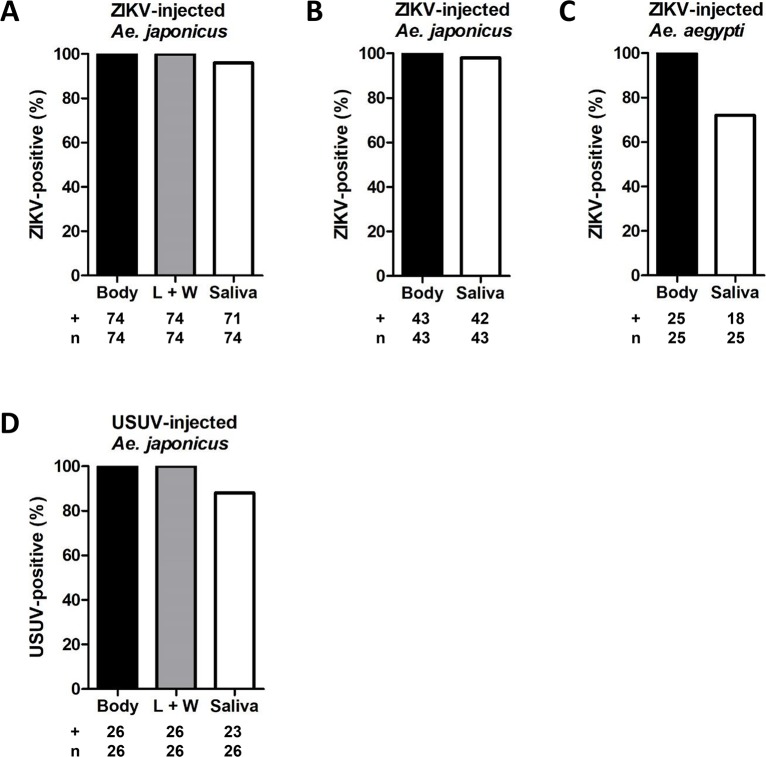
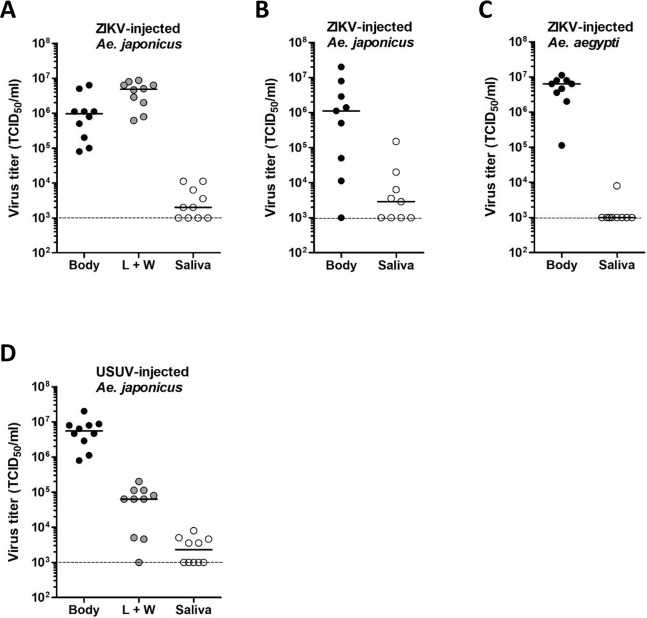
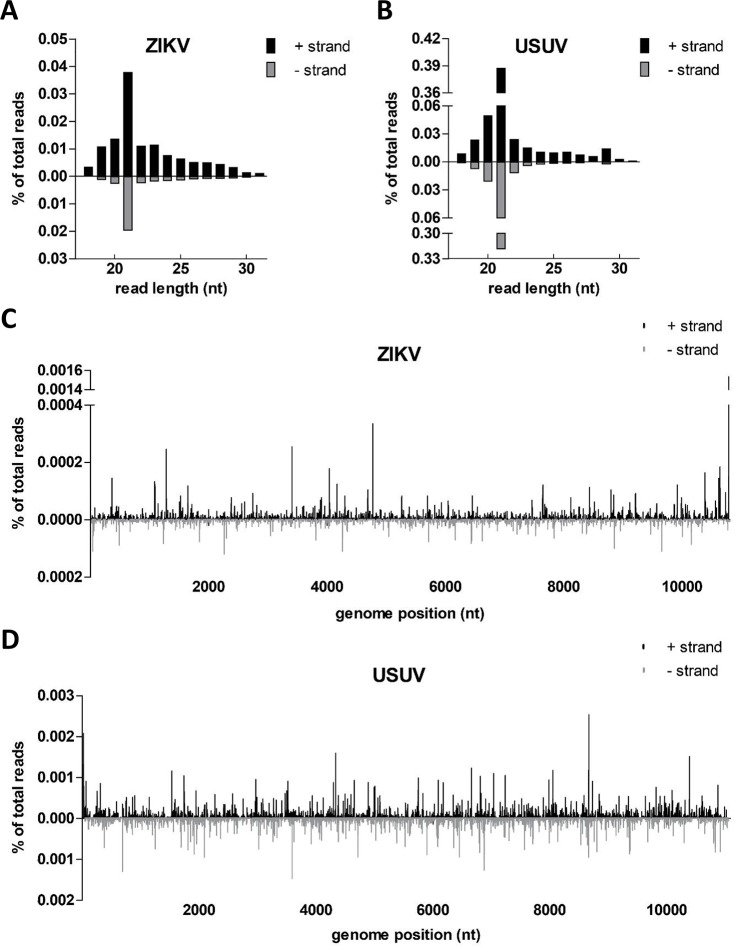
METHODOLOGY/PRINCIPAL FINDINGS: In our study, field-collected Ae. japonicus females received an infectious blood meal with ZIKV or USUV by droplet feeding. After 14 days at 28°C, 3% of the ZIKV-blood fed mosquitoes and 13% of the USUV-blood fed mosquitoes showed virus-positive saliva, indicating that Ae. japonicus can transmit both viruses. To investigate the effect of the mosquito midgut barrier on virus transmission, female mosquitoes were intrathoracically injected with ZIKV or USUV. Of the injected mosquitoes, 96% (ZIKV) and 88% (USUV) showed virus-positive saliva after 14 days at 28°C. This indicates that ZIKV and USUV can efficiently replicate in Ae. japonicus but that a strong midgut barrier is normally restricting virus dissemination. Small RNA deep sequencing of orally infected mosquitoes confirmed active replication of ZIKV and USUV, as demonstrated by potent small interfering RNA responses against both viruses. Additionally, de novo small RNA assembly revealed the presence of a novel narnavirus in Ae. japonicus.
CONCLUSIONS/SIGNIFICANCE: Given that Ae. japonicus can experimentally transmit arthropod-borne viruses (arboviruses) like ZIKV and USUV and is currently expanding its territories, we should consider this mosquito as a potential vector for arboviral diseases in Europe.
亚洲丛林蚊(Aedes japonicus)正在入侵欧洲,2013 年首次在荷兰莱利斯塔德(Lelystad)发现,此后已在该地建立了永久种群。在本研究中,我们调查了来自荷兰的亚洲丛林蚊对新兴寨卡病毒(ZIKV)和人畜共患的乌苏图病毒(USUV)的媒介传播能力。寨卡病毒可导致人类严重的先天性小头畸形和格林-巴利综合征。乌苏图病毒与西尼罗河病毒密切相关,最近已在整个欧洲传播,并导致大量鸟类死亡。人类感染乌苏图病毒后,临床表现从轻症到严重神经损伤不等。
方法/主要发现:在我们的研究中,通过液滴喂养采集的野外亚洲丛林蚊雌蚊接受了含 ZIKV 或 USUV 的感染性血餐。在 28°C 下饲养 14 天后,3%的 ZIKV 血餐蚊和 13%的 USUV 血餐蚊的唾液呈病毒阳性,表明亚洲丛林蚊可以传播这两种病毒。为了研究蚊中肠屏障对病毒传播的影响,对雌性蚊子进行了胸内注射 ZIKV 或 USUV。在 28°C 下饲养 14 天后,96%(ZIKV)和 88%(USUV)的注射蚊唾液呈病毒阳性。这表明 ZIKV 和 USUV 可以在亚洲丛林蚊中有效复制,但强大的中肠屏障通常会限制病毒的传播。经口感染的蚊子的小 RNA 深度测序证实了 ZIKV 和 USUV 的活跃复制,因为针对这两种病毒的强效小干扰 RNA 反应得到了证实。此外,从头组装小 RNA 揭示了亚洲丛林蚊中存在一种新型的 narnavirus。
结论/意义:鉴于亚洲丛林蚊能够实验性传播寨卡病毒和乌苏图病毒等虫媒病毒,且其领地正在扩大,我们应该将这种蚊子视为欧洲虫媒病毒病的潜在传播媒介。