Lee Na-Rae, Lee Choong Hwan, Lee Dong-Yup, Park Jin-Byung
Department of Bioscience and Biotechnology, Konkuk University, Seoul 05029, Korea.
Department of Food Science and Engineering, Ewha Womans University, Seoul 03760, Korea.
Microorganisms. 2020 Apr 9;8(4):539. doi: 10.3390/microorganisms8040539.
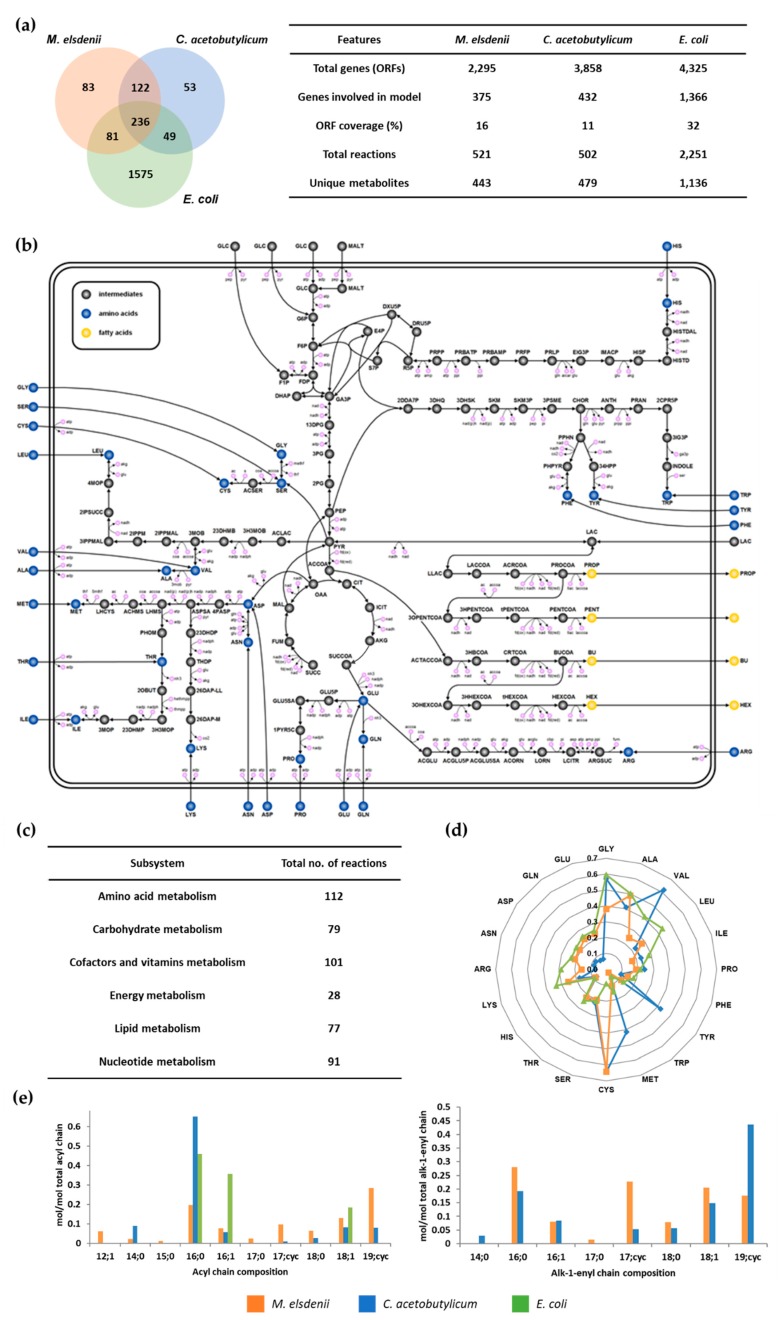
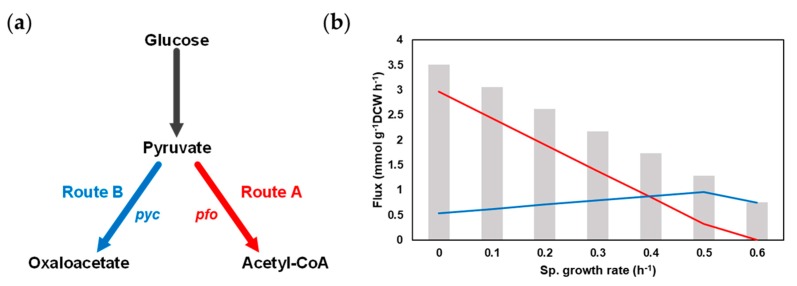
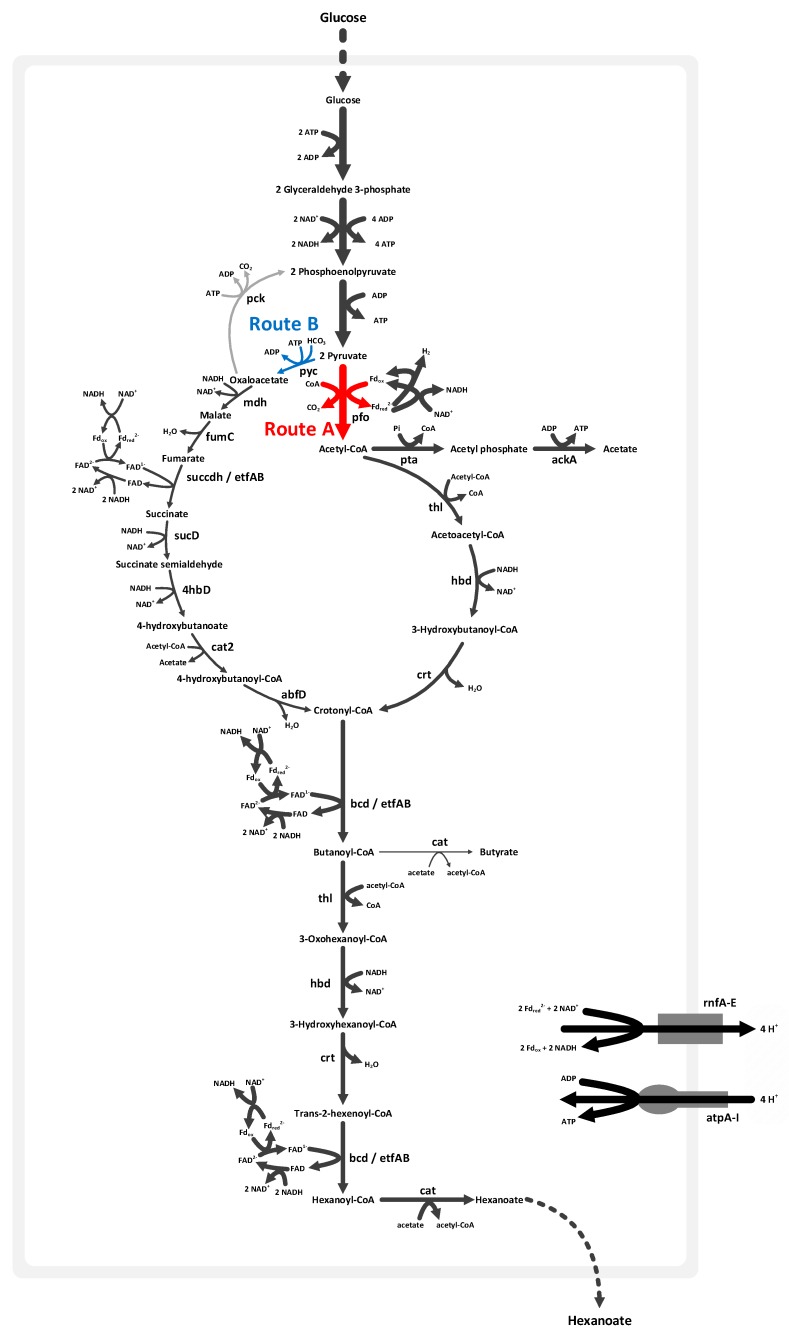
Hexanoic acid and its derivatives have been recently recognized as value-added materials and can be synthesized by several microbes. Of them, has been considered as an interesting hexanoic acid producer because of its capability to utilize a variety of carbons sources. However, the cellular metabolism and physiology of still remain uncharacterized. Therefore, in order to better understand hexanoic acid synthetic metabolism in , we newly reconstructed its genome-scale metabolic model, ME375, which accounts for 375 genes, 521 reactions, and 443 metabolites. A constraint-based analysis was then employed to evaluate cell growth under various conditions. Subsequently, a flux ratio analysis was conducted to understand the mechanism of bifurcated hexanoic acid synthetic pathways, including the typical fatty acid synthetic pathway via acetyl-CoA and the TCA cycle in a counterclockwise direction through succinate. The resultant metabolic states showed that the highest hexanoic acid production could be achieved when the balanced fractional contribution via acetyl-CoA and succinate in reductive TCA cycle was formed in various cell growth rates. The highest hexanoic acid production was maintained in the most perturbed flux ratio, as phosphoenolpyruvate carboxykinase () enables the bifurcated pathway to form consistent fluxes. Finally, organic acid consuming simulations suggested that succinate can increase both biomass formation and hexanoic acid production.
己酸及其衍生物最近被认为是有附加值的材料,并且可以由几种微生物合成。其中,[微生物名称]因其能够利用多种碳源而被视为一种有趣的己酸生产者。然而,[微生物名称]的细胞代谢和生理学仍未得到表征。因此,为了更好地理解[微生物名称]中己酸的合成代谢,我们新构建了其基因组规模的代谢模型ME375,该模型包含375个基因、521个反应和443种代谢物。然后采用基于约束的分析来评估各种条件下的细胞生长。随后,进行了通量比分析,以了解己酸合成途径分叉的机制,包括通过乙酰辅酶A的典型脂肪酸合成途径和通过琥珀酸沿逆时针方向的三羧酸循环。所得的代谢状态表明,当在各种细胞生长速率下通过还原型三羧酸循环中乙酰辅酶A和琥珀酸形成平衡的分数贡献时,可以实现最高的己酸产量。在最受干扰的通量比下保持了最高的己酸产量,因为磷酸烯醇式丙酮酸羧激酶([酶名称])使分叉途径能够形成一致的通量。最后,有机酸消耗模拟表明琥珀酸可以增加生物量形成和己酸产量。