Department of Orthopaedic Surgery, Tohoku University School of Medicine, 2-1 Seiryo-machi, Aoba-ku, Sendai, Miyagi, 980-8574, Japan.
Division of Epidemiology, Department of Health Informatics and Public Health, Tohoku University Graduate School of Public Health, 2-1 Seiryo-machi, Aoba-ku, Sendai, Miyagi, 980-8575, Japan.
BMC Musculoskelet Disord. 2020 Apr 13;21(1):227. doi: 10.1186/s12891-020-03234-0.
Low back pain (LBP) is a common health problem experienced after natural disasters. LBP is often concurrent with other musculoskeletal pain; however, the effects of preexisting musculoskeletal pain on the development of LBP are not clear. The purpose of this study was to elucidate the association of musculoskeletal pain in other body sites with new-onset LBP among survivors of the Great East Japan Earthquake (GEJE).
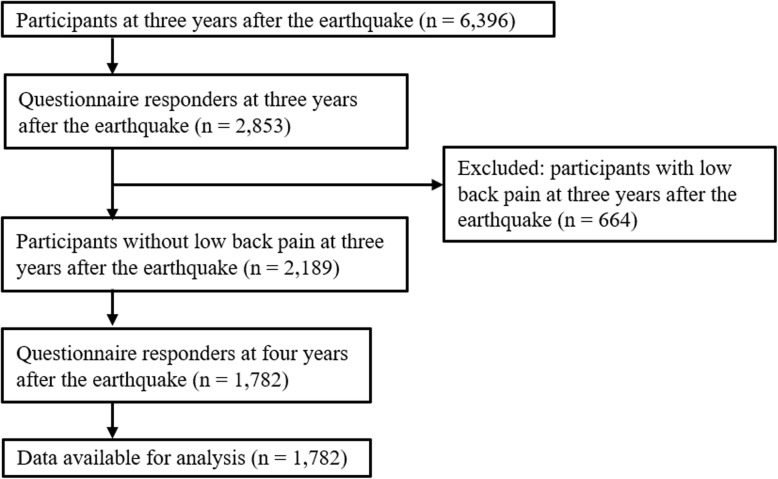
A longitudinal study was conducted with survivors of the GEJE. The survivors who did not have LBP at the 3 year time period after the GEJE were followed up 1 year later (n = 1782). Musculoskeletal pain, such as low back, hand and/or foot, knee, shoulder, and neck pain, were assessed with self-reported questionnaires. The outcome of interest was new-onset LBP, which was defined as LBP absent at 3 years but present at 4 years after the disaster. The main predictor was musculoskeletal pain in other body sites 3 years after the GEJE, which was categorized according to the number of pain sites (0, 1, ≥ 2). Multiple regression analyses were performed to calculate the odds ratio (OR) and 95% confidence interval (CI) for new-onset LBP due to musculoskeletal pain in other body sites.
The incidence of new-onset LBP was 14.1% (251/1782). Musculoskeletal pain in other body sites was significantly associated with new-onset LBP. Including people without other musculoskeletal pain as a reference, the adjusted OR and 95% CI for new-onset LBP were 1.73 (1.16-2.57) for people with one musculoskeletal pain site and 3.20 (2.01-5.09) for people with ≥ 2 sites (p < 0.001).
Preexisting musculoskeletal pain in other body sites was associated with new-onset LBP among survivors in the recovery period after the GEJE.
下背痛(LBP)是自然灾害后常见的健康问题。LBP 常与其他肌肉骨骼疼痛同时发生;然而,先前存在的肌肉骨骼疼痛对 LBP 发展的影响尚不清楚。本研究旨在阐明大地震幸存者其他身体部位的肌肉骨骼疼痛与新发 LBP 之间的关系。
对东日本大地震(GEJE)幸存者进行了一项纵向研究。在 GEJE 3 年后没有 LBP 的幸存者在 1 年后进行了随访(n=1782)。使用自我报告问卷评估肌肉骨骼疼痛,如下背部、手和/或脚部、膝盖、肩部和颈部疼痛。感兴趣的结果是新发 LBP,定义为灾难后 3 年无 LBP,但 4 年后出现 LBP。主要预测指标是 GEJE 3 年后其他身体部位的肌肉骨骼疼痛,根据疼痛部位的数量(0、1、≥2)进行分类。采用多回归分析计算其他身体部位肌肉骨骼疼痛导致新发 LBP 的比值比(OR)和 95%置信区间(CI)。
新发 LBP 的发生率为 14.1%(251/1782)。其他身体部位的肌肉骨骼疼痛与新发 LBP 显著相关。将没有其他肌肉骨骼疼痛的人作为参照,新发 LBP 的调整 OR 和 95%CI 为有 1 个肌肉骨骼疼痛部位的人 1.73(1.16-2.57),有≥2 个部位的人 3.20(2.01-5.09)(p<0.001)。
GEJE 恢复期其他身体部位的先前存在的肌肉骨骼疼痛与新发 LBP 有关。