Department of Sports Science and Clinical Biomechanics, Faculty of Health Sciences, University of Southern Denmark, Odense, Denmark.
Department of Public Health and Nursing, NTNU - Norwegian University of Science and Technology, Trondheim, Norway.
BMC Musculoskelet Disord. 2021 Jan 18;22(1):91. doi: 10.1186/s12891-020-03893-z.
Co-occurring musculoskeletal pain is common among people with persistent low back pain (LBP) and associated with more negative consequences than LBP alone. The distribution and prevalence of musculoskeletal pain co-occurring with persistent LBP has not been systematically described, which hence was the aim of this review.
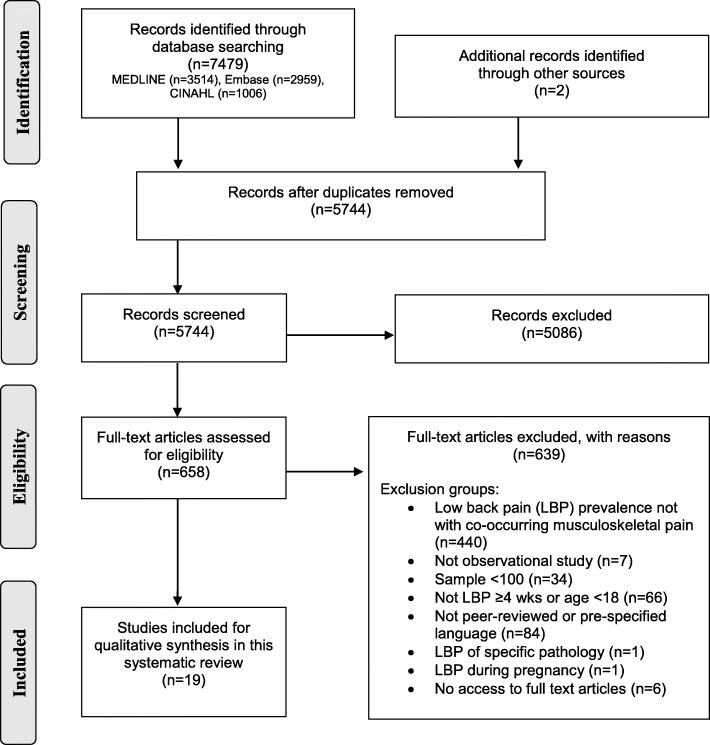
Literature searches were performed in MEDLINE, Embase, CINAHL and Scopus. We considered observational studies from clinical settings or based on cohorts of the general or working populations involving adults 18 years or older with persistent LBP (≥4 wks) and co-occurring musculoskeletal pain for eligibility. Study selection, data extraction and risk of bias assessment were carried out by independent reviewers. Results are presented according to study population, distribution and location(s) of co-occurring pain.
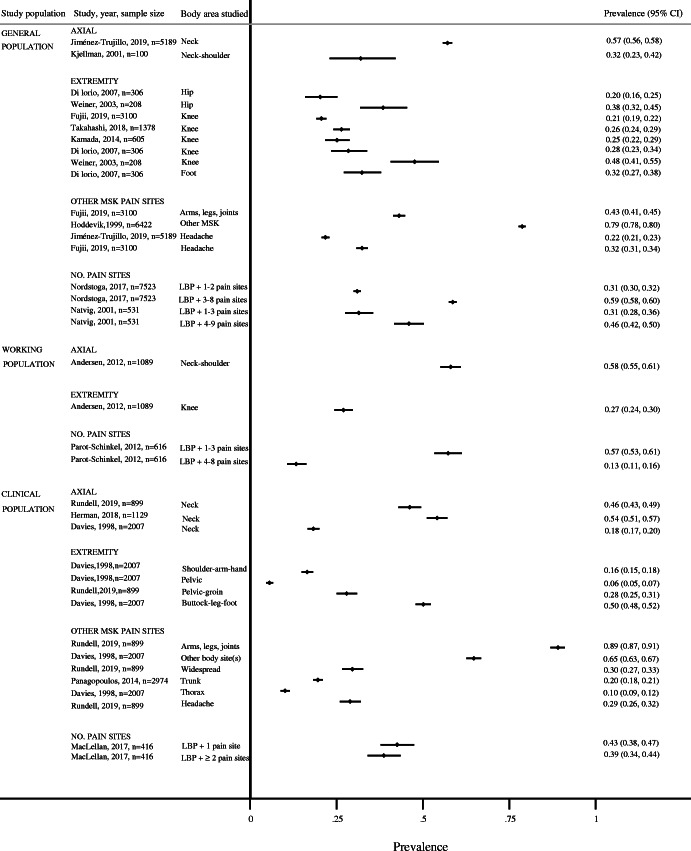
Nineteen studies out of 5744 unique records met the inclusion criteria. Studies were from high-income countries in Europe, USA and Japan. A total of 34,492 people with persistent LBP were included in our evidence synthesis. Methods for assessing and categorizing co-occurring pain varied considerably between studies, but based on the available data from observational studies, we identified three main categories of co-occurring pain - these were axial pain (18 to 58%), extremity pain (6 to 50%), and multi-site musculoskeletal pain (10 to 89%). Persistent LBP with co-occurring pain was reported more often by females than males, and co-occurring pain was reported more often in patients with more disability.
People with persistent LBP often report co-occurring neck pain, extremity pain or multi-site pain. Assessment of co-occurring pain alongside persistent LBP vary considerable between studies and there is a need for harmonisation of measurement methods to advance our understanding of how pain in different body regions occur alongside persistent LBP.
PROSPERO CRD42017068807 .
持续性下背痛(LBP)患者常同时伴有肌肉骨骼疼痛,其不良后果比单纯 LBP 更为严重。目前尚未系统描述持续性 LBP 伴发肌肉骨骼疼痛的分布和流行情况,因此,本综述旨在对此进行描述。
在 MEDLINE、Embase、CINAHL 和 Scopus 中进行文献检索。我们纳入了来自临床环境或基于一般人群或工作人群队列的观察性研究,纳入标准为:年龄≥18 岁的成年人,持续 LBP(≥4 周)且伴有肌肉骨骼疼痛。通过独立评审员进行研究选择、数据提取和偏倚风险评估。结果按照研究人群、伴发疼痛的分布和(或)部位进行呈现。
在 5744 篇独特记录中,有 19 篇研究符合纳入标准。这些研究来自欧洲、美国和日本的高收入国家。我们的证据综合共纳入了 34492 名持续性 LBP 患者。评估和分类伴发疼痛的方法在研究之间差异很大,但根据观察性研究的现有数据,我们确定了伴发疼痛的三个主要类别:轴性疼痛(18%至 58%)、四肢疼痛(6%至 50%)和多部位肌肉骨骼疼痛(10%至 89%)。伴有疼痛的持续性 LBP 患者中女性多于男性,且疼痛程度与残疾程度相关。
持续性 LBP 患者常报告伴有颈部疼痛、四肢疼痛或多部位疼痛。对持续性 LBP 伴发疼痛的评估在研究之间存在很大差异,需要对测量方法进行协调统一,以增进我们对不同身体部位疼痛与持续性 LBP 同时发生的理解。
PROSPERO CRD42017068807。