Department of Chemistry, Massachusetts Institute of Technology, 77 Massachusetts Avenue, Cambridge, MA 02139, USA.
Institute of Molecular, Cell and Systems Biology, College of Medical, Veterinary and Life Science, University of Glasgow, Glasgow G12 8QQ, UK.
Sci Adv. 2020 Apr 3;6(14):eaaz4888. doi: 10.1126/sciadv.aaz4888. eCollection 2020 Apr.
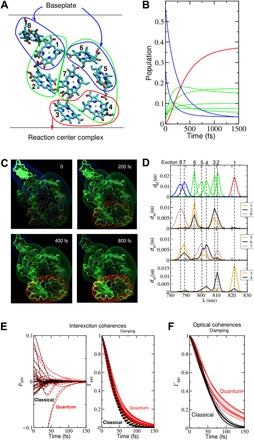
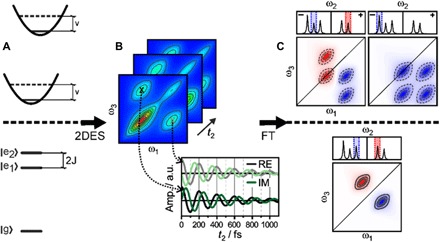
Photosynthesis is a highly optimized process from which valuable lessons can be learned about the operating principles in nature. Its primary steps involve energy transport operating near theoretical quantum limits in efficiency. Recently, extensive research was motivated by the hypothesis that nature used quantum coherences to direct energy transfer. This body of work, a cornerstone for the field of quantum biology, rests on the interpretation of small-amplitude oscillations in two-dimensional electronic spectra of photosynthetic complexes. This Review discusses recent work reexamining these claims and demonstrates that interexciton coherences are too short lived to have any functional significance in photosynthetic energy transfer. Instead, the observed long-lived coherences originate from impulsively excited vibrations, generally observed in femtosecond spectroscopy. These efforts, collectively, lead to a more detailed understanding of the quantum aspects of dissipation. Nature, rather than trying to avoid dissipation, exploits it via engineering of exciton-bath interaction to create efficient energy flow.
光合作用是一个高度优化的过程,从中可以汲取有关自然界运行原理的宝贵经验。其主要步骤涉及到在效率上接近理论量子极限的能量传输。最近,由于假设自然界利用量子相干来指导能量转移,激发了广泛的研究。这项工作是量子生物学领域的基石,其依据是对光合作用复合物二维电子光谱中小振幅振荡的解释。这篇综述讨论了最近重新检验这些主张的工作,并表明激子相干的寿命太短,无法在光合作用能量转移中具有任何功能意义。相反,观察到的长寿命相干性源自于在飞秒光谱学中普遍观察到的冲动激发振动。这些努力共同导致对耗散量子方面的更详细理解。自然不是试图避免耗散,而是通过工程设计激子-浴相互作用来创造有效的能量流来利用它。