• 文献检索
  • 文档翻译
  • 深度研究
  • 学术资讯
  • Suppr Zotero 插件Zotero 插件
  • 邀请有礼
  • 套餐&价格
  • 历史记录
应用&插件
Suppr Zotero 插件Zotero 插件浏览器插件Mac 客户端Windows 客户端微信小程序
定价
高级版会员购买积分包购买API积分包
服务
文献检索文档翻译深度研究API 文档MCP 服务
关于我们
关于 Suppr公司介绍联系我们用户协议隐私条款
关注我们

Suppr 超能文献

核心技术专利:CN118964589B侵权必究
粤ICP备2023148730 号-1Suppr @ 2026

文献检索

告别复杂PubMed语法,用中文像聊天一样搜索,搜遍4000万医学文献。AI智能推荐,让科研检索更轻松。

立即免费搜索

文件翻译

保留排版,准确专业,支持PDF/Word/PPT等文件格式,支持 12+语言互译。

免费翻译文档

深度研究

AI帮你快速写综述,25分钟生成高质量综述,智能提取关键信息,辅助科研写作。

立即免费体验

比较两种单胃草食性和五种杂食性哺乳动物的粪便微生物群。

Comparison of the fecal microbiota of two monogastric herbivorous and five omnivorous mammals.

机构信息

Laboratory of Animal Science, Kyoto Prefectural University, Kyoto, Japan.

Laboratory of Veterinary Physiology, Tokyo University of Agriculture and Technology, Fuchu, Japan.

出版信息

Anim Sci J. 2020 Jan-Dec;91(1):e13366. doi: 10.1111/asj.13366.

DOI:10.1111/asj.13366
PMID:32285557
原文链接:https://pmc.ncbi.nlm.nih.gov/articles/PMC7216987/
Abstract

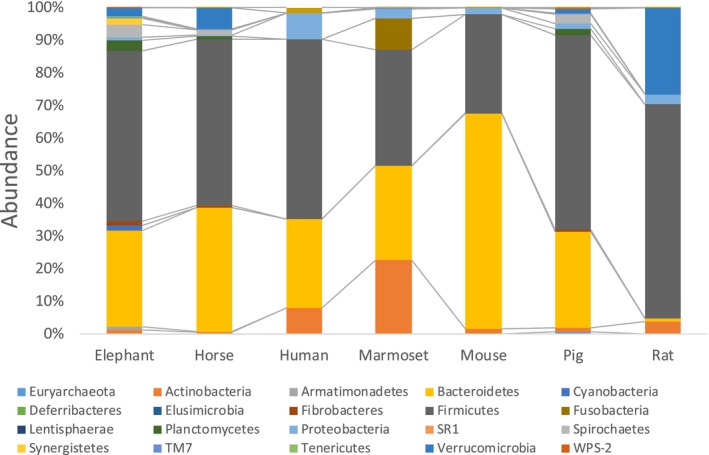
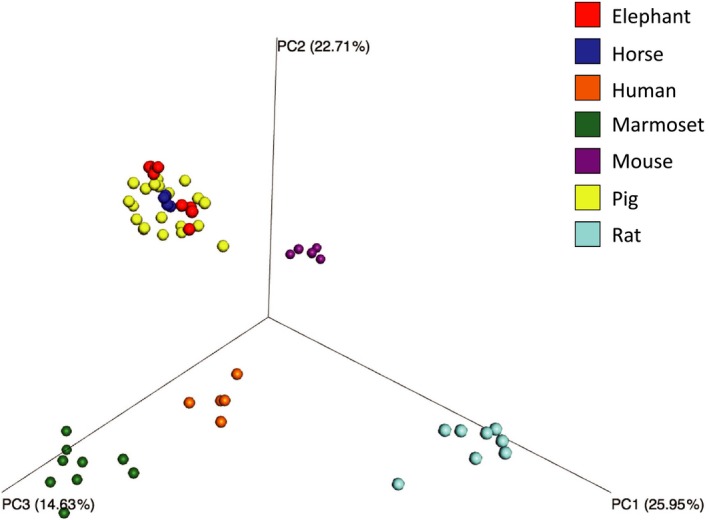
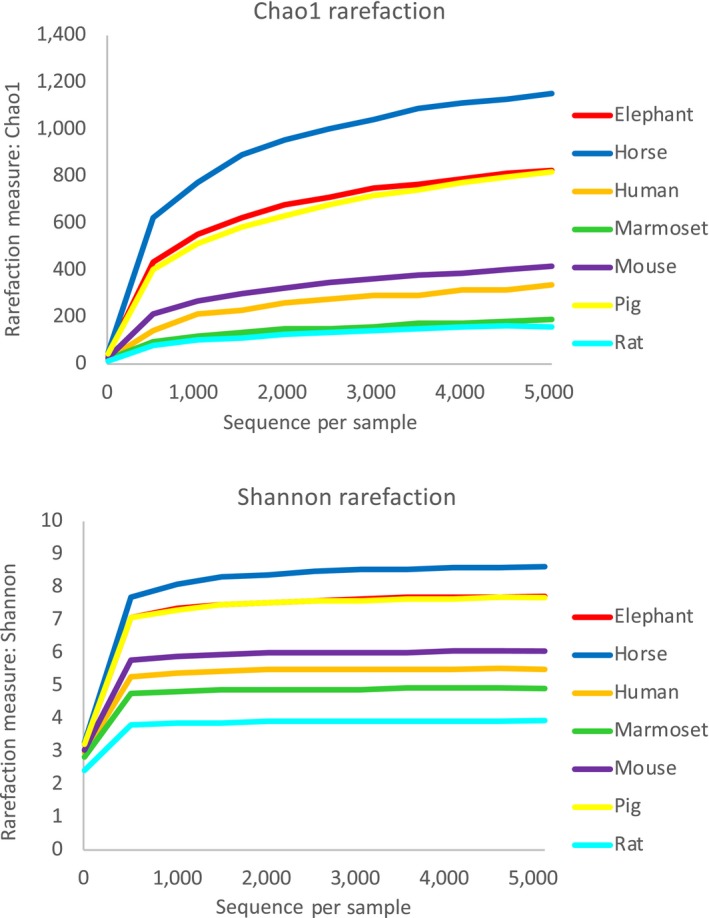
Fecal microbiota in seven different monogastric animal species, elephant, horse, human, marmoset, mouse, pig and, rat were compared using the same analytical protocol of 16S rRNA metagenome. Fecal microbiota in herbivores showed higher alpha diversity than omnivores except for pigs. Additionally, principal coordinate analysis based on weighted UniFrac distance demonstrated that herbivores and pigs clustered together, whereas other animal species were separately aggregated. In view of butyrate- and lactate-producing bacteria, predominant genera were different depending on animal species. For example, the abundance of Faecalibacterium, a known butyrate producer, was 8.02% ± 3.22% in human while it was less than 1% in other animal species. Additionally, Bifidobacterium was a predominant lactate producer in human and marmoset, while it was rarely detected in other omnivores. The abundance of lactate-producing bacteria in herbivores was notably lower than omnivores. On the other hand, herbivores as well as pig possess Fibrobacter, a cellulolytic bacterium. This study demonstrated that fecal microbiota in herbivorous animals is similar, sharing some common features such as higher alpha diversity and higher abundance of cellulolytic bacterium. On the other hand, omnivorous animals seem to possess unique fecal microbiota. It is of interest that pigs, although omnivore, have fecal microbiota showing some common features with herbivores.

摘要

采用相同的 16S rRNA 宏基因组分析方案,比较了 7 种单胃动物(大象、马、人、狨猴、鼠、猪和鼠)的粪便微生物群。食草动物的粪便微生物群的α多样性高于杂食动物,但猪除外。此外,基于加权 UniFrac 距离的主坐标分析表明,食草动物和猪聚在一起,而其他动物物种则分别聚集。就丁酸和乳酸产生菌而言,主要属因动物物种而异。例如,已知的丁酸产生菌 Faecalibacterium 在人体中的丰度为 8.02%±3.22%,而在其他动物物种中的丰度低于 1%。此外,双歧杆菌是人及狨猴中主要的乳酸产生菌,而在其他杂食动物中很少检测到。食草动物中乳酸产生菌的丰度明显低于杂食动物。另一方面,食草动物和猪都具有纤维素分解菌 Fibrobacter。本研究表明,食草动物的粪便微生物群相似,具有一些共同特征,如较高的α多样性和较高的纤维素分解菌丰度。另一方面,杂食动物似乎具有独特的粪便微生物群。有趣的是,尽管猪是杂食动物,但它们的粪便微生物群具有与食草动物相似的一些特征。
https://cdn.ncbi.nlm.nih.gov/pmc/blobs/b56c/7216987/34ff8b3a8b6b/ASJ-91-e13366-g004.jpg
https://cdn.ncbi.nlm.nih.gov/pmc/blobs/b56c/7216987/4c8e6a504b4b/ASJ-91-e13366-g001.jpg
https://cdn.ncbi.nlm.nih.gov/pmc/blobs/b56c/7216987/7e4d7adc9412/ASJ-91-e13366-g002.jpg
https://cdn.ncbi.nlm.nih.gov/pmc/blobs/b56c/7216987/49eb3d8f371b/ASJ-91-e13366-g003.jpg
https://cdn.ncbi.nlm.nih.gov/pmc/blobs/b56c/7216987/34ff8b3a8b6b/ASJ-91-e13366-g004.jpg
https://cdn.ncbi.nlm.nih.gov/pmc/blobs/b56c/7216987/4c8e6a504b4b/ASJ-91-e13366-g001.jpg
https://cdn.ncbi.nlm.nih.gov/pmc/blobs/b56c/7216987/7e4d7adc9412/ASJ-91-e13366-g002.jpg
https://cdn.ncbi.nlm.nih.gov/pmc/blobs/b56c/7216987/49eb3d8f371b/ASJ-91-e13366-g003.jpg
https://cdn.ncbi.nlm.nih.gov/pmc/blobs/b56c/7216987/34ff8b3a8b6b/ASJ-91-e13366-g004.jpg

相似文献

1
Comparison of the fecal microbiota of two monogastric herbivorous and five omnivorous mammals.比较两种单胃草食性和五种杂食性哺乳动物的粪便微生物群。
Anim Sci J. 2020 Jan-Dec;91(1):e13366. doi: 10.1111/asj.13366.
2
Core fecal microbiota of domesticated herbivorous ruminant, hindgut fermenters, and monogastric animals.家养草食反刍动物、后肠发酵者和单胃动物的核心粪便微生物群。
Microbiologyopen. 2017 Oct;6(5). doi: 10.1002/mbo3.509. Epub 2017 Aug 22.
3
The bamboo-eating giant panda harbors a carnivore-like gut microbiota, with excessive seasonal variations.以竹子为食的大熊猫拥有类似食肉动物的肠道微生物群,且存在过度的季节性变化。
mBio. 2015 May 19;6(3):e00022-15. doi: 10.1128/mBio.00022-15.
4
Diet is a major factor governing the fecal butyrate-producing community structure across Mammalia, Aves and Reptilia.饮食是决定哺乳动物、鸟类和爬行动物粪便中产生丁酸盐群落结构的主要因素。
ISME J. 2015 Mar 17;9(4):832-43. doi: 10.1038/ismej.2014.179.
5
Comparative and functional analyses of fecal microbiome in Asian elephants.亚洲象粪便微生物组的比较和功能分析。
Antonie Van Leeuwenhoek. 2022 Sep;115(9):1187-1202. doi: 10.1007/s10482-022-01757-1. Epub 2022 Jul 28.
6
Composition and functional diversity of fecal bacterial community of wild boar, commercial pig and domestic native pig as revealed by 16S rRNA gene sequencing.基于 16S rRNA 基因测序揭示野猪、商品猪和本地家猪粪便细菌群落的组成和功能多样性。
Arch Microbiol. 2020 May;202(4):843-857. doi: 10.1007/s00203-019-01787-w. Epub 2020 Jan 1.
7
The impact of human-facilitated selection on the gut microbiota of domesticated mammals.人为选择对驯养哺乳动物肠道微生物群的影响。
FEMS Microbiol Ecol. 2019 Sep 1;95(9). doi: 10.1093/femsec/fiz121.
8
The Core Gut Microbiome of the American Cockroach, Periplaneta americana, Is Stable and Resilient to Dietary Shifts.美国蟑螂(美洲大蠊)的核心肠道微生物群稳定且对饮食变化具有抗性。
Appl Environ Microbiol. 2016 Oct 27;82(22):6603-6610. doi: 10.1128/AEM.01837-16. Print 2016 Nov 15.
9
Association of dietary type with fecal microbiota in vegetarians and omnivores in Slovenia.斯洛文尼亚素食者和杂食者的饮食类型与粪便微生物群的关联
Eur J Nutr. 2014 Jun;53(4):1051-64. doi: 10.1007/s00394-013-0607-6. Epub 2013 Oct 31.
10
Amish (Rural) vs. non-Amish (Urban) Infant Fecal Microbiotas Are Highly Diverse and Their Transplantation Lead to Differences in Mucosal Immune Maturation in a Humanized Germfree Piglet Model.阿米什(农村)与非阿米什(城市)婴儿粪便微生物群高度多样化,其移植可导致人源化无菌猪模型中黏膜免疫成熟的差异。
Front Immunol. 2019 Jul 16;10:1509. doi: 10.3389/fimmu.2019.01509. eCollection 2019.

引用本文的文献

1
Exploring the distinctive characteristics of gut microbiota across different horse breeds and ages using metataxonomics.运用宏分类学探索不同马种和年龄的肠道微生物群的独特特征。
Front Cell Infect Microbiol. 2025 Jul 7;15:1590839. doi: 10.3389/fcimb.2025.1590839. eCollection 2025.
2
Analysis on gut microbiota diversity of wild Asian elephants (Elephas maximus) from three regions of Yunnan Province.云南省三个地区野生亚洲象(Elephas maximus)肠道微生物群多样性分析
Sci Rep. 2025 Jul 1;15(1):20692. doi: 10.1038/s41598-025-06798-w.
3
Impact of Parenteral Ceftiofur on Developmental Dynamics of Early Life Fecal Microbiota and Antibiotic Resistome in Neonatal Lambs.
静脉注射头孢噻呋对新生羔羊早期粪便微生物群和抗生素耐药组发育动态的影响
Antibiotics (Basel). 2025 Apr 25;14(5):434. doi: 10.3390/antibiotics14050434.
4
Gut microbiota diversity among humans, elephants, livestock and wild herbivores in Chitwan National Park bears implications for conservation medicine.奇特旺国家公园内人类、大象、家畜和野生食草动物的肠道微生物群多样性对保护医学具有重要意义。
Sci Rep. 2025 Apr 4;15(1):11596. doi: 10.1038/s41598-025-89402-5.
5
Gut Microecology of Four Sympatric Desert Rodents Varies by Diet.四种同域沙漠啮齿动物的肠道微生物群落因饮食而异。
Ecol Evol. 2025 Feb 27;15(3):e70992. doi: 10.1002/ece3.70992. eCollection 2025 Mar.
6
Unravelling Faecal Microbiota Variations in Equine Atypical Myopathy: Correlation with Blood Markers and Contribution of Microbiome.解析马属动物非典型肌病中粪便微生物群的变化:与血液标志物的相关性及微生物组的作用
Animals (Basel). 2025 Jan 26;15(3):354. doi: 10.3390/ani15030354.
7
Relationship between the components of mare breast milk and foal gut microbiome: shaping gut microbiome development after birth.马母乳成分与幼驹肠道微生物群的关系:塑造幼驹出生后的肠道微生物群发育。
Vet Q. 2024 Dec;44(1):1-9. doi: 10.1080/01652176.2024.2349948. Epub 2024 May 10.
8
Characteristics of gut microbiota in captive Asian elephants (Elephas maximus) from infant to elderly.圈养亚洲象(Elephas maximus)幼象至老年个体的肠道微生物群特征。
Sci Rep. 2023 Dec 27;13(1):23027. doi: 10.1038/s41598-023-50429-1.
9
Review: Effect of Experimental Diets on the Microbiome of Productive Animals.综述:实验性日粮对生产动物微生物组的影响
Microorganisms. 2023 Aug 31;11(9):2219. doi: 10.3390/microorganisms11092219.
10
Partially hydrolyzed guar gum suppresses the progression of pulmonary arterial hypertension in a SU5416/hypoxia rat model.部分水解瓜尔胶可抑制SU5416/低氧大鼠模型中肺动脉高压的进展。
Pulm Circ. 2023 Jul 12;13(3):e12266. doi: 10.1002/pul2.12266. eCollection 2023 Jul.