Harvard Radiation Oncology Program, Harvard Medical School, Boston, MA, USA.
Department of Radiation Oncology, Massachusetts General Hospital, Boston, MA, USA.
Sci Rep. 2020 Apr 14;10(1):6331. doi: 10.1038/s41598-020-63158-6.
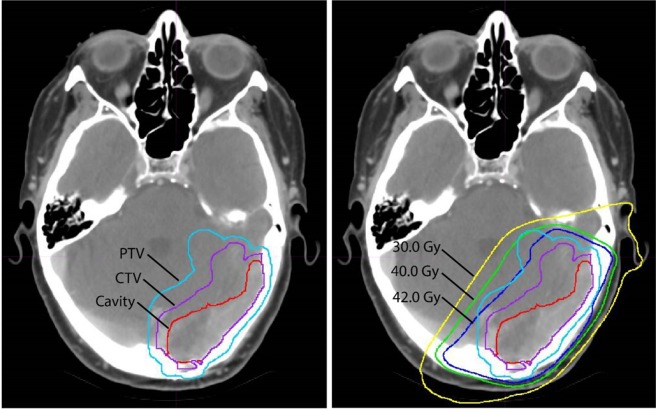
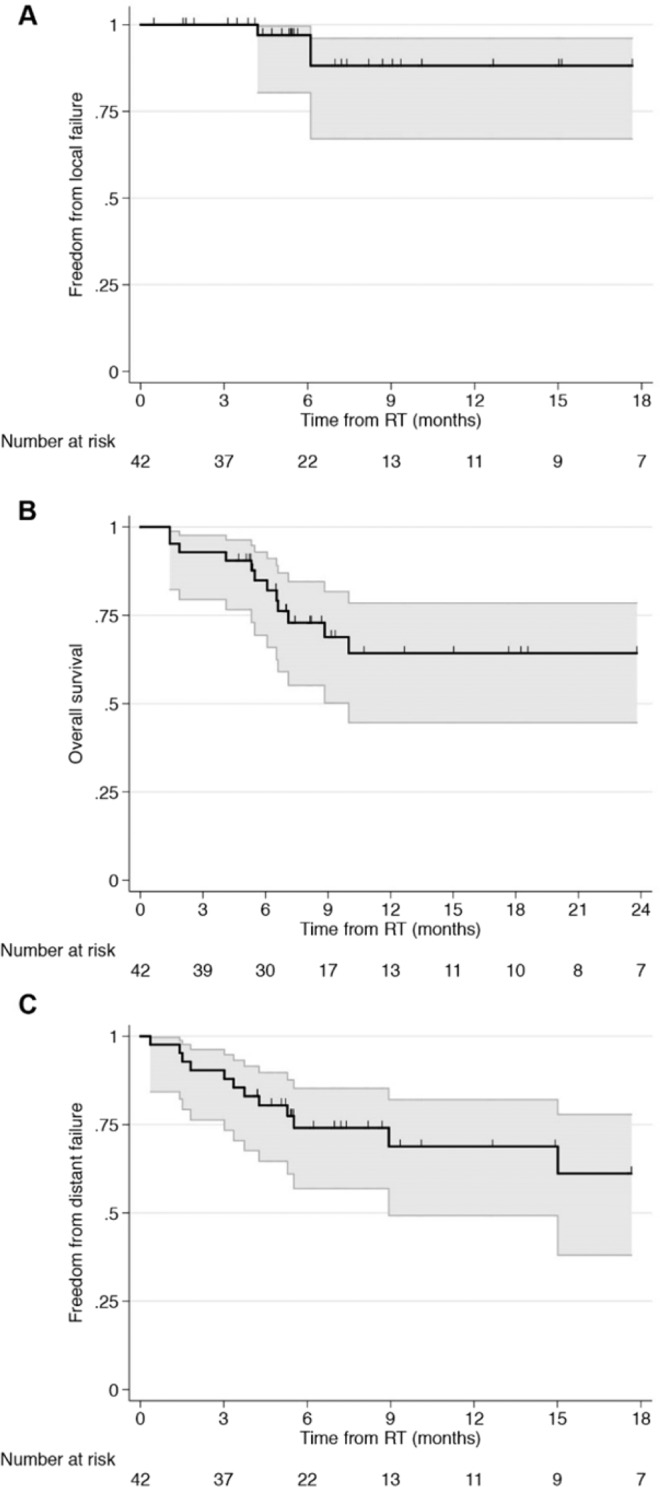
The paradigm for post-operative cavity radiation therapy has shifted to more targeted, less morbid approaches. Single-fraction or hypofractionated radiation therapy is a common approach to treating the postoperative cavity but is associated with a local failure rate 20-40%. We employed an alternative treatment strategy involving fractionated partial brain radiation therapy to the surgical cavity. Patients with brain metastases who underwent radiation treatment 30-42 Gy in 3 Gy/fraction regimens to surgical cavity were retrospectively identified. The 6-month and 12-month freedom from local failure rates were 97.0% and 88.2%. Three patients (7%) experienced local failure at 4, 6, and 22 months. Of these, the histologies were colorectal adenocarcinoma (N = 1) and breast adenocarcinoma (N = 2). The 6-month and 12-month freedom from distant brain metastases rates were 74.1% and 68.8%, respectively, and the 6-month and 12-month overall survival rates were 84.9% and 64.3% respectively. The median overall survival was 39 months, and there were no events of late radionecrosis. Fractionated partial brain irradiation to the surgical cavity of resected brain metastases results in low rates of local failure. This strategy represents an alternative to SRS and WBRT.
术后腔放疗模式已转向更具针对性、更少病态的方法。单次或低分割放疗是治疗术后腔的常见方法,但局部失败率为 20-40%。我们采用了一种替代治疗策略,即对手术腔进行分次部分脑放疗。回顾性分析了接受 30-42Gy 分 3Gy/fraction 方案治疗手术腔的脑转移瘤患者。6 个月和 12 个月无局部失败率分别为 97.0%和 88.2%。3 名患者(7%)在 4、6 和 22 个月时发生局部失败。其中,组织学为结直肠腺癌(N=1)和乳腺腺癌(N=2)。6 个月和 12 个月无远处脑转移率分别为 74.1%和 68.8%,6 个月和 12 个月总生存率分别为 84.9%和 64.3%。中位总生存期为 39 个月,无迟发性放射性坏死事件。对切除的脑转移瘤的手术腔进行分次部分脑放疗可导致较低的局部失败率。这种策略是 SRS 和 WBRT 的替代方法。