Department of Bioengineering, University of California, Berkeley, USA.
Department of Radiology and Biomedical Imaging, University of California, San Francisco, USA.
Sci Rep. 2020 Apr 14;10(1):6371. doi: 10.1038/s41598-020-63395-9.
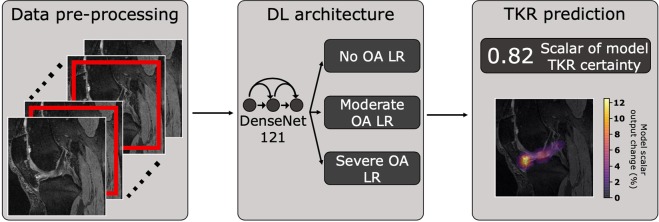
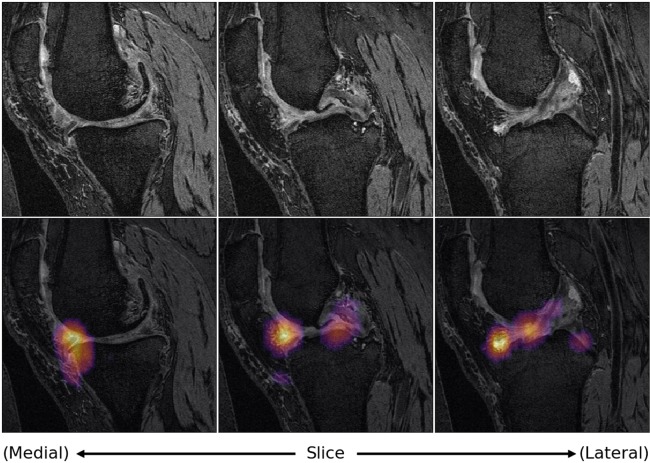
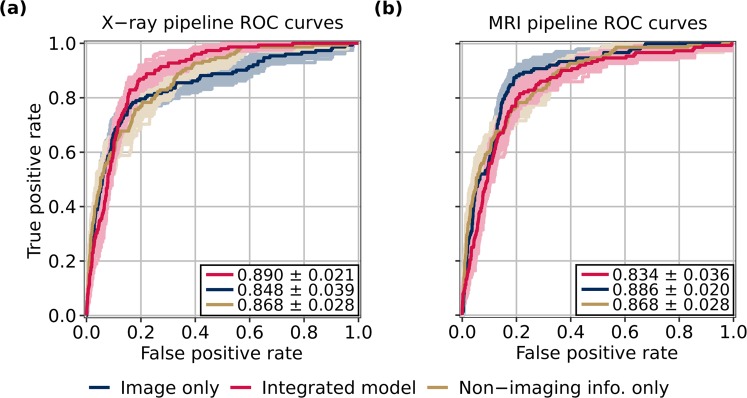
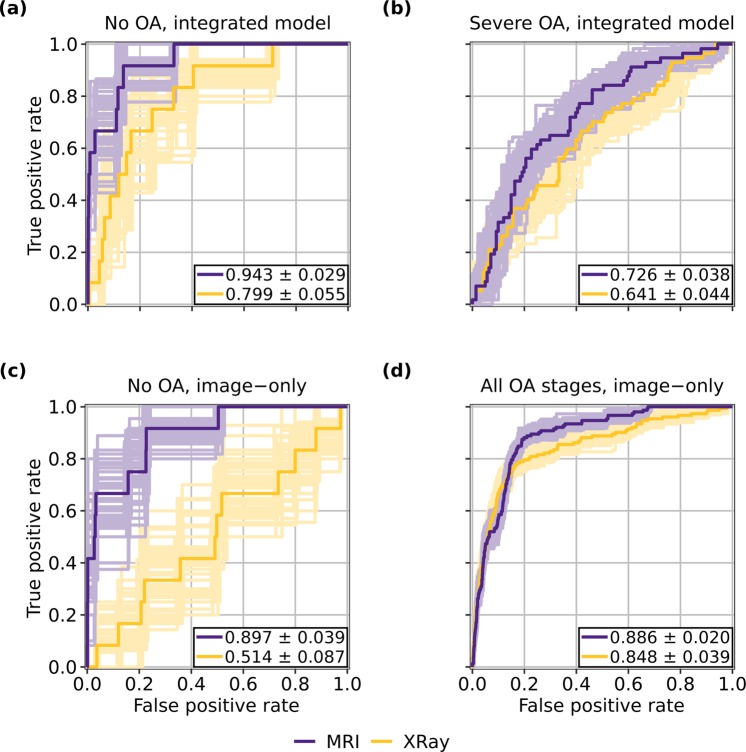
Knee Osteoarthritis (OA) is a common musculoskeletal disorder in the United States. When diagnosed at early stages, lifestyle interventions such as exercise and weight loss can slow OA progression, but at later stages, only an invasive option is available: total knee replacement (TKR). Though a generally successful procedure, only 2/3 of patients who undergo the procedure report their knees feeling "normal" post-operation, and complications can arise that require revision. This necessitates a model to identify a population at higher risk of TKR, particularly at less advanced stages of OA, such that appropriate treatments can be implemented that slow OA progression and delay TKR. Here, we present a deep learning pipeline that leverages MRI images and clinical and demographic information to predict TKR with AUC 0.834 ± 0.036 (p < 0.05). Most notably, the pipeline predicts TKR with AUC 0.943 ± 0.057 (p < 0.05) for patients without OA. Furthermore, we develop occlusion maps for case-control pairs in test data and compare regions used by the model in both, thereby identifying TKR imaging biomarkers. As such, this work takes strides towards a pipeline with clinical utility, and the biomarkers identified further our understanding of OA progression and eventual TKR onset.
膝关节骨关节炎(OA)是美国常见的肌肉骨骼疾病。在早期诊断时,运动和减肥等生活方式干预可以减缓 OA 的进展,但在晚期,仅有一种侵入性选择:全膝关节置换术(TKR)。虽然这是一种普遍成功的手术,但只有 2/3 接受该手术的患者报告术后膝盖“正常”,并且可能会出现需要进行翻修的并发症。这就需要建立一种模型来识别 TKR 风险较高的人群,特别是在 OA 较不严重的阶段,以便实施适当的治疗方法来减缓 OA 的进展并延迟 TKR。在这里,我们提出了一个深度学习管道,该管道利用 MRI 图像以及临床和人口统计学信息来预测 TKR,AUC 为 0.834 ± 0.036(p < 0.05)。值得注意的是,该管道对没有 OA 的患者的 TKR 预测 AUC 为 0.943 ± 0.057(p < 0.05)。此外,我们在测试数据中为病例对照对开发了闭塞图,并比较了模型在两者中使用的区域,从而确定了 TKR 成像生物标志物。因此,这项工作朝着具有临床应用价值的管道迈出了一步,所确定的生物标志物进一步加深了我们对 OA 进展和最终 TKR 发病的理解。