Lu Chang-Qin, Siu Oi-Ling, Chen Wei-Qing, Wang Hai-Jiang
Peking University, Beijing, China.
Lingnan University, Hong Kong, China.
J Vocat Behav. 2011 Feb;78(1):100-109. doi: 10.1016/j.jvb.2010.07.005. Epub 2010 Jul 27.
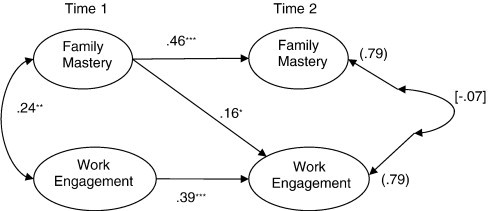
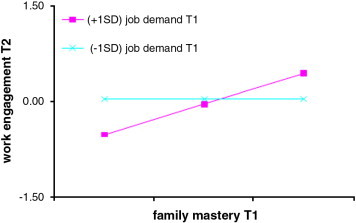
Based on Greenhaus and Powell's (2006) theory of work-family enrichment and the job demands-resources (JD-R) model of work engagement (Bakker & Demerouti, 2008), this study focused on the family-to-work enrichment process by investigating the effect of family mastery on work engagement in a Chinese context. A sample of 279 Chinese female nurses completed questionnaires in a two-wave longitudinal survey. With a cross-lagged analysis, the results indicated that family mastery at Time 1 had a significant positive effect on work engagement at Time 2. Furthermore, the relationship between family mastery and work engagement was stronger in a context of high (vs. low) job demand. These findings suggested that resource generated in family could directly help people stay engaged in the workplace, particularly under stressful working conditions. Our findings have expanded the JD-R model of work engagement and bridged it with theory of work-family enrichment. Implications for theory and practices are discussed.
基于格林豪斯和鲍威尔(2006)的工作-家庭充实理论以及工作投入的工作要求-资源(JD-R)模型(巴克尔和德梅罗蒂,2008),本研究通过调查在中国背景下家庭掌控对工作投入的影响,聚焦于从家庭到工作的充实过程。279名中国女护士样本在两波纵向调查中完成了问卷。通过交叉滞后分析,结果表明,时间1的家庭掌控对时间2的工作投入有显著的正向影响。此外,在高(与低相比)工作需求的背景下,家庭掌控与工作投入之间的关系更强。这些发现表明,家庭中产生的资源可以直接帮助人们在工作场所保持投入,特别是在压力较大的工作条件下。我们的研究结果扩展了工作投入的JD-R模型,并将其与工作-家庭充实理论联系起来。还讨论了对理论和实践的启示。