Uk Lee Byung, Yermakov Mikhail, Grinshpun Sergey A
Department of Environmental Health, Center for Health-Related Aerosol Studies, University of Cincinnati, P.O. Box 670056, 3223 Eden Avenue, Cincinnati, OH 45267-0056, USA.
J Aerosol Sci. 2004 Nov;35(11):1359-1368. doi: 10.1016/j.jaerosci.2004.05.006. Epub 2004 Jul 7.
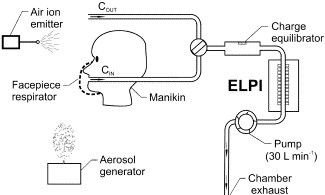
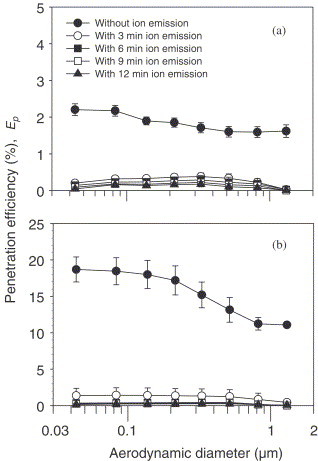
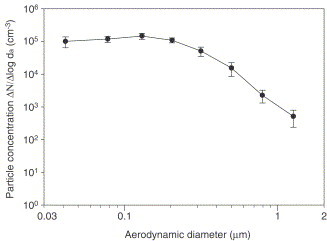
We developed a novel concept that allows to considerably improve the performance of conventionally used filtering-facepiece respirators against fine and ultrafine aerosols including airborne viral and bacterial agents. The concept is based on the continuous emission of unipolar ions. The effect was evaluated through the real-time monitoring of the concentration and size distribution of fine and ultrafine aerosol particles. The measurements were conducted inside and outside of a respiratory mask that was face sealed on a breathing manikin. A commonly used Type N95 respirator and surgical mask were utilized for the tests. The manikin was placed in a 24.3-m indoor test chamber and exposed to polydisperse surrogate aerosols simulating viral and bacterial particles with respect to the aerodynamic size. The particle penetration through the mask was found to decrease by one-to-two orders of magnitude as a result of continuous unipolar ion emission in the chamber. The flux of air ions migrated to the breathing zone and imparted electrical charges of the same polarity to the aerosol particles and the respirator filter surface. This created an electrostatic shield along the external surface of the filter, thus enhancing the protection characteristics provided by the respirator. The above performance enhancement effect is crucial for minimizing the infectious risk in the cases when the conventional filtering-facepiece respirators are not able to provide an adequate protection against airborne viruses and bacteria.
我们提出了一种新颖的概念,能够显著提高传统过滤式面罩呼吸器对包括空气传播的病毒和细菌病原体在内的细颗粒物和超细颗粒物的防护性能。该概念基于单极离子的持续发射。通过对细颗粒物和超细气溶胶颗粒的浓度及粒径分布进行实时监测来评估其效果。测量在呼吸模拟人面部密封佩戴的呼吸面罩内外进行。测试使用了常用的N95型呼吸器和外科口罩。将呼吸模拟人放置在一个24.3米的室内测试舱中,并暴露于模拟病毒和细菌颗粒空气动力学粒径的多分散替代气溶胶中。由于测试舱中持续发射单极离子,发现通过面罩的颗粒穿透率降低了一到两个数量级。空气离子通量迁移到呼吸区域,并给气溶胶颗粒和呼吸器过滤器表面赋予相同极性的电荷。这在过滤器外表面形成了一个静电屏蔽,从而增强了呼吸器提供的防护特性。上述性能增强效果对于在传统过滤式面罩呼吸器无法对空气传播的病毒和细菌提供充分防护的情况下将感染风险降至最低至关重要。