Madonna Angelo J, Voorhees Kent J, Hadfield Ted L
Department of Chemistry, Colorado School of Mines, Golden, CO 80401, USA.
Armed Forces of Institute of Pathology, Washington DC 20306-6000, USA.
J Anal Appl Pyrolysis. 2001 Nov;61(1):65-89. doi: 10.1016/S0165-2370(01)00136-X. Epub 2001 Oct 8.
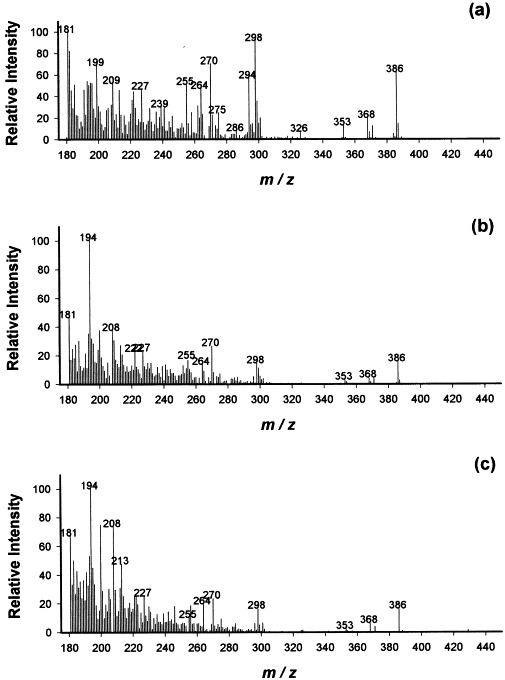
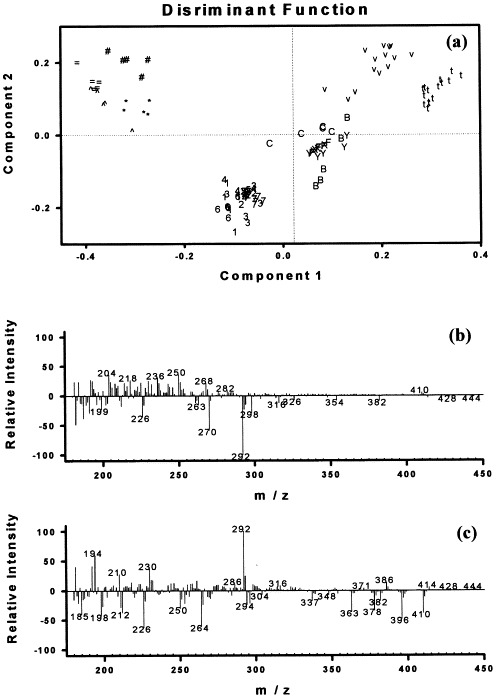
Implications for the rapid interrogation of biological materials collected from the atmosphere using a simple, one step, sample preparation technique was explored. For this purpose, various samples of whole bacteria, fungi, pollen, media contaminated with viruses, and proteins were treated with an aliquot of methanolic tetramethylammonium hydroxide prior to thermal introduction into the ion source of a triple quadrupole mass spectrometer. Molecular and fragment ions, consistent with fatty acid methyl esters (FAMEs) and steroids (non-methylated and methylated), generated during electron ionization (70 eV) of the volatile hydrolysates were subsequently detected. The varying distributions and relative intensities of these ions were used to discriminate between the different biological samples. More specifically, it was found that polyunsaturated FAMEs and steroids could be used to differentiate eukaryotic cells from prokaryotic cells since the latter do not generally synthesize either of these lipid membrane constituents. Further discrimination of the different eukaryotic samples was made based on the detection of ergosterol for fungi, cholesterol for the viral media, and C18:3Me for pollen. Multivariate statistical analysis was employed to evaluate and compare the large set of mass spectra generated during the study and to build a trained model for predicting the class membership of test samples entered as unknowns. Of 132 different samples subjected to the model as unknowns, 131 were correctly classified into their proper biological categories. Moreover, 29 out of 30 bacteria test samples representing five species of pathogenic bacteria were correctly classified at the species level.
探讨了使用一种简单的一步样品制备技术对从大气中收集的生物材料进行快速分析的意义。为此,在将各种全细菌、真菌、花粉、受病毒污染的培养基和蛋白质样品热引入三重四极杆质谱仪的离子源之前,先用一份甲醇氢氧化四甲铵处理。随后检测到在挥发性水解产物的电子电离(70 eV)过程中产生的与脂肪酸甲酯(FAMEs)和类固醇(未甲基化和甲基化)一致的分子离子和碎片离子。这些离子的不同分布和相对强度被用于区分不同的生物样品。更具体地说,发现多不饱和FAMEs和类固醇可用于区分真核细胞和原核细胞,因为后者通常不合成这两种脂质膜成分中的任何一种。基于对真菌的麦角固醇、病毒培养基的胆固醇和花粉的C18:3Me的检测,对不同的真核样品进行了进一步区分。采用多变量统计分析来评估和比较研究过程中产生的大量质谱,并建立一个训练模型来预测作为未知物输入的测试样品的类别归属。在作为未知物输入该模型的132个不同样品中,有131个被正确分类到其适当的生物类别中。此外,代表五种致病细菌的30个细菌测试样品中有29个在物种水平上被正确分类。