Small Michael, Tse C K
Department of Electronic and Information Engineering, The Hong Kong Polytechnic University, Hung Hom, Kowloon, Hong Kong, Hong Kong.
Physica A. 2005 Jun 15;351(2):499-511. doi: 10.1016/j.physa.2005.01.009. Epub 2005 Jan 26.
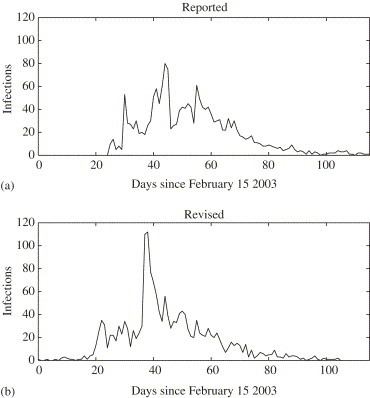
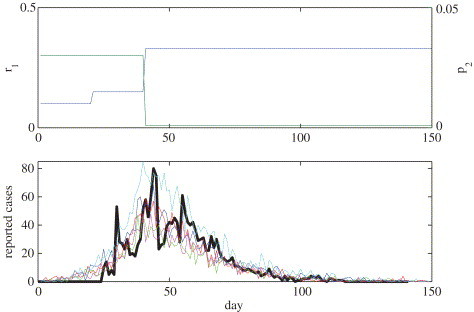
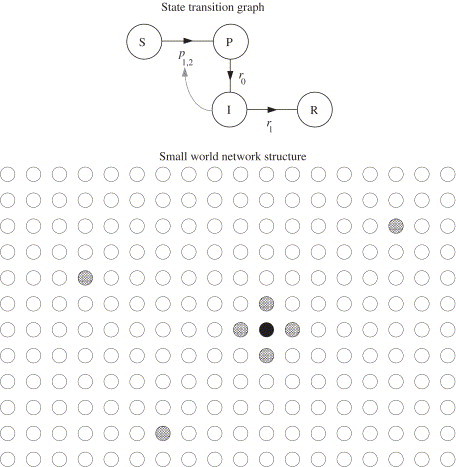
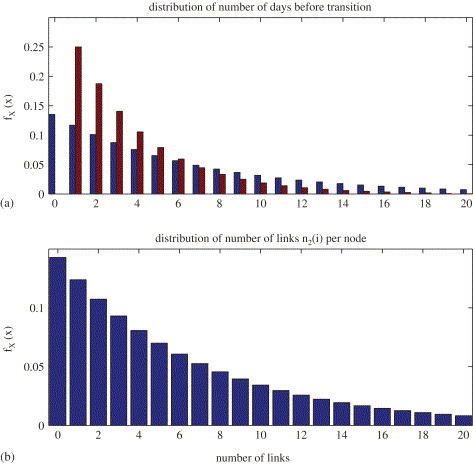
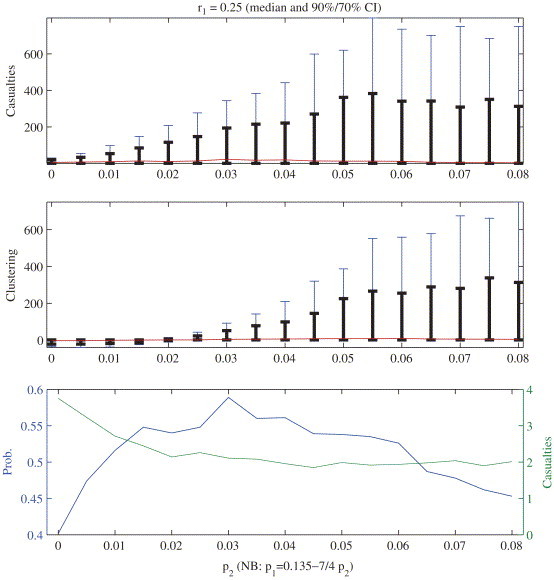
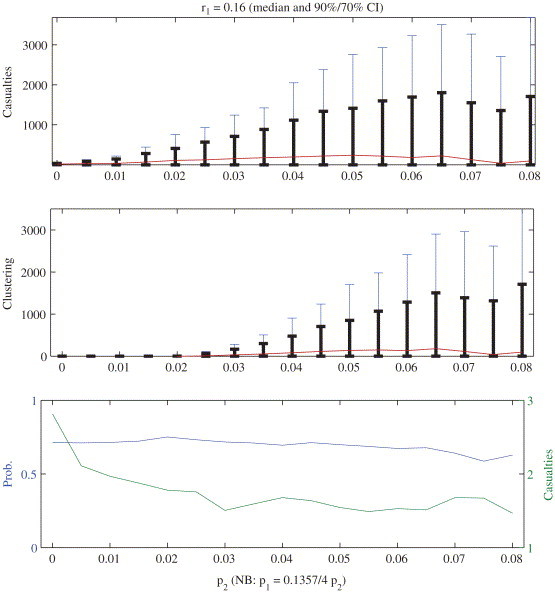
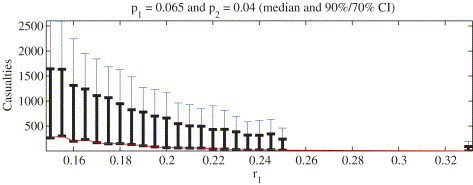
We propose a new four state model for disease transmission and illustrate the model with data from the 2003 SARS epidemic in Hong Kong. The critical feature of this model is that the community is modelled as a small-world network of interconnected nodes. Each node is linked to a fixed number of immediate neighbors and a random number of geographically remote nodes. Transmission can only propagate between linked nodes. This model exhibits two features typical of SARS transmission: geographically localized outbreaks and "super-spreaders". Neither of these features are evident in standard susceptible-infected-removed models of disease transmission. Our analysis indicates that "super-spreaders" may occur even if the infectiousness of all infected individuals is constant. Moreover, we find that nosocomial transmission in Hong Kong directly contributed to the severity of the outbreak and that by limiting individual exposure time to 3-5 days the extent of the SARS epidemic would have been minimal.
我们提出了一种新的疾病传播四态模型,并用2003年香港SARS疫情的数据对该模型进行了说明。此模型的关键特征是将社区建模为一个由相互连接的节点组成的小世界网络。每个节点与固定数量的直接邻居以及随机数量的地理上遥远的节点相连。传播只能在相连的节点之间进行。该模型展现出SARS传播的两个典型特征:地理上局部爆发和“超级传播者”。在标准的疾病传播易感-感染-移除模型中,这些特征均不明显。我们的分析表明,即使所有受感染个体的传染性恒定,“超级传播者”也可能出现。此外,我们发现香港的医院内传播直接导致了疫情的严重性,并且通过将个体暴露时间限制在3至5天,SARS疫情的规模本可以最小化。