Department of Biochemical Sciences, Faculty of Health and Medical Sciences, University of Surrey, Guildford GU2 7XH, UK.
Department of Nutritional Sciences, Faculty of Health and Medical Sciences, University of Surrey, Guildford GU2 7XH, UK.
Nutrients. 2020 Apr 10;12(4):1053. doi: 10.3390/nu12041053.
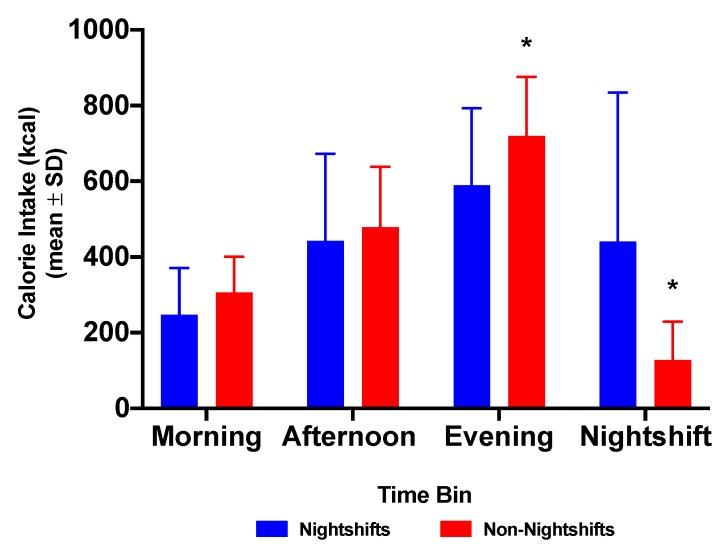
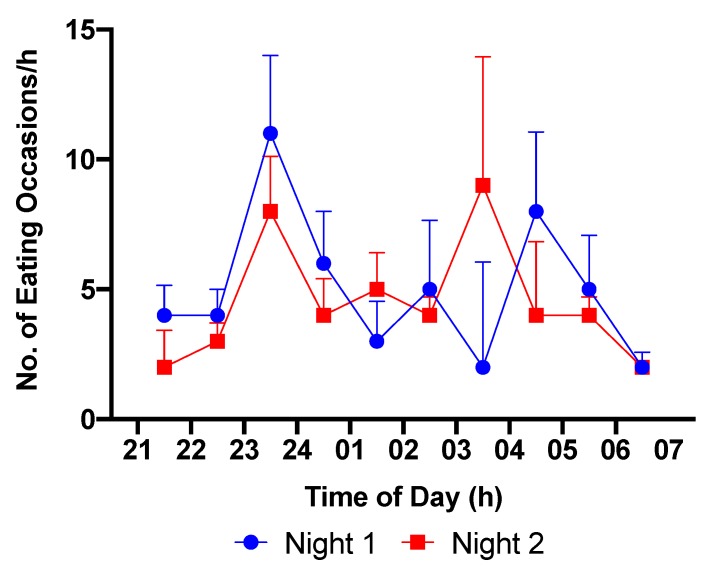
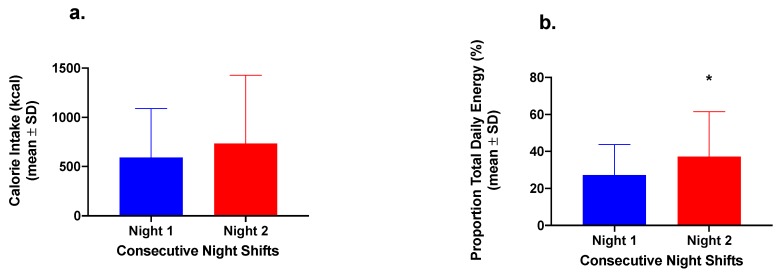
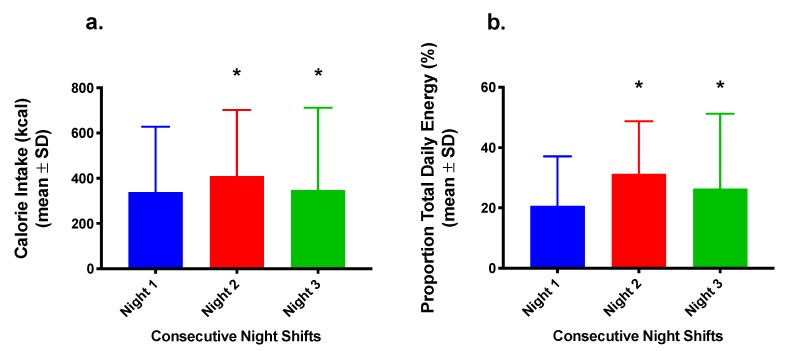
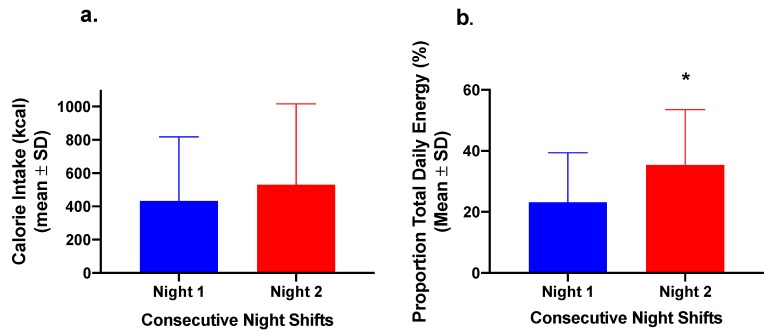
Nightshift work is associated with adverse health outcomes, which may be related to eating during the biological night, when circadian rhythms and food intake are misaligned. Nurses often undertake nightshift work, and we aimed to investigate patterns of energy distribution and dietary intake across 14 days in 20 UK National Health Service (NHS) nurses working rotational shifts. We hypothesised that the proportion of daily energy consumed during the nightshift would increase over consecutive nights. Primary and secondary outcome measures included intakes of energy and macronutrients. Our results show that nurses consumed the same total daily energy on nightshifts and non-nightshifts, but redistributed energy to the nightshift period in increasing proportions with a significant difference between Night 1 and 2 in the proportion of total daily energy consumed (26.0 ± 15.7% vs. 33.5 ± 20.2%, mean ± SD; 0.01). This finding indicates that, rather than increasing total energy intake, nurses redistribute energy consumed during nightshifts as a behavioural response to consecutive nightshifts. This finding informs our understanding of how the intake of energy during the biological night can influence adverse health outcomes of nightshift work.
夜班工作与健康不良后果有关,这可能与在生物夜间进食有关,此时昼夜节律和食物摄入不匹配。护士经常上夜班,我们旨在调查 20 名英国国家医疗服务体系(NHS)轮班护士在 14 天内的能量分布和饮食摄入模式。我们假设,在连续的夜班期间,夜间消耗的每日能量比例会增加。主要和次要结果测量包括能量和宏量营养素的摄入量。我们的研究结果表明,护士在夜班和非夜班期间消耗的总能量相同,但能量重新分配到夜班期间的比例逐渐增加,夜间 1 天和 2 天之间消耗的总日能量比例有显著差异(26.0 ± 15.7%比 33.5 ± 20.2%,均值 ± 标准差;0.01)。这一发现表明,护士并没有增加夜间总能量摄入,而是将夜间消耗的能量重新分配,作为对连续夜班的行为反应。这一发现使我们了解了在生物夜间摄入能量如何影响夜班工作的健康不良后果。