Department of Emergency and Disaster Medicine, Mie University Graduate School of Medicine, 2-174 Edobashi, Tsu, Mie, 514-8507, Japan.
Department of Anesthesiology and Critical Care Medicine, Mie University Graduate School of Medicine, 2-174 Edobashi, Tsu, Mie, 514-8507, Japan.
J Med Case Rep. 2020 Apr 14;14(1):46. doi: 10.1186/s13256-020-02370-4.
Fasciotomy is a life-saving procedure to treat acute compartment syndrome, a surgical emergency. As fasciotomy dramatically improves wound pain, it should be performed as soon as possible. Moreover, delays in the use of fasciotomy can increase the rate of wound infections. Once the fasciotomy wound is infected, pain control is achieved via the long-term use of opioids or anti-inflammatory analgesics. However, the administration of high doses of opioids may cause complications, such as respiratory depression, over-sedation, and constipation. Therefore, treatment methods other than narcotic administration should be established to better manage the pain caused by fasciotomy wound infections. Virtual reality has recently been introduced in analgesic therapy as a replacement, or complement, to conventional pharmacological treatments. Its use has been extensively studied in the pain management of patients with burns. An increasing number of painful conditions are being successfully treated with virtual reality. Here, we report a case of acute compartment syndrome complicated by fasciotomy wound infection.
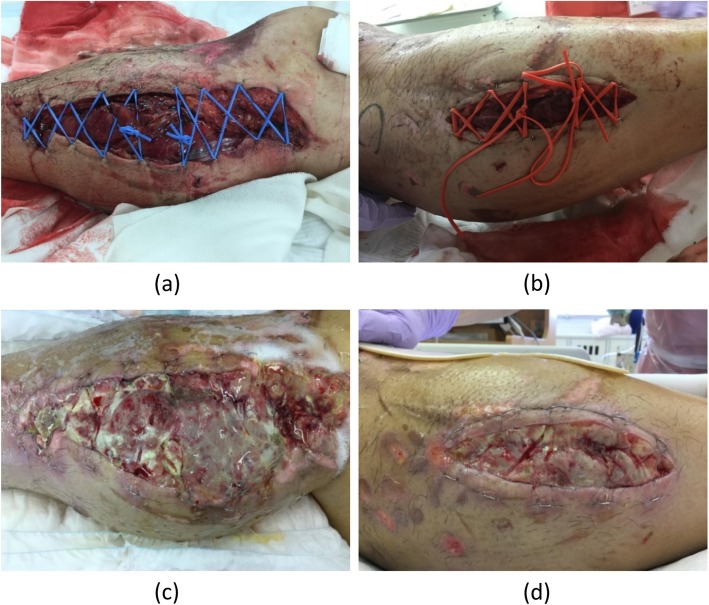
A 40-year-old Japanese man suffering from acute compartment syndrome of his leg due to a car accident trauma was treated with a fasciotomy to decompress intra-compartmental pressure and restore tissue perfusion, and admitted to an intensive care unit. Unfortunately, as the open fasciotomy wound was complicated by infection, he complained of hyperalgesia and severe pain during wound debridement. He was therefore given acetaminophen and high-dose intravenous patient-controlled analgesic fentanyl (35 μg/kg per day) to reduce the pain. Despite these efforts, the pain was poorly controlled and opioid-induced side effects such as respiratory depression were observed. An immersive virtual reality analgesic therapy aimed at distraction and relaxation was used and effectively alleviated the pain. Three sessions of virtual reality analgesic therapy over 2 days produced sustainable analgesic effects, which led to a 25-75% dose reduction in fentanyl administration and the concomitant alleviation of respiratory depression.
This case suggests the feasibility of virtual reality analgesic therapy for pain management of fasciotomy wound complications in acute compartment syndromes. Virtual reality represents a treatment option that would reduce analgesic consumption and eliminate opioid-induced respiratory depression to treat fasciotomy wound infection.
筋膜切开术是治疗急性筋膜间室综合征的救命手术,这是一种外科急症。由于筋膜切开术可显著缓解伤口疼痛,因此应尽快进行。此外,筋膜切开术的延迟会增加伤口感染的发生率。一旦筋膜切开术伤口感染,疼痛控制是通过长期使用阿片类药物或抗炎镇痛药来实现的。然而,高剂量阿片类药物的使用可能会导致并发症,如呼吸抑制、过度镇静和便秘。因此,应该建立除了使用麻醉剂以外的治疗方法,以更好地管理筋膜切开术伤口感染引起的疼痛。虚拟现实技术最近已被引入镇痛治疗中,作为传统药物治疗的替代或补充。它已在烧伤患者的疼痛管理中得到广泛研究。越来越多的疼痛疾病正在通过虚拟现实技术得到成功治疗。在这里,我们报告了一例因车祸外伤导致腿部急性筋膜间室综合征并接受筋膜切开术减压以恢复组织灌注的患者,并发筋膜切开术伤口感染。不幸的是,由于开放性筋膜切开术伤口感染,他在清创时主诉出现痛觉过敏和剧烈疼痛,因此给予对乙酰氨基酚和高剂量静脉自控镇痛芬太尼(35μg/kg/天)以减轻疼痛。尽管采取了这些措施,但疼痛仍未得到有效控制,并出现了阿片类药物引起的呼吸抑制等副作用。使用了一种旨在分散注意力和放松的沉浸式虚拟现实镇痛治疗,有效地缓解了疼痛。2 天内进行了 3 次虚拟现实镇痛治疗,产生了可持续的镇痛效果,导致芬太尼用量减少了 25-75%,同时缓解了呼吸抑制。
本病例提示虚拟现实镇痛治疗在急性筋膜间室综合征筋膜切开术并发症的疼痛管理中具有可行性。虚拟现实技术代表了一种治疗选择,可以减少阿片类药物的消耗,并消除阿片类药物引起的呼吸抑制,从而治疗筋膜切开术伤口感染。