Centre for Global eHealth Innovation, Techna Institute, University Health Network, Toronto General Hospital, Toronto, ON, M5G 2C4 Canada
Institute of Health Policy, Management and Evaluation, Dalla Lana School of Public Health, University of Toronto, ON, Canada.
BMJ. 2020 Apr 14;369:m982. doi: 10.1136/bmj.m982.
To evaluate the compliance with prospective registration and inclusion of the trial registration number (TRN) in published randomised controlled trials (RCTs), and to analyse the rationale behind, and detect selective registration bias in, retrospective trial registration.
Cross sectional analysis.
PubMed, the 17 World Health Organization's trial registries, University of Toronto library, International Committee of Medical Journal Editors (ICMJE) list of member journals, and the InCites Journal Citation Reports.
RCTs registered in any WHO trial registry and published in any PubMed indexed journal in 2018.
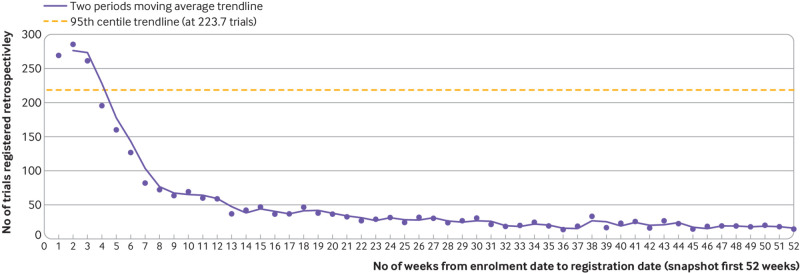
This study included 10 500 manuscripts published in 2105 journals. Overall, 71.2% (7473/10500) reported the TRN and 41.7% (3013/7218) complied with prospective trial registration. The univariable and multivariable analyses reported significant relations (P<0.05) between reporting the TRN and the impact factor and ICMJE membership of the publishing journal. A significant relation (P<0.05) was also observed between prospective trial registration and the registry, region, condition, funding, trial size, interval between paper registration and submission dates, impact factor, and ICMJE membership of the publishing journal. A manuscript published in an ICMJE member journal was 5.8 times more likely to include the TRN (odds ratio 5.8, 95% confidence interval 4.0 to 8.2), and a published trial was 1.8 times more likely to be registered prospectively (1.8, 1.5 to 2.2) when published in an ICMJE member journal compared with other journals. This study detected a new form of bias, selective registration bias, with a higher proportion (85.2% (616/723)) of trials registered retrospectively within a year of submission for publication. Higher rates of retrospective registrations were observed within the first three to eight weeks after enrolment of study participants. Within the 286 RCTs registered retrospectively and published in an ICMJE member journal, only 2.8% (8/286) of the authors included a statement justifying the delayed registration. Reasons included lack of awareness, error of omission, and the registration process taking longer than anticipated.
This study found a high compliance in reporting of the TRN for trial papers published in ICMJE member journals, but prospective trial registration was low.
评估前瞻性注册和已发表随机对照试验(RCT)中试验注册编号(TRN)纳入情况,分析回顾性试验注册背后的原理,并发现选择性注册偏倚。
横断面分析。
PubMed、17 个世界卫生组织试验注册处、多伦多大学图书馆、国际医学期刊编辑委员会(ICMJE)成员期刊列表和 InCites 期刊引文报告。
在任何 WHO 试验注册处注册并在 2018 年任何 PubMed 索引期刊上发表的 RCT。
本研究纳入了 2105 种期刊发表的 10500 篇手稿。总体而言,71.2%(7473/10500)报告了 TRN,41.7%(3013/7218)符合前瞻性试验注册。单变量和多变量分析报告了报告 TRN 与出版期刊的影响因子和 ICMJE 成员之间存在显著关系(P<0.05)。还观察到前瞻性试验注册与注册处、地区、条件、资金、试验规模、论文注册与提交日期之间的间隔、影响因子以及出版期刊的 ICMJE 成员之间存在显著关系(P<0.05)。发表在 ICMJE 成员期刊上的手稿包含 TRN 的可能性是发表在其他期刊上的手稿的 5.8 倍(优势比 5.8,95%置信区间 4.0 至 8.2),并且发表在 ICMJE 成员期刊上的试验进行前瞻性注册的可能性是发表在其他期刊上的试验的 1.8 倍(1.8,1.5 至 2.2)。本研究发现了一种新的选择性注册偏倚形式,即在提交发表后一年内,有更高比例(85.2%(616/723))的试验进行回顾性注册。在研究参与者入组后的前三至八周内,观察到更高的回顾性注册率。在 286 项回顾性注册并发表在 ICMJE 成员期刊上的 RCT 中,只有 2.8%(8/286)的作者包含了延迟注册的理由。原因包括缺乏意识、遗漏错误以及注册过程比预期的要长。
本研究发现,在 ICMJE 成员期刊上发表的试验论文报告 TRN 的情况符合高要求,但前瞻性试验注册率较低。