Clinical Research Division, The Fred Hutchinson Cancer Research Center, Seattle, Washington.
Department of Medicine, The University of Washington, Seattle, Washington.
Clin J Am Soc Nephrol. 2020 May 7;15(5):633-642. doi: 10.2215/CJN.15951219. Epub 2020 Apr 14.
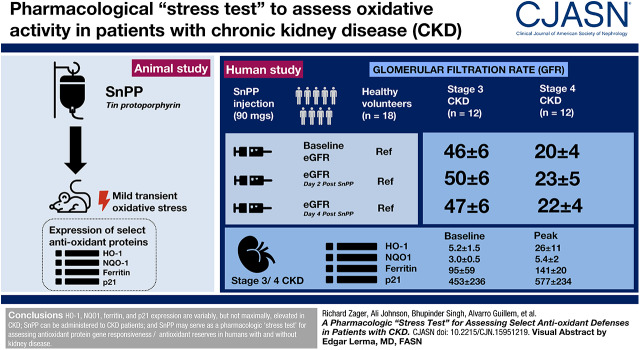
Oxidative stress is a hallmark and mediator of CKD. Diminished antioxidant defenses are thought to be partly responsible. However, there is currently no way to prospectively assess antioxidant defenses in humans. Tin protoporphyrin (SnPP) induces mild, transient oxidant stress in mice, triggering increased expression of select antioxidant proteins (, heme oxygenase 1 [HO-1], NAD[P]H dehydrogenase [quinone] 1 [NQO1], ferritin, p21). Hence, we tested the hypothesis that SnPP can also variably increase these proteins in humans and can thus serve as a pharmacologic "stress test" for gauging gene responsiveness and antioxidant reserves.
A total of 18 healthy volunteers and 24 participants with stage 3 CKD (=12; eGFR 30-59 ml/min per 1.73 m) or stage 4 CKD (=12; eGFR 15-29 ml/min per 1.73 m) were injected once with SnPP (9, 27, or 90 mg). Plasma and/or urinary antioxidant proteins were measured at baseline and for up to 4 days post-SnPP dosing. Kidney safety was gauged by serial measurements of BUN, creatinine, eGFR, albuminuria, and four urinary AKI biomarkers (kidney injury molecule 1, neutrophil gelatinase-associated lipocalin, cystatin C, and N-acetyl glucosaminidase).
Plasma HO-1, ferritin, p21, and NQO1 were all elevated at baseline in CKD participants. Plasma HO-1 and urine NQO1 levels each inversely correlated with eGFR (=-0.85 to -0.95). All four proteins manifested statistically significant dose- and time-dependent elevations after SnPP injection. However, marked intersubject differences were observed. p21 responses to high-dose SnPP and HO-1 responses to low-dose SnPP were significantly suppressed in participants with CKD versus healthy volunteers. SnPP was well tolerated by all participants, and no evidence of nephrotoxicity was observed.
SnPP can be safely administered and, after its injection, the resulting changes in plasma HO-1, NQO1, ferritin, and p21 concentrations can provide information as to antioxidant gene responsiveness/reserves in subjects with and without kidney disease.
A Study with RBT-1, in Healthy Volunteers and Subjects with Stage 3-4 Chronic Kidney Disease, NCT0363002 and NCT03893799.
氧化应激是 CKD 的一个标志和介导因素。人们认为,抗氧化防御能力的减弱在一定程度上是其原因。然而,目前还没有前瞻性评估人类抗氧化防御能力的方法。锡原卟啉(SnPP)在小鼠中诱导轻度、短暂的氧化应激,触发选择性抗氧化蛋白(血红素加氧酶 1 [HO-1]、NAD[P]H 脱氢酶[醌]1 [NQO1]、铁蛋白、p21)的表达增加。因此,我们假设 SnPP 也可以在人体内不同程度地增加这些蛋白质,从而可以作为衡量基因反应性和抗氧化储备的药理学“应激测试”。
共有 18 名健康志愿者和 24 名 3 期 CKD 患者(=12;eGFR 为 30-59 ml/min/1.73 m)或 4 期 CKD 患者(=12;eGFR 为 15-29 ml/min/1.73 m)一次接受 SnPP(9、27 或 90 mg)注射。在 SnPP 给药前和给药后最多 4 天测量血浆和/或尿液抗氧化蛋白。通过连续测量 BUN、肌酐、eGFR、蛋白尿和四个尿急性肾损伤生物标志物(肾损伤分子 1、中性粒细胞明胶酶相关脂质运载蛋白、胱抑素 C 和 N-乙酰氨基葡萄糖苷酶)来评估肾脏安全性。
CKD 患者的血浆 HO-1、铁蛋白、p21 和 NQO1 基线均升高。血浆 HO-1 和尿 NQO1 水平均与 eGFR 呈负相关(=-0.85 至-0.95)。SnPP 注射后,所有四种蛋白质均表现出统计学上显著的剂量和时间依赖性升高。然而,观察到明显的个体间差异。与健康志愿者相比,高剂量 SnPP 引起的 p21 反应和低剂量 SnPP 引起的 HO-1 反应在 CKD 患者中受到显著抑制。所有参与者均耐受 SnPP 良好,未观察到肾毒性证据。
SnPP 可安全给药,给药后,血浆 HO-1、NQO1、铁蛋白和 p21 浓度的变化可提供有或无肾脏疾病患者的抗氧化基因反应性/储备信息。
一项在健康志愿者和 3-4 期慢性肾脏病患者中进行的 RBT-1 研究,NCT0363002 和 NCT03893799。