Department of Medicine, University of Washington, Seattle, WA, USA.
Fred Hutchinson Cancer Research Center, Seattle, WA, USA.
Physiol Rep. 2020 Sep;8(18):e14566. doi: 10.14814/phy2.14566.
Tin protoporphyrin (SnPP), a heme oxygenase 1 (HO-1) inhibitor, triggers adaptive tissue responses that confer potent protection against acute renal- and extra-renal tissue injuries. This effect is mediated, in part, via SnPP-induced activation of the cytoprotective Nrf2 pathway. However, it remains unclear as to whether SnPP can also upregulate humoral cytokine defenses, either in healthy human subjects or in patients with CKD. If so, then systemically derived cytokines could contribute SnPP-induced tissue protection.
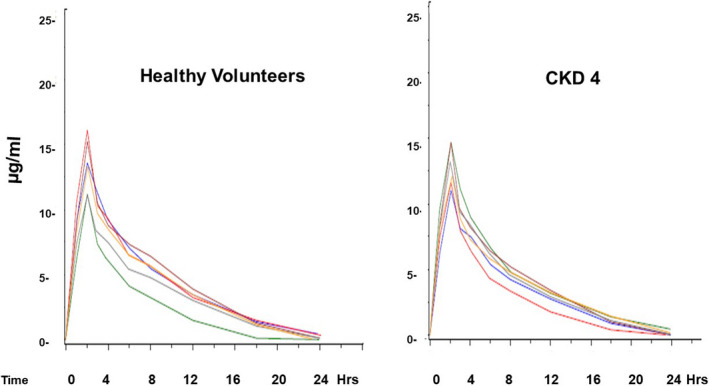
SnPP (90 mg IV) was administered over 2 hr to six healthy human volunteers (HVs) and 12 subjects with stage 3-4 CKD. Plasma samples were obtained from baseline upto 72 hr post injection. Two representative anti-inflammatory cytokines (IL-10, TGFβ1), and a pro-inflammatory cytokine (TNF-α), were assayed. Because IL-6 has been shown to induce tissue preconditioning, its plasma concentrations were also assessed. In complementary mouse experiments, SnPP effects on renal, splenic, and hepatic IL-10, IL-6, TGFβ1, and TNF-α production (as gauged by their mRNAs) were tested. Tissue HO-1 mRNA served as an Nrf2 activation marker.
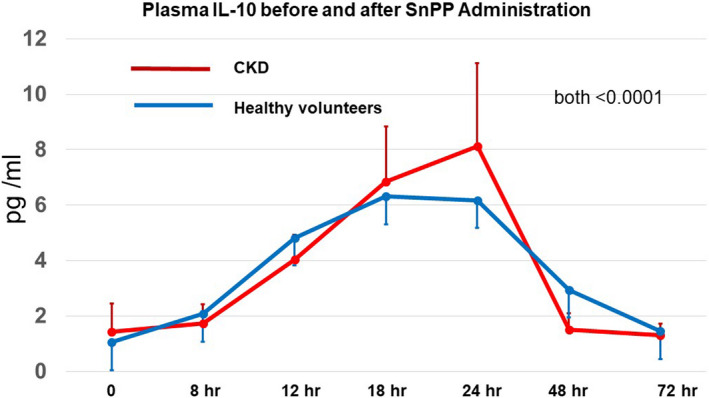
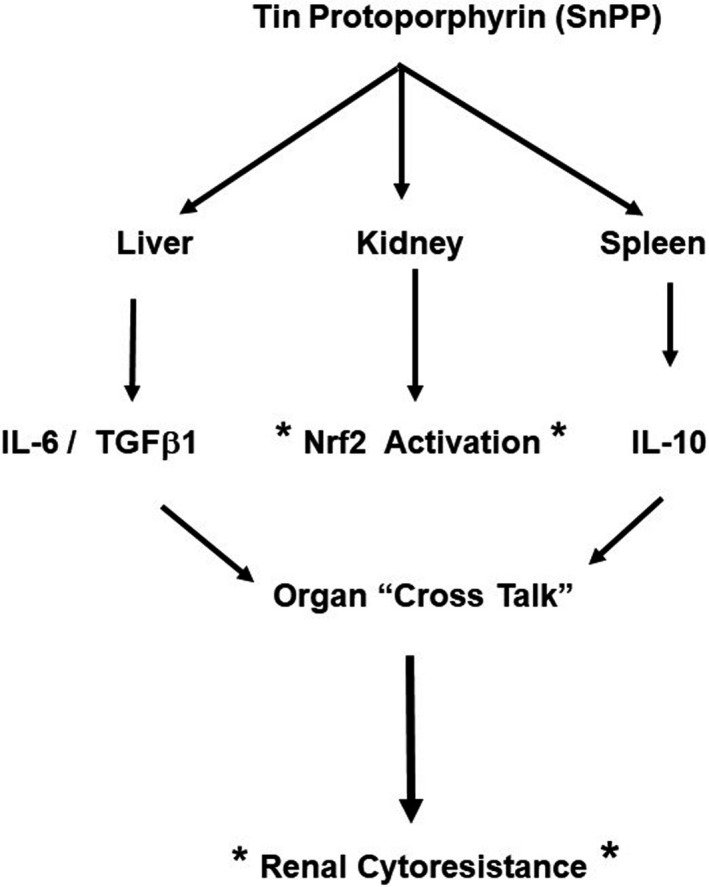
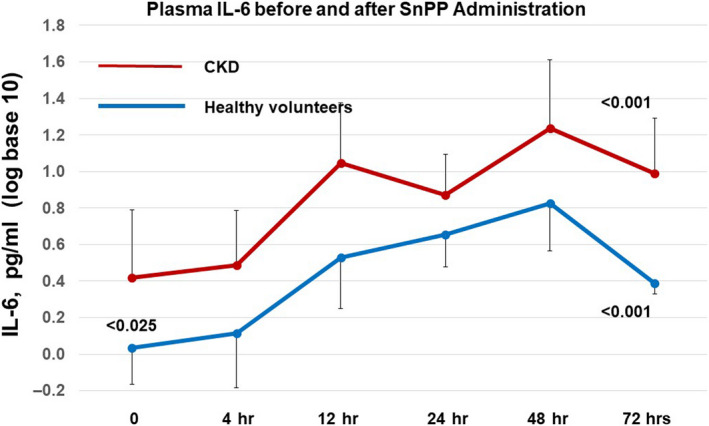
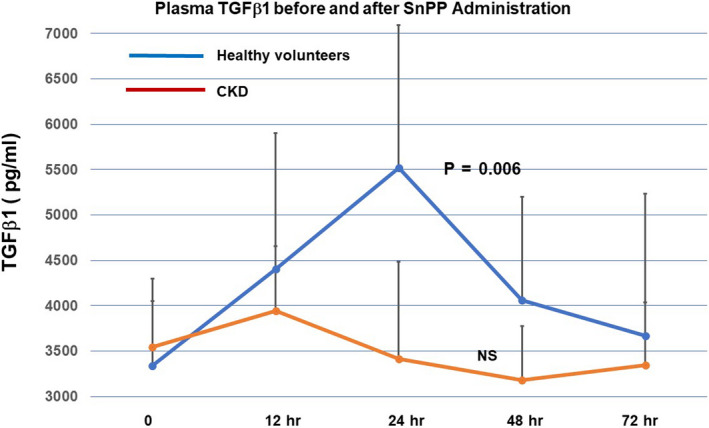
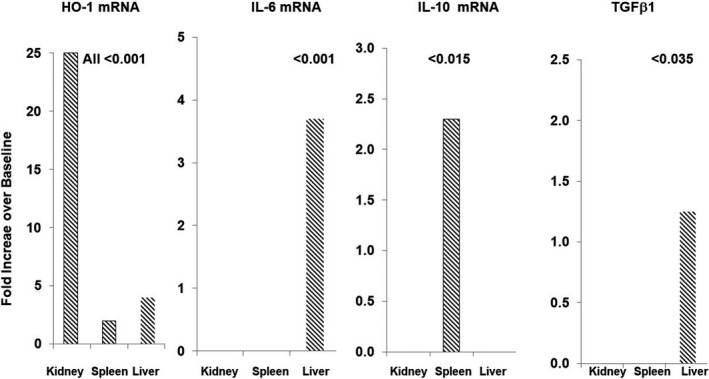
SnPP induced marked (~5-7x) increases in plasma IL-10 and IL-6 concentrations within 24-48 hr, and to equal degrees in HVs and CKD patients. SnPP modestly raised plasma TGFβ1 without impacting plasma TNF-α levels. In mouse experiments, SnPP did not affect IL-6, IL-10, TNF-α, or TGFβ1 mRNAs in kidney despite marked renal Nrf2 activation. Conversely, SnPP increased splenic IL-10 and hepatic IL-6/TGFβ1 mRNA levels, suggesting these organs as sites of extra-renal cytokine generation.
SnPP can trigger cytoprotective cytokine production, most likely in extra-renal tissues. With ready glomerular cytokine filtration, extra-renal/renal "organ cross talk" can result. Thus, humoral factors seemingly can contribute to SnPP's cytoprotective effects.
锡原卟啉(SnPP)是血红素加氧酶 1(HO-1)的抑制剂,可引发适应性组织反应,对急性肾和肾外组织损伤提供有力保护。这种作用部分是通过 SnPP 诱导的细胞保护 Nrf2 途径的激活介导的。然而,目前尚不清楚 SnPP 是否也可以上调健康人体受试者或 CKD 患者的体液细胞因子防御。如果是这样,那么系统来源的细胞因子可能有助于 SnPP 诱导的组织保护。
将 SnPP(90mg IV)在 2 小时内输注给 6 名健康志愿者(HV)和 12 名 3-4 期 CKD 患者。从基线到注射后 72 小时采集血浆样本。测定了两种代表性的抗炎细胞因子(IL-10、TGFβ1)和一种促炎细胞因子(TNF-α)。因为 IL-6 已被证明可诱导组织预处理,所以还测定了其血浆浓度。在补充的小鼠实验中,测试了 SnPP 对肾、脾和肝组织中 IL-10、IL-6、TGFβ1 和 TNF-α产生的影响(通过它们的 mRNAs 来衡量)。组织 HO-1 mRNA 作为 Nrf2 激活标志物。
SnPP 在 24-48 小时内诱导血浆 IL-10 和 IL-6 浓度显著(~5-7 倍)增加,在 HV 和 CKD 患者中增加程度相同。SnPP 适度升高血浆 TGFβ1 而不影响 TNF-α 水平。在小鼠实验中,尽管肾 Nrf2 明显激活,但 SnPP 不影响肾脏中 IL-6、IL-10、TNF-α 或 TGFβ1 的 mRNAs。相反,SnPP 增加了脾脏中 IL-10 和肝脏中 IL-6/TGFβ1 mRNA 水平,表明这些器官是产生肾外细胞因子的部位。
SnPP 可引发细胞保护细胞因子的产生,很可能发生在肾外组织中。由于肾小球有充分的细胞因子滤过作用,可能会导致肾外/肾组织的“器官交叉对话”。因此,体液因子似乎可以有助于 SnPP 的细胞保护作用。