Anigboro Akpovwehwee Akporhuarho, Avwioroko Oghenetega Jonathan, Cholu Cletus Ozege
Department of Biochemistry, Faculty of Science, Delta State University, Abraka, Delta State 330106, Nigeria.
Department of Biochemistry, Faculty of Basic Medical Sciences, Redeemer's University, Ede, Osun State 232102, Nigeria.
Prev Nutr Food Sci. 2020 Mar 31;25(1):58-64. doi: 10.3746/pnf.2020.25.1.58.
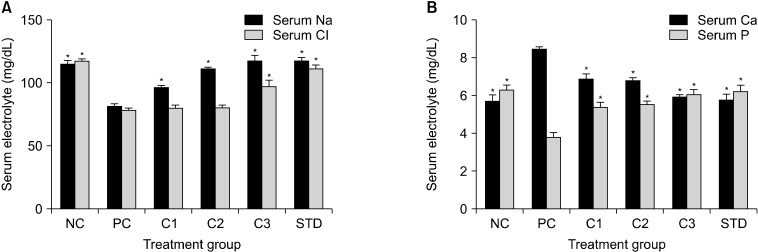
This study examined the bioactive components of aqueous leaf extracts and their protective effects on liver and renal function in a -induced albino mouse model of malarial infection. The results showed that extracts are rich in phytochemicals, including flavonoids, phenols, saponin, terpenes, and tannin. Four days after infection with malaria, elevated parasitemia levels in untreated control mice dropped by 4.57%. Administration of extracts at doses of 100, 200, and 300 mg/kg significantly decreased parasitemia levels by 17.39, 61.88, and 60.53%, respectively (all <0.05), relative to untreated control mice; however, standard antimalarial drugs were more efficacious and reduced parasitemia by 86.73%. Treatment with both extracts (100∼300 mg/kg) and standard antimalarial drugs significantly decreased malarial-induced physiological imbalances in liver and renal biomarkers, and serum electrolytes in malaria-infected mice compared with controls (<0.05). The therapeutic effect of was greatest at a dose of 200 and 300 mg/kg. These findings indicate that aqueous leaf extracts could protect against malarial-induced aberrations in liver and renal function whilst exhibiting anti-malarial effects, and could explain its use as an antimalarial remedy in traditional medicine.
本研究检测了叶水提取物的生物活性成分及其对疟原虫感染诱导的白化病小鼠模型肝脏和肾脏功能的保护作用。结果表明,提取物富含植物化学物质,包括黄酮类、酚类、皂苷、萜类和单宁。感染疟疾四天后,未治疗的对照小鼠体内升高的寄生虫血症水平下降了4.57%。相对于未治疗的对照小鼠,以100、200和300mg/kg剂量给予提取物可使寄生虫血症水平分别显著降低17.39%、61.88%和60.53%(均P<0.05);然而,标准抗疟药物更有效,可使寄生虫血症降低86.73%。与对照组相比,提取物(100~300mg/kg)和标准抗疟药物治疗均显著降低了疟疾感染小鼠肝脏和肾脏生物标志物以及血清电解质中疟疾诱导的生理失衡(P<0.05)。提取物在200和300mg/kg剂量时治疗效果最佳。这些发现表明,叶水提取物可以预防疟疾诱导的肝脏和肾脏功能异常,同时具有抗疟作用,这可以解释其在传统医学中作为抗疟药物的用途。