Department of Maternal and Child Health and Urological Sciences, Sapienza University of Rome, Italy.
Fetal Medicine Unit, Saint George's Hospital, London, United Kingdom.
Am J Obstet Gynecol MFM. 2020 May;2(2):100107. doi: 10.1016/j.ajogmf.2020.100107. Epub 2020 Mar 25.
The aim of this systematic review was to report pregnancy and perinatal outcomes of coronavirus spectrum infections, and particularly coronavirus 2019 (COVID-19) disease because of severe acute respiratory syndrome-coronavirus-2 infection during pregnancy.
Medline, Embase, Cinahl, and Clinicaltrials.gov databases were searched electronically utilizing combinations of word variants for coronavirus or severe acute respiratory syndrome or SARS or Middle East respiratory syndrome or MERS or COVID-19 and pregnancy. The search and selection criteria were restricted to English language.
Inclusion criteria were hospitalized pregnant women with a confirmed coronavirus related-illness, defined as severe acute respiratory syndrome (SARS), Middle East respiratory syndrome (MERS), or COVID-19.
We used meta-analyses of proportions to combine data and reported pooled proportions, so that a pooled proportion may not coincide with the actual raw proportion in the results. The pregnancy outcomes observed included miscarriage, preterm birth, preeclampsia, preterm prelabor rupture of membranes, fetal growth restriction, and mode of delivery. The perinatal outcomes observed were fetal distress, Apgar score <7 at 5 minutes, neonatal asphyxia, admission to a neonatal intensive care unit, perinatal death, and evidence of vertical transmission.
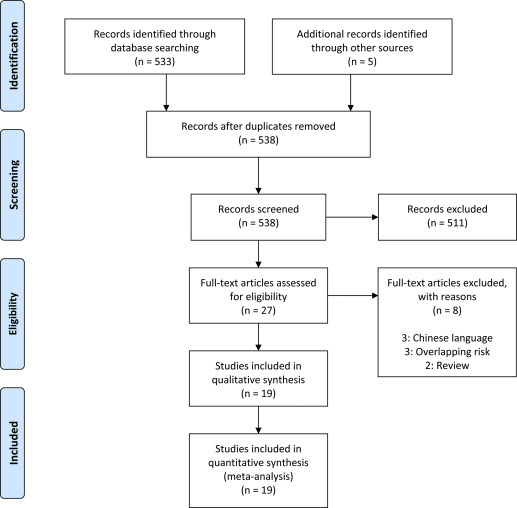
Nineteen studies including 79 hospitalized women were eligible for this systematic review: 41 pregnancies (51.9%) affected by COVID-19, 12 (15.2%) by MERS, and 26 (32.9%) by SARS. An overt diagnosis of pneumonia was made in 91.8%, and the most common symptoms were fever (82.6%), cough (57.1%), and dyspnea (27.0%). For all coronavirus infections, the pooled proportion of miscarriage was 64.7% (8/12; 95% confidence interval, 37.9-87.3), although reported only for women affected by SARS in two studies with no control group; the pooled proportion of preterm birth <37 weeks was 24.3% (14/56; 95% confidence interval, 12.5-38.6); premature prelabor rupture of membranes occurred in 20.7% (6/34; 95% confidence interval, 9.5-34.9), preeclampsia in 16.2% (2/19; 95% confidence interval, 4.2-34.1), and fetal growth restriction in 11.7% (2/29; 95% confidence interval, 3.2-24.4), although reported only for women affected by SARS; 84% (50/58) were delivered by cesarean; the pooled proportion of perinatal death was 11.1% (5/60; 95% confidence interval, 84.8-19.6), and 57.2% of newborns (3/12; 95% confidence interval, 3.6-99.8) were admitted to the neonatal intensive care unit. When focusing on COVID-19, the most common adverse pregnancy outcome was preterm birth <37 weeks, occurring in 41.1% of cases (14/32; 95% confidence interval, 25.6-57.6), while the pooled proportion of perinatal death was 7.0% (2/41; 95% confidence interval, 1.4-16.3). None of the 41 newborns assessed showed clinical signs of vertical transmission.
In hospitalized mothers infected with coronavirus infections, including COVID-19, >90% of whom also had pneumonia, preterm birth is the most common adverse pregnancy outcome. COVID-19 infection was associated with higher rate (and pooled proportions) of preterm birth, preeclampsia, cesarean, and perinatal death. There have been no published cases of clinical evidence of vertical transmission. Evidence is accumulating rapidly, so these data may need to be updated soon. The findings from this study can guide and enhance prenatal counseling of women with COVID-19 infection occurring during pregnancy, although they should be interpreted with caution in view of the very small number of included cases.
本系统评价旨在报告冠状病毒谱系感染(尤其是因严重急性呼吸系统综合征冠状病毒-2 感染而导致的 2019 年冠状病毒病)的妊娠和围产期结局。
我们利用冠状病毒、严重急性呼吸系统综合征、中东呼吸系统综合征、MERS、COVID-19 等词的变体,在 Medline、Embase、Cinahl 和 Clinicaltrials.gov 数据库中进行了电子检索。搜索和选择标准仅限于英语。
纳入标准为患有经证实的冠状病毒相关疾病(定义为严重急性呼吸系统综合征[SARS]、中东呼吸系统综合征[MERS]或 COVID-19)并住院的孕妇。
我们使用比例的荟萃分析来合并数据,并报告合并比例,因此合并比例可能与结果中的实际原始比例不一致。观察到的妊娠结局包括流产、早产、子痫前期、早产胎膜早破、胎儿生长受限和分娩方式。观察到的围产儿结局包括胎儿窘迫、5 分钟时 Apgar 评分<7、新生儿窒息、入住新生儿重症监护病房、围产儿死亡和垂直传播的证据。
19 项研究纳入了 79 名住院孕妇,符合本系统评价标准:41 例妊娠(51.9%)受 COVID-19 影响,12 例(15.2%)受 MERS 影响,26 例(32.9%)受 SARS 影响。91.8%的孕妇有明显的肺炎诊断,最常见的症状是发热(82.6%)、咳嗽(57.1%)和呼吸困难(27.0%)。对于所有冠状病毒感染,流产的合并比例为 64.7%(12/18;95%置信区间,37.9-87.3),尽管仅在两项无对照组的 SARS 研究中报告了受 SARS 影响的孕妇;早产<37 周的合并比例为 24.3%(14/56;95%置信区间,12.5-38.6);早产胎膜早破的发生率为 20.7%(6/34;95%置信区间,9.5-34.9),子痫前期为 16.2%(2/19;95%置信区间,4.2-34.1),胎儿生长受限为 11.7%(2/29;95%置信区间,3.2-24.4),尽管仅在受 SARS 影响的孕妇中报告;84%(50/58)经剖宫产分娩;围产儿死亡的合并比例为 11.1%(5/45;95%置信区间,84.8-19.6),57.2%(12/18;95%置信区间,3.6-99.8)的新生儿入住新生儿重症监护病房。当重点关注 COVID-19 时,最常见的不良妊娠结局是早产<37 周,发生在 41.1%的病例中(14/32;95%置信区间,25.6-57.6),而围产儿死亡的合并比例为 7.0%(2/41;95%置信区间,1.4-16.3)。评估的 41 名新生儿均无垂直传播的临床证据。
在感染冠状病毒感染(包括 COVID-19)的住院母亲中,>90%的母亲还患有肺炎,早产是最常见的不良妊娠结局。COVID-19 感染与较高的早产、子痫前期、剖宫产和围产儿死亡发生率(和合并比例)相关。尚未有临床垂直传播证据的报道。由于纳入病例数非常少,因此证据正在迅速积累,这些数据可能需要很快更新。尽管如此,本研究结果可以为患有 COVID-19 感染的孕妇提供产前咨询和指导,尽管应谨慎解释,因为纳入的病例数量非常少。