Ismail Ishamri, Hwang Young-Hwa, Joo Seon-Tea
Division of Applied Life Science (BK21+), Gyeongsang National University, Jinju 52828, Korea.
Faculty of Bioresources and Food Industry, Universiti Sultan Zainal Abidin, Besut Campus, Terengganu 22200, Malaysia.
J Anim Sci Technol. 2020 Mar;62(2):111-120. doi: 10.5187/jast.2020.62.2.111. Epub 2020 Mar 31.
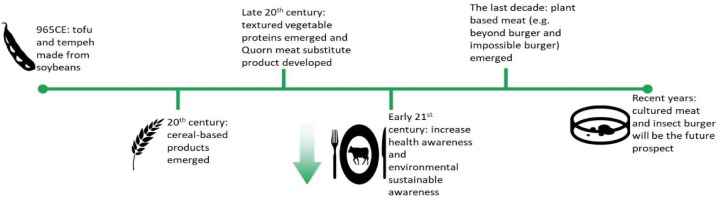
The definition of meat analog refers to the replacement of the main ingredient with other than meat. It also called a meat substitute, meat alternatives, fake or mock meat, and imitation meat. The increased importance of meat analog in the current trend is due to the health awareness among consumers in their diet and for a better future environment. The factors that lead to this shift is due to low fat and calorie foods intake, flexitarians, animal disease, natural resources depletion, and to reduce greenhouse gas emission. Currently, available marketed meat analog products are plant-based meat in which the quality (i.e., texture and taste) are similar to the conventional meat. The ingredients used are mainly soy proteins with novel ingredients added, such as mycoprotein and soy leghemoglobin. However, plant-based meat is sold primarily in Western countries. Asian countries also will become a potential market in the near future due to growing interest in this product. With the current advance technology, lab-grown meat with no livestock raising or known as cultured meat will be expected to boost the food market in the future. Also, insect-based products will be promising to be the next protein resource for human food. Nevertheless, other than acceptability, cost-effective, reliable production, and consistent quality towards those products, product safety is the top priority. Therefore, the regulatory frameworks need to be developed alongside.
肉类替代品的定义是指用肉类以外的其他成分替代主要成分。它也被称为肉类替代品、肉类代用品、人造肉或仿肉。在当前趋势下,肉类替代品的重要性日益增加,这是由于消费者在饮食方面的健康意识以及为了实现更美好的未来环境。导致这种转变的因素包括低脂肪和低热量食物的摄入、弹性素食者、动物疾病、自然资源枯竭以及减少温室气体排放。目前,市场上销售的肉类替代品产品主要是植物性肉类,其质量(即质地和口感)与传统肉类相似。所使用的成分主要是大豆蛋白,并添加了新型成分,如真菌蛋白和大豆豆血红蛋白。然而,植物性肉类主要在西方国家销售。由于对该产品的兴趣日益浓厚,亚洲国家在不久的将来也将成为一个潜在市场。随着当前技术的进步,无需饲养牲畜的实验室培育肉类或称为 cultured meat( cultured meat 直译为“培养肉”,在国内也常被称为“细胞培养肉” )有望在未来推动食品市场发展。此外,昆虫基产品有望成为人类食物的下一个蛋白质来源。然而,除了这些产品的可接受性、成本效益、可靠的生产和稳定的质量外,产品安全是首要任务。因此,监管框架也需要同步制定。