Donders Institute, Centre for Cognitive Neuroimaging, Radboud University, Nijmegen, The Netherlands.
Behavioural Science Institute, Radboud University Nijmegen, The Netherlands.
Hum Brain Mapp. 2020 Aug 1;41(11):3089-3099. doi: 10.1002/hbm.25000. Epub 2020 Apr 15.
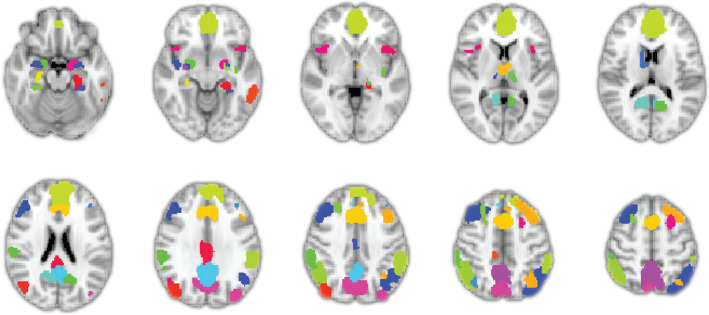
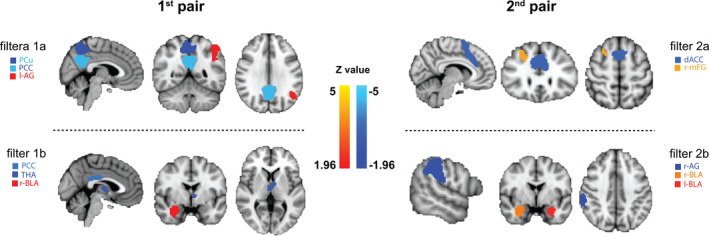
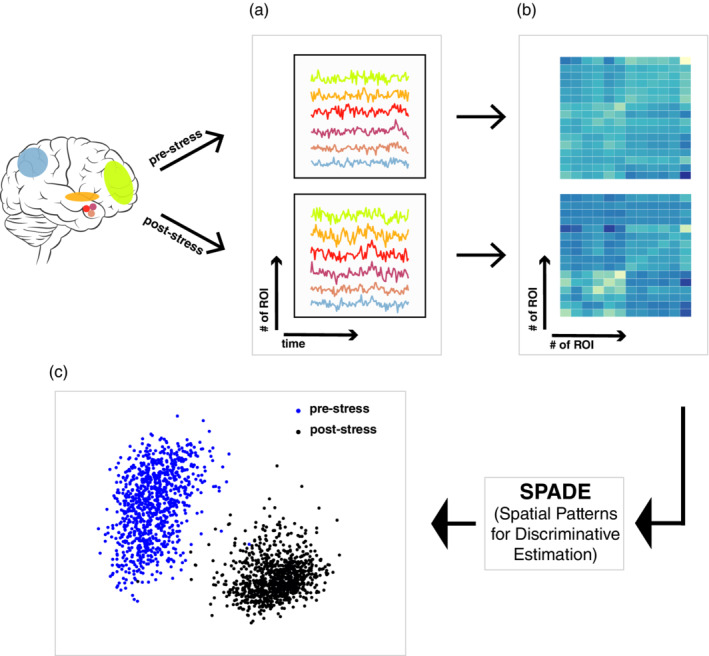
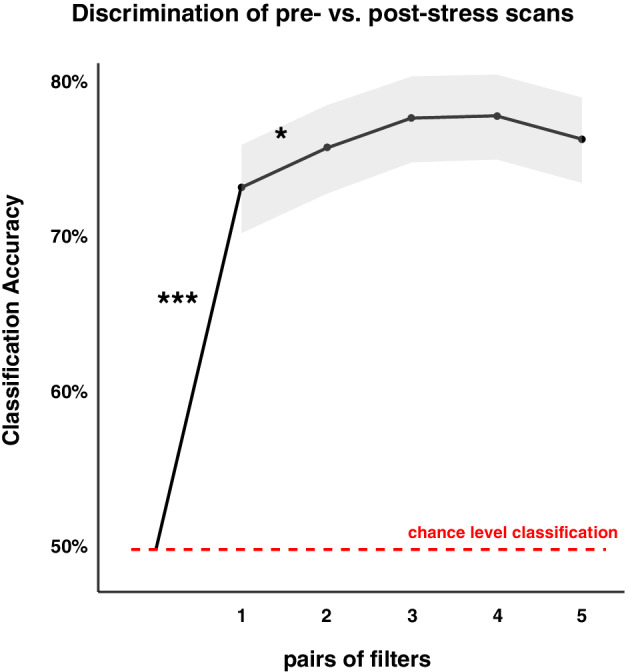
Acute stress induces large-scale neural reorganization with relevance to stress-related psychopathology. Here, we applied a novel supervised machine learning method, combining the strengths of a priori theoretical insights with a data-driven approach, to identify which connectivity changes are most prominently associated with a state of acute stress and individual differences therein. Resting-state functional magnetic resonance imaging scans were taken from 334 healthy participants (79 females) before and after a formal stress induction. For each individual scan, mean time-series were extracted from 46 functional parcels of three major brain networks previously shown to be potentially sensitive to stress effects (default mode network (DMN), salience network (SN), and executive control networks). A data-driven approach was then used to obtain discriminative spatial linear filters that classified the pre- and post-stress scans. To assess potential relevance for understanding individual differences, probability of classification using the most discriminative filters was linked to individual cortisol stress responses. Our model correctly classified pre- versus post-stress states with highly significant accuracy (above 75%; leave-one-out validation relative to chance performance). Discrimination between pre- and post-stress states was mainly based on connectivity changes in regions from the SN and DMN, including the dorsal anterior cingulate cortex, amygdala, posterior cingulate cortex, and precuneus. Interestingly, the probability of classification using these connectivity changes were associated with individual cortisol increases. Our results confirm the involvement of DMN and SN using a data-driven approach, and specifically single out key regions that might receive additional attention in future studies for their relevance also for individual differences.
急性应激会引起大规模的神经重组,与应激相关的精神病理学有关。在这里,我们应用了一种新的监督机器学习方法,将先验理论见解的优势与数据驱动的方法相结合,以确定哪些连接变化与急性应激状态及其个体差异最相关。从 334 名健康参与者(79 名女性)中采集了静息态功能磁共振成像扫描,这些参与者在正式的应激诱导前后进行了扫描。对于每个个体扫描,从先前显示对应激效应具有潜在敏感性的三个主要脑网络(默认模式网络(DMN)、突显网络(SN)和执行控制网络)的 46 个功能区中提取了平均时间序列。然后使用数据驱动的方法获得了可区分的空间线性滤波器,这些滤波器可以对预应激和应激后扫描进行分类。为了评估对理解个体差异的潜在相关性,使用最具区分力的滤波器进行分类的概率与个体皮质醇应激反应相关联。我们的模型以非常显著的准确性(高于 75%;相对于机会表现的留一法验证)正确地对预应激与应激后状态进行了分类。预应激与应激后状态之间的区分主要基于来自 SN 和 DMN 的区域的连接变化,包括背侧前扣带皮层、杏仁核、后扣带皮层和楔前叶。有趣的是,使用这些连接变化进行分类的概率与个体皮质醇的增加有关。我们的结果使用数据驱动的方法证实了 DMN 和 SN 的参与,并特别指出了可能在未来研究中受到更多关注的关键区域,因为它们与个体差异也有关。