Heart Failure Unit, Hospital Universitari Germans Trias i Pujol, Badalona, Barcelona, Spain.
Endocrinology Department, Hospital Universitari Germans Trias i Pujol, Badalona, Barcelona, Spain.
Cardiovasc Diabetol. 2020 Mar 23;19(1):38. doi: 10.1186/s12933-020-01011-w.
Left ventricular ejection fraction (LVEF) trajectories and functional recovery with current heart failure (HF) management is increasingly recognized. Type 2 diabetes mellitus (T2D) leads to a worse prognosis in HF patients. However, it is unknown whether T2D interferes with LVEF trajectories. The aim of this study was to prospectively assess very long-term (up to 15 years) LVEF trajectories in patients with and without T2D and underlying HF.
Ambulatory patients admitted to a multidisciplinary HF clinic were prospectively evaluated by scheduled two-dimensional echocardiography at baseline, 1 year, and then every 2 years afterwards, up to 15 years. Statistical analyses of LVEF change with time were performed using the linear mixed effects (LME) models, and locally weighted error sum of squares (Loess) curves were plotted.
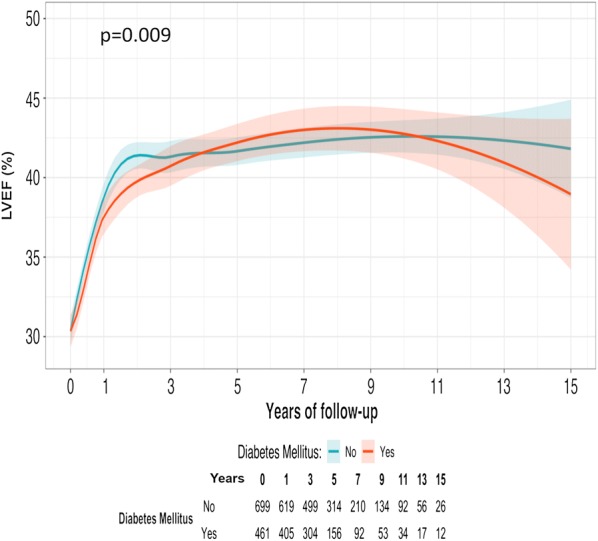
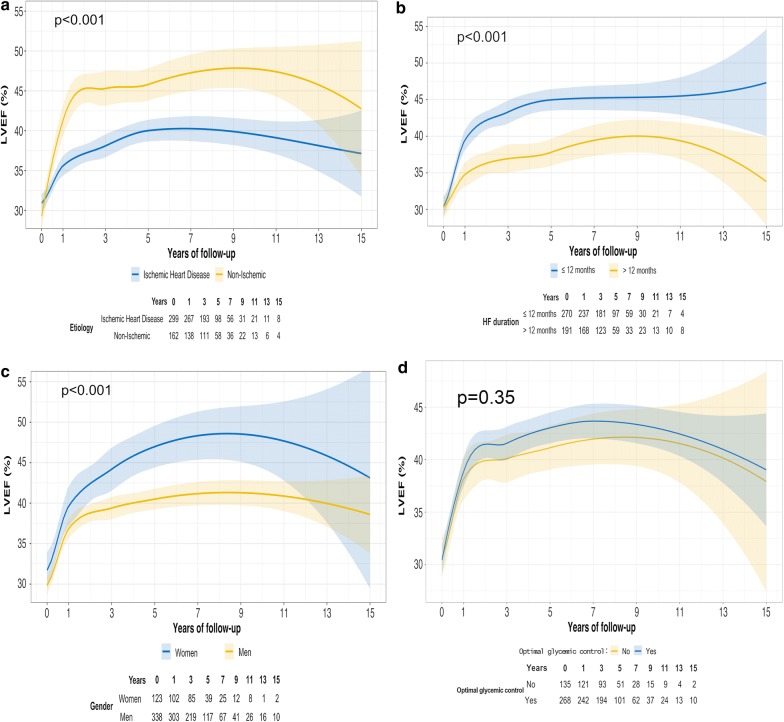
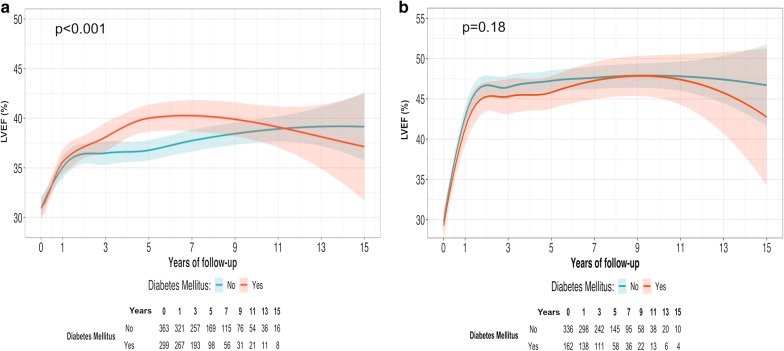
Of the 1921 patients, 461 diabetic and 699 non-diabetic patients with LVEF < 50% were included in the study. The mean number of echocardiography measurements performed in diabetic patients was 3.3 ± 1.6. Early LVEF recovery was similar in diabetic and non-diabetic patients, but Loess curves showed a more pronounced inverted U shape in diabetics with a more pronounced decline after 9 years. LME analysis showed a statistical interaction between T2D and LVEF trajectory over time (p = 0.009), which was statistically significant in patients with ischemic etiologies (p < 0.001). Other variables that showed an interaction between LVEF trajectories and T2D were male sex (p = 0.04) and HF duration (p = 0.008).
LVEF trajectories in T2D patients with depressed systolic function showed a pronounced inverted U shape with a marked decline after 9 years. Diabetic cardiomyopathy may underlie the functional decline observed.
左心室射血分数(LVEF)轨迹和心力衰竭(HF)管理的功能恢复越来越受到重视。2 型糖尿病(T2D)导致 HF 患者预后更差。然而,尚不清楚 T2D 是否会干扰 LVEF 轨迹。本研究旨在前瞻性评估 T2D 合并和不合并 HF 的患者的 LVEF 非常长期(长达 15 年)轨迹。
多学科 HF 诊所的门诊患者通过二维超声心动图在基线、1 年和之后每 2 年进行前瞻性评估,最长可达 15 年。使用线性混合效应(LME)模型对 LVEF 随时间的变化进行统计分析,并绘制局部加权误差和平方(Loess)曲线。
在 1921 例患者中,纳入了 461 例糖尿病和 699 例 LVEF<50%的非糖尿病患者。糖尿病患者的平均超声心动图测量次数为 3.3±1.6 次。糖尿病患者和非糖尿病患者的早期 LVEF 恢复相似,但 Loess 曲线显示糖尿病患者的倒 U 形更为明显,9 年后下降更为明显。LME 分析显示 T2D 和 LVEF 轨迹之间存在统计学上的时间交互作用(p=0.009),在缺血性病因患者中具有统计学意义(p<0.001)。其他显示 LVEF 轨迹与 T2D 之间存在交互作用的变量包括男性(p=0.04)和 HF 持续时间(p=0.008)。
收缩功能障碍的 T2D 患者的 LVEF 轨迹呈明显的倒 U 形,9 年后明显下降。观察到的功能下降可能是糖尿病心肌病的原因。