Zhou Ling, Chen Jia, Shen Wei, Chen Zheng-Lu, Huang Shuang, Tao Chang-Juan, Chen Ming, Yu Zhong-Hua, Chen Yuan-Yuan
Institute of Cancer and Basic Medicine (ICBM), Chinese Academy of Sciences, Hangzhou, China.
Department of Radiation Oncology, Cancer Hospital of University of Chinese Academy of Sciences, Hangzhou, China.
Radiat Oncol. 2020 Mar 23;15(1):68. doi: 10.1186/s13014-020-01490-x.
We investigated the risk factors of radiation-induced thyroid dysfunction, then combined the clinical factors and optimum thyroid dosimetric parameters to predict the incidence rate of hypothyroidism (HT) and to guide individualized treatment.
A total of 206 patients with histologically proven nasopharyngeal carcinoma (NPC) treated at the Cancer Hospital of the University of Chinese Academy of Sciences between January 2015 and August 2018 were included. Dose-volume histogram (DVH) data, including mean dose, absolute volume, V, V, V, V, V, V, V V, and V were extracted and used as dosimetric parameters. A logistic regression analysis model was built to identify predictors related to HT occurring within 2 years.
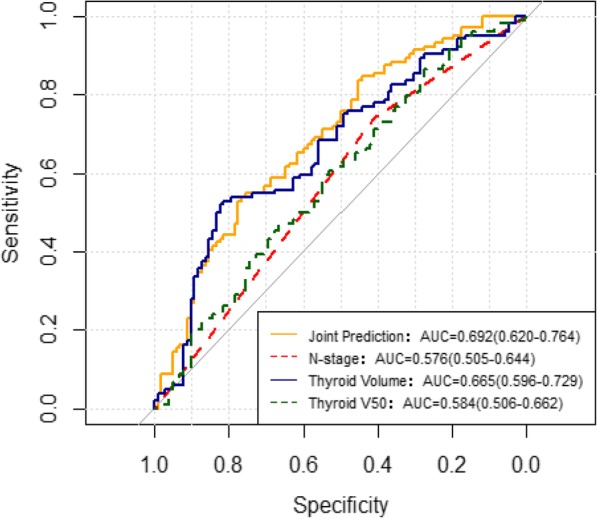
Sex, N stage, thyroid volume, mean thyroid dose, and thyroid V and V were significantly different between patients with and without HT. Logistic regression analysis showed that N stage, thyroid volume, and thyroid V were independent predictors of HT. The radiosensitivity of the thyroid decreased as the thyroid volume increased. Patients with N stage > 1 had significantly higher HT incidence (37.38%) than patients with N stage ≤1 (13.11%). The incidence of HT was 54.55% in patients with thyroid V > 24% and was 34.15% in patients with thyroid V ≤ 24%.
The incidence of HT is significantly associated with N stage, thyroid volume, and thyroid V. More attention should be paid to patients with NPC with thyroid volume ≤ 12.82 cm and advanced N stage disease.
我们研究了放射性甲状腺功能障碍的危险因素,然后结合临床因素和最佳甲状腺剂量学参数来预测甲状腺功能减退症(HT)的发生率并指导个体化治疗。
纳入2015年1月至2018年8月在中国科学院大学附属肿瘤医院接受治疗的206例经组织学证实的鼻咽癌(NPC)患者。提取剂量体积直方图(DVH)数据,包括平均剂量、绝对体积、V、V、V、V、V、V、V V和V,并将其用作剂量学参数。建立逻辑回归分析模型以识别与2年内发生HT相关的预测因素。
HT患者和非HT患者在性别、N分期、甲状腺体积、平均甲状腺剂量以及甲状腺V和V方面存在显著差异。逻辑回归分析表明,N分期、甲状腺体积和甲状腺V是HT的独立预测因素。随着甲状腺体积增加,甲状腺的放射敏感性降低。N分期>1的患者HT发生率(37.38%)显著高于N分期≤1的患者(13.11%)。甲状腺V>24%的患者HT发生率为54.55%,甲状腺V≤24%的患者HT发生率为34.15%。
HT的发生率与N分期、甲状腺体积和甲状腺V显著相关。对于甲状腺体积≤12.82 cm且N分期为晚期的NPC患者应给予更多关注。