Cancer Hospital, Shantou University Medical College, Shantou, China.
Department of Health Technology and Informatics, Hong Kong Polytechnic University, Hung Hom, Kowloon, Hong Kong SAR.
PLoS One. 2018 Jul 9;13(7):e0200310. doi: 10.1371/journal.pone.0200310. eCollection 2018.
Radiation-induced hypothyroidism is the most common thyroid disorder after radiotherapy in nasopharyngeal carcinoma (NPC) patients. This study evaluated the pattern of radiation-induced thyroid gland changes in 48 months after radiotherapy in NPC patients and the association of hypothyroidism incidence with thyroid dose.
Fifty-six NPC patients treated by intensity modulated radiotherapy in 2013 were recruited. All patients received baseline thyroid hormones (fT3, fT4 and TSH) tests and CT scan before radiotherapy. Repeated measures of the thyroid hormones and gland volume were performed at 3, 6, 12, 18, 24, 30, 36 and 48 months after treatment. Trend lines of the thyroid volume and hormone level changes against time were plotted. The incidence of hypothyroidism patients and its relationship with the dose were also evaluated.
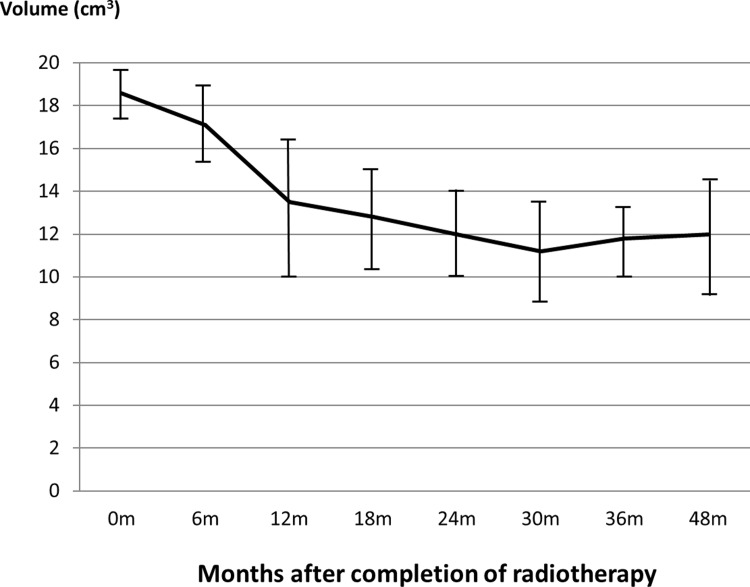
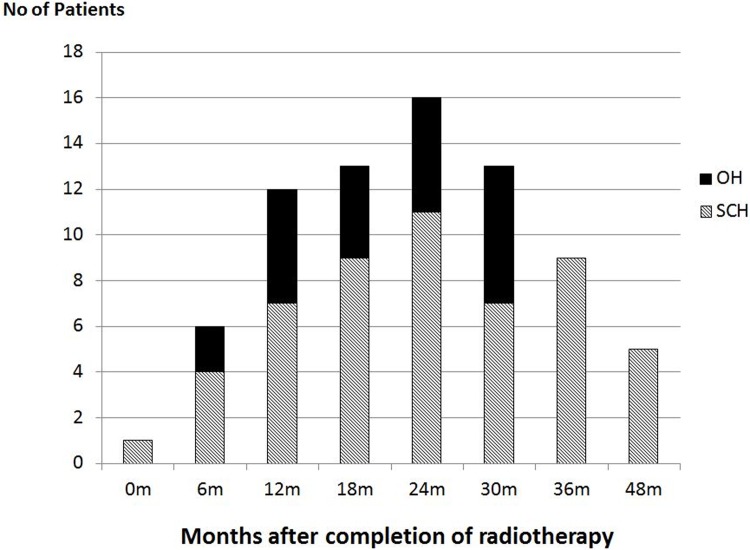
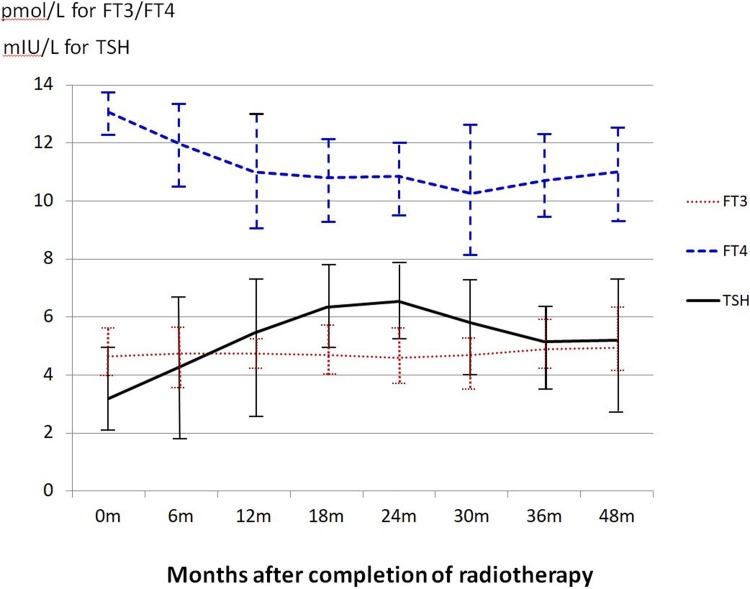
The mean thyroid volume followed a decreasing trend after radiotherapy, reaching a minimum (-39.8%) at 30 months and slightly increased afterward. The fT4 level followed a similar pattern with its mean value dropped by 21.5% at 30 months and became steady after 36 months. TSH level showed gradual rise from just after radiotherapy, reaching a peak at 24 months and became relatively steady after 36 months. The incidence of hypothyroidism increased to a maximum at 24 months (28.6%) and dropped afterwards. Thyroid Dmean and D50 were significantly correlated with hypothyroidism incidence in 12 to 30 months (ρ > 0.40, p < 0.05).
The patterns of radiation induced thyroid volume shrinkage and fT4 level reduction were similar, with both of them showed decreasing trend from 0 to 30 months. The thyroid volume and function reached a relatively steady state after 36 months. The incidence of hypothyroidism increased up to 24 months and its frequency was associated with the thyroid dose.
鼻咽癌(NPC)患者放疗后,放射性甲状腺功能减退症是最常见的甲状腺疾病。本研究评估了 NPC 患者放疗后 48 个月放射性甲状腺变化的模式,以及甲状腺功能减退症的发生率与甲状腺剂量的关系。
招募了 2013 年接受调强放疗的 56 例 NPC 患者。所有患者在放疗前均进行了基础甲状腺激素(fT3、fT4 和 TSH)检测和 CT 扫描。在治疗后 3、6、12、18、24、30、36 和 48 个月时,对甲状腺激素和腺体体积进行了重复测量。绘制了甲状腺体积和激素水平随时间变化的趋势线。还评估了甲状腺功能减退症患者的发生率及其与剂量的关系。
放疗后甲状腺体积呈下降趋势,30 个月时达到最小值(-39.8%),此后略有增加。fT4 水平呈相似模式,其平均值在 30 个月时下降了 21.5%,36 个月后趋于稳定。TSH 水平从放疗后逐渐升高,24 个月时达到峰值,36 个月后相对稳定。甲状腺功能减退症的发生率在 24 个月时达到最大值(28.6%),随后下降。12 至 30 个月时,甲状腺 Dmean 和 D50 与甲状腺功能减退症的发生率显著相关(ρ>0.40,p<0.05)。
放射性甲状腺体积缩小和 fT4 水平降低的模式相似,两者在 0 至 30 个月期间均呈下降趋势。36 个月后,甲状腺体积和功能达到相对稳定状态。甲状腺功能减退症的发生率在 24 个月时增加,其频率与甲状腺剂量有关。