Health Behavior Change Research Group, School of Psychology, National University of Ireland, Galway, H91 TK33, Ireland.
Department of Psychology, University of Quebec at Montreal, Montreal, QC, Canada.
Trials. 2020 Mar 23;21(1):292. doi: 10.1186/s13063-020-04235-z.
Non-communicable chronic diseases are linked to behavioral risk factors (including smoking, poor diet and physical inactivity), so effective behavior change interventions are needed to improve population health. However, uptake and impact of these interventions is limited by methodological challenges. We aimed to identify and achieve consensus on priorities for methodological research in behavioral trials in health research among an international behavioral science community.
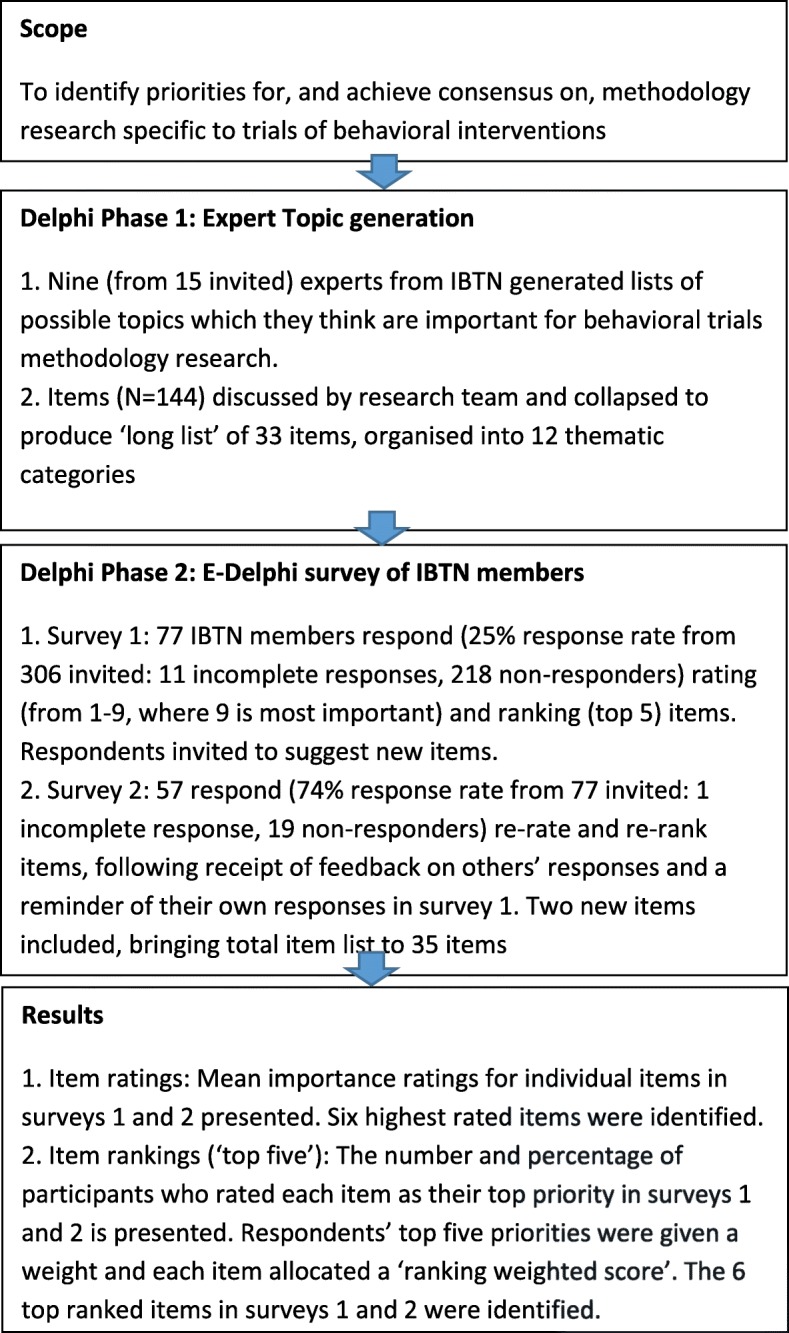
An international, Delphi consensus study was conducted. Fifteen core members of the International Behavioral Trials Network (IBTN) were invited to generate methodological items that they consider important. From these, the research team agreed a "long-list" of unique items. Two online surveys were administered to IBTN members (N = 306). Respondents rated the importance of items on a 9-point scale, and ranked their "top-five" priorities. In the second survey, respondents received feedback on others' responses, before rerating items and re-selecting their top five.
Nine experts generated 144 items, which were condensed to a long-list of 33 items. The four most highly endorsed items, in both surveys 1 (n = 77) and 2 (n = 57), came from two thematic categories:"Intervention development" ("Specifying intervention components" and "Tailoring interventions to specific populations and contexts") and "Implementation" ("How to disseminate behavioral trial research findings to increase implementation" and "Methods for ensuring that behavioral interventions are implementable into practice and policy"). "Development of novel research designs to test behavioral interventions" also emerged as a highly ranked research priority.
From a wide array of identified methodological issues, intervention development, implementation and novel research designs are key themes to drive the future behavioral trials' research agenda. Funding bodies should prioritize these issues in resource allocation.
非传染性慢性疾病与行为风险因素(包括吸烟、不良饮食和缺乏身体活动)有关,因此需要有效的行为改变干预措施来改善人群健康。然而,这些干预措施的采用和影响受到方法学挑战的限制。我们旨在确定并就国际行为科学界健康研究中行为试验的方法学研究重点达成共识。
进行了一项国际德尔菲共识研究。邀请了国际行为试验网络(IBTN)的 15 名核心成员提出他们认为重要的方法学项目。从这些项目中,研究团队商定了一个“长清单”上的独特项目。对 IBTN 成员(n=306)进行了两次在线调查。受访者根据 9 分制对项目的重要性进行评分,并对他们的“前五名”优先事项进行排名。在第二次调查中,在重新评分和重新选择前五名之前,受访者收到了对他人回应的反馈。
9 名专家提出了 144 个项目,这些项目被压缩成一个 33 个项目的长清单。在两次调查 1(n=77)和 2(n=57)中,两个主题类别中的四个最受支持的项目分别是:“干预措施的开发”(“具体干预措施组成部分”和“针对特定人群和背景调整干预措施”)和“实施”(“如何传播行为试验研究结果以增加实施”和“确保行为干预措施可实施到实践和政策中的方法”)。“开发新型研究设计以测试行为干预措施”也被认为是一个高度优先的研究重点。
从广泛确定的方法学问题中,干预措施的开发、实施和新型研究设计是推动未来行为试验研究议程的关键主题。资助机构应在资源分配中优先考虑这些问题。