,.
Invest Ophthalmol Vis Sci. 2020 Apr 9;61(4):12. doi: 10.1167/iovs.61.4.12.
There is little research evidence to explain why older adults have more problems adapting to new spectacles incorporating astigmatic changes than younger adults. We tested the hypothesis that astigmatic lenses oriented obliquely would lead to errors in verticality perception that are greater for older than younger adults.
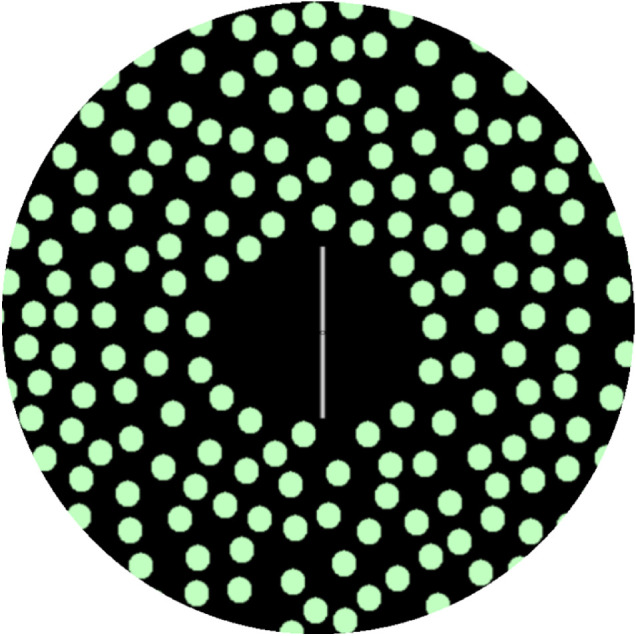
Participants included 12 young (mean ± SD age 25.1 ± 5.0 years) and 12 older (70.2 ± 6.3 years) adults with normal vision. Verticality perception was assessed using a computer-based subjective visual vertical (SVV) task, under static and dynamic (in the presence of a moving peripheral distractor) conditions and when viewing targets through the near refractive correction (control condition), and two forms of astigmatic lenses oriented in the vertical, horizontal, and oblique meridians.
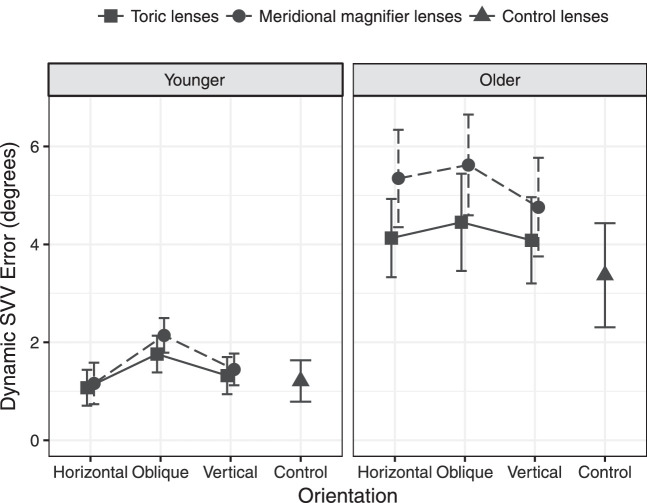
The older group demonstrated much greater dynamic SVV errors (e.g., 3.4° for the control condition) than the younger group (1.2°, P = 0.002), larger errors with vertical and horizontal astigmatic lenses (older group 4.1°and 5.2° for toric and magnifier lenses vs. younger group 1.2° and 1.4°, respectively, P < 0.001), and a larger influence of the oblique astigmatic lenses (older group 5.6° vs. younger group 2.1°, P<0.001).
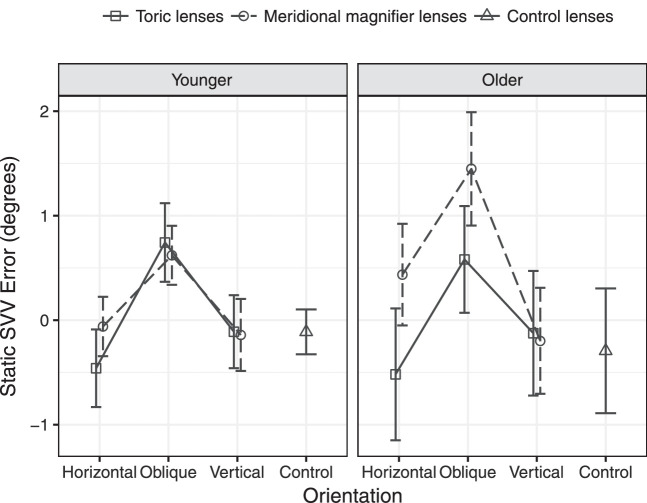
Astigmatic lenses produced little or no errors in SVV in young adults, but large static and dynamic SVV errors in older adults. This indicates a greater reliance on visual input with increased age for SVV, and helps explain why oblique astigmatic refractive corrections can cause dizziness in older patients and why they report greater difficulties adapting to new spectacles with astigmatic changes.
对于为什么老年人适应包含散光变化的新眼镜比年轻人更困难,目前仅有少量研究证据可以解释。我们验证了这样一个假设,即斜轴散光镜会导致垂直知觉错误,且对于老年人比年轻人更为明显。
参与者包括 12 名视力正常的年轻人(平均年龄 ± 标准差 25.1 ± 5.0 岁)和 12 名老年人(70.2 ± 6.3 岁)。使用基于计算机的主观垂直视觉(SVV)任务评估垂直知觉,分别在静态和动态(存在移动外周干扰物的情况下)条件下,以及通过近折射矫正(对照条件)观察目标时,以及通过垂直、水平和斜轴子午线定位的两种散光镜观察目标时。
与年轻人(例如对照条件下为 3.4°)相比,老年人(3.4°)的动态 SVV 误差大得多(P = 0.002),垂直和水平散光镜的误差更大(老年人的散光矫正镜和放大镜分别为 4.1°和 5.2°,年轻人为 1.2°和 1.4°,P < 0.001),斜轴散光镜的影响也更大(老年人为 5.6°,年轻人为 2.1°,P<0.001)。
散光镜在年轻人的 SVV 中几乎没有或没有产生误差,但在老年人中会产生较大的静态和动态 SVV 误差。这表明,随着年龄的增长,老年人对 SVV 的视觉输入的依赖性更大,这有助于解释为什么斜轴散光矫正会导致老年患者头晕,以及为什么他们报告适应包含散光变化的新眼镜更困难。