Department of Neurology, Ajou University School of Medicine, Ajou University Medical Center, Suwon, Republic of Korea.
Department of Emergency Medicine, Ajou University School of Medicine, Ajou University Medical Center, Suwon, Republic of Korea.
PLoS One. 2020 Apr 15;15(4):e0231113. doi: 10.1371/journal.pone.0231113. eCollection 2020.
Stroke recognition systems have been developed to reduce time delays, however, a comprehensive triaging score identifying stroke subtypes is needed to guide appropriate management. We aimed to develop a prehospital scoring system for rapid stroke recognition and identify stroke subtype simultaneously.
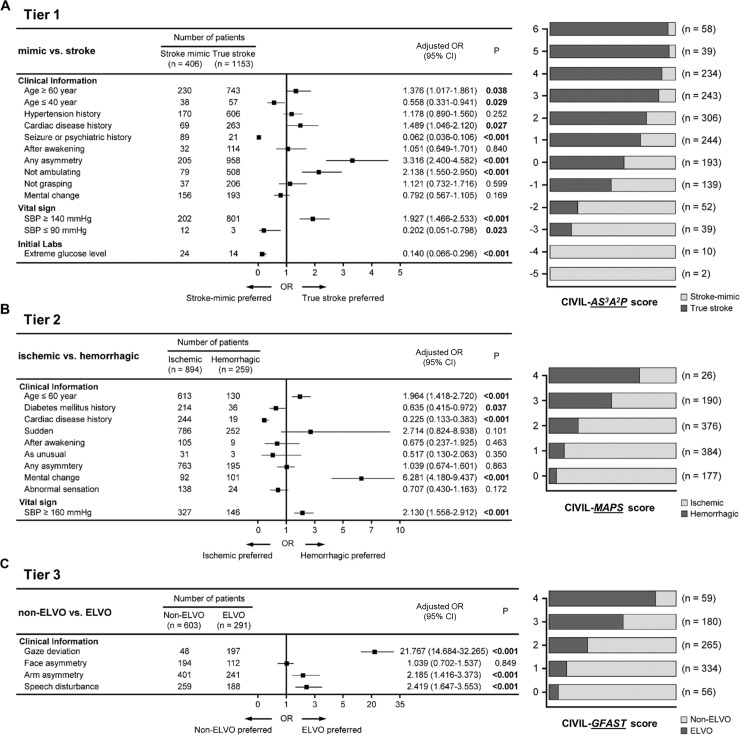
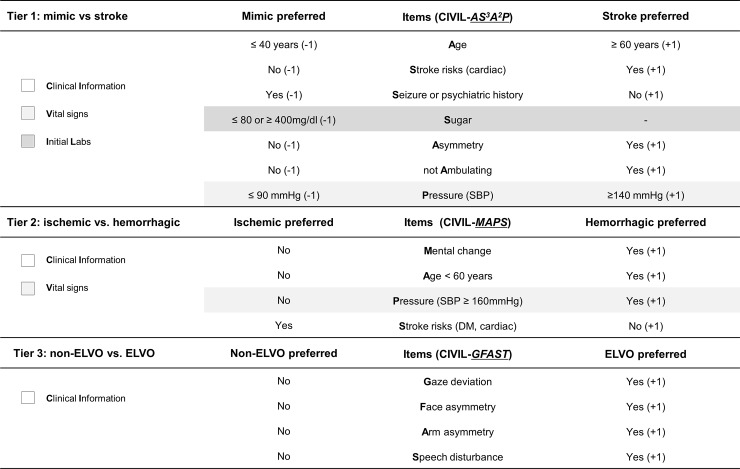
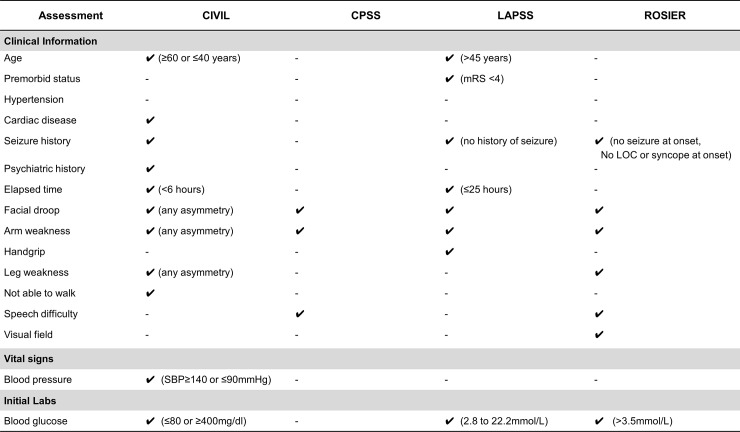
In prospective database of regional emergency and stroke center, Clinical Information, Vital signs, and Initial Labs (CIVIL) of 1,599 patients suspected of acute stroke was analyzed from an automatically-stored electronic health record. Final confirmation was performed with neuroimaging. Using multiple regression analyses, we determined independent predictors of tier 1 (true-stroke or not), tier 2 (hemorrhagic stroke or not), and tier 3 (emergent large vessel occlusion [ELVO] or not). The diagnostic performance of the stepwise CIVIL scoring system was investigated using internal validation. A new scoring system characterized by a stepwise clinical assessment has been developed in three tiers. Tier 1: Seven CIVIL-AS3A2P items (total score from -7 to +6) were deduced for true stroke as Age (≥ 60 years); Stroke risks without Seizure or psychiatric disease, extreme Sugar; "any Asymmetry", "not Ambulating"; abnormal blood Pressure at a cut-off point ≥ 1 with diagnostic sensitivity of 82.1%, specificity of 56.4%. Tier 2: Four items for hemorrhagic stroke were identified as the CIVIL-MAPS indicating Mental change, Age below 60 years, high blood Pressure, no Stroke risks with cut-point ≥ 2 (sensitivity 47.5%, specificity 85.4%). Tier 3: For ELVO diagnosis: we applied with CIVIL-GFAST items (Gaze, Face, Arm, Speech) with cut-point ≥ 3 (sensitivity 66.5%, specificity 79.8%). The main limitation of this study is its retrospective nature and require a prospective validation of the CIVIL scoring system.
The CIVIL score is a comprehensive and versatile system that recognizes strokes and identifies the stroke subtype simultaneously.
已经开发出了卒中识别系统以减少时间延迟,然而,需要一种全面的分诊评分来确定卒中亚型,以指导适当的管理。我们旨在开发一种院前卒中识别评分系统,并同时识别卒中亚型。
在区域急救和卒中中心的前瞻性数据库中,分析了来自自动存储的电子健康记录的 1599 例疑似急性卒中患者的临床信息、生命体征和初始实验室检查(CIVIL)。最终通过神经影像学进行确认。使用多元回归分析,我们确定了一级(是否为真卒中)、二级(是否为出血性卒中)和三级(是否为紧急大血管闭塞[ELVO])的独立预测因素。使用内部验证研究了逐步 CIVIL 评分系统的诊断性能。开发了一种新的评分系统,其特征是分三个层次进行逐步临床评估。一级:七个 CIVIL-AS3A2P 项目(总分从-7 到+6)被推断为真卒中,包括年龄(≥60 岁);无癫痫或精神疾病的卒中风险,极端血糖;“任何不对称”,“不能行走”;血压异常,截断值≥1,诊断灵敏度为 82.1%,特异性为 56.4%。二级:确定了四项出血性卒中的项目,即 CIVIL-MAPS,表明精神状态改变、年龄低于 60 岁、高血压、无卒中风险且截断值≥2(灵敏度 47.5%,特异性 85.4%)。三级:对于 ELVO 诊断:我们应用 CIVIL-GFAST 项目(眼球、面部、手臂、言语),截断值≥3(灵敏度 66.5%,特异性 79.8%)。本研究的主要局限性在于其回顾性性质,需要对 CIVIL 评分系统进行前瞻性验证。
CIVIL 评分是一种全面而通用的系统,可同时识别卒中并确定卒中亚型。