Purrucker Jan Christoph, Härtig Florian, Richter Hardy, Engelbrecht Andreas, Hartmann Johannes, Auer Jonas, Hametner Christian, Popp Erik, Ringleb Peter Arthur, Nagel Simon, Poli Sven
Department of Neurology, Heidelberg University Hospital, Heidelberg, Germany.
Department of Neurology and Stroke, Hertie Institute for Clinical Brain Research, Tuebingen University Hospital, Tuebingen, Germany.
BMJ Open. 2017 Sep 1;7(9):e016893. doi: 10.1136/bmjopen-2017-016893.
To develop an NIH Stroke Scale (NIHSS)-compatible, all-in-one scale for rapid and comprehensive prehospital stroke assessment including stroke recognition, severity grading and progression monitoring as well as prediction of large vessel occlusion (LVO).
Emergency medical services (EMS) personnel and stroke physicians (n=326) rated each item of the NIHSS regarding suitability for prehospital use; best rated items were included. Stroke recognition was evaluated retrospectively in 689 consecutive patients with acute stroke or stroke mimics, prediction of LVO in 741 consecutive patients with ischaemic stroke with acute vessel imaging independent of admission NIHSS score.
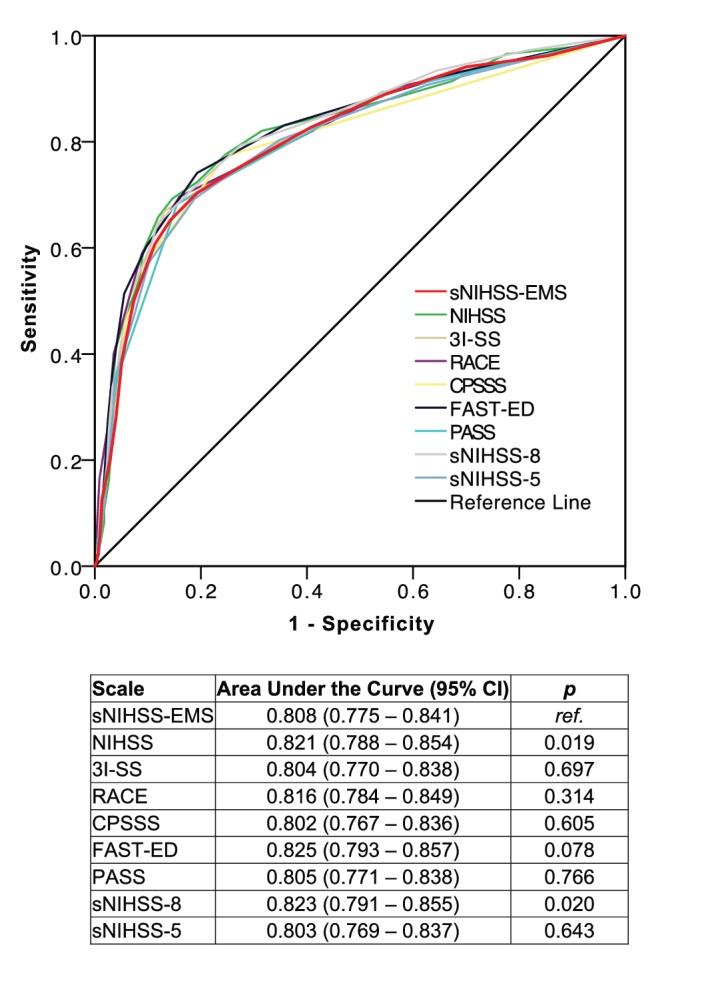
Nine of the NIHSS items were rated as 'suitable for prehospital use.' After excluding two items in order to increase specificity, the final scale (termed shortened NIHSS for EMS, sNIHSS-EMS) consists of 'level of consciousness', 'facial palsy', 'motor arm/leg', 'sensory', 'language' and 'dysarthria'. Sensitivity for stroke recognition of the sNIHSS-EMS is 91% (95% CI 86 to 94), specificity 52% (95% CI 47 to 56). Receiver operating curve analysis revealed an optimal cut-off point for LVO prediction of ≥6 (sensitivity 70% (95% CI 65 to 76), specificity 81% (95% CI 76 to 84), positive predictive value 70 (95% CI 65 to 75), area under the curve 0.81 (95% CI 0.78 to 0.84)). Test characteristics were non-inferior to non-comprehensive scales.
The sNIHSS-EMS may overcome the sequential use of multiple emergency stroke scales by permitting parallel stroke recognition, severity grading and LVO prediction. Full NIHSS-item compatibility allows for evaluation of stroke progression starting at the prehospital phase.
开发一种与美国国立卫生研究院卒中量表(NIHSS)兼容的一体化量表,用于快速、全面的院前卒中评估,包括卒中识别、严重程度分级、病情进展监测以及大血管闭塞(LVO)预测。
急诊医疗服务(EMS)人员和卒中医生(n = 326)对NIHSS的每个项目在院前使用的适用性进行评分;纳入评分最高的项目。对689例连续的急性卒中和疑似卒中患者进行回顾性卒中识别评估,对741例连续的急性缺血性卒中患者在不考虑入院时NIHSS评分的情况下进行急性血管成像,以预测LVO。
NIHSS的9个项目被评为“适用于院前使用”。为提高特异性排除两个项目后,最终量表(称为EMS缩短版NIHSS,sNIHSS - EMS)包括“意识水平”“面瘫”“上肢/下肢运动”“感觉”“语言”和“构音障碍”。sNIHSS - EMS对卒中识别的敏感性为91%(95%CI 86至94),特异性为52%(95%CI 47至56)。受试者工作特征曲线分析显示,LVO预测的最佳截断点为≥6(敏感性70%(95%CI 65至76),特异性81%(95%CI 76至84),阳性预测值70(95%CI 65至75),曲线下面积0.81(95%CI 0.78至0.84))。测试特征不劣于非综合量表。
sNIHSS - EMS通过允许并行进行卒中识别、严重程度分级和LVO预测,可能克服多种急诊卒中量表的顺序使用。完全的NIHSS项目兼容性允许从院前阶段开始评估卒中进展。