Zhang Yi, Wang Hou-Ling, Li Zhonghai, Guo Hongwei
Beijing Advanced Innovation Center for Tree Breeding by Molecular Design, Beijing Forestry University, Beijing 100083, China.
Institute of Plant and Food Science, Department of Biology, Southern University of Science and Technology (SUSTech), Shenzhen 518055, China.
Plants (Basel). 2020 Apr 13;9(4):495. doi: 10.3390/plants9040495.
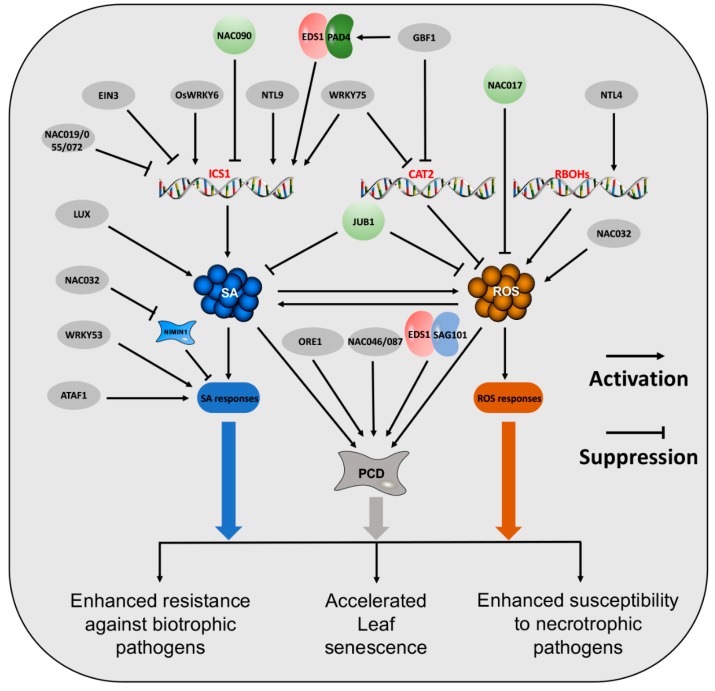
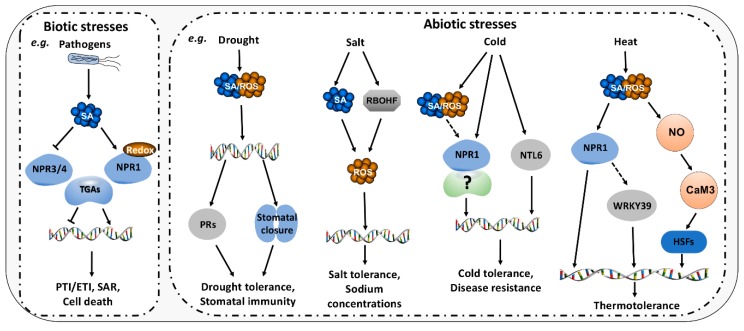
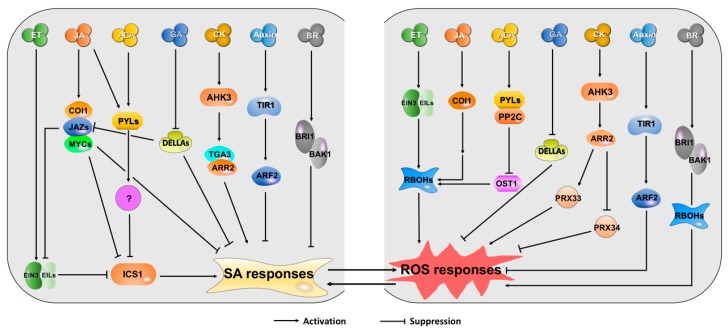
Leaf senescence is an essential physiological process that is accompanied by the remobilization of nutrients from senescent leaves to young leaves or other developing organs. Although leaf senescence is a genetically programmed process, it can be induced by a wide variety of biotic and abiotic factors. Accumulating studies demonstrate that senescence-associated transcription factors (Sen-TFs) play key regulatory roles in controlling the initiation and progression of leaf senescence process. Interestingly, recent functional studies also reveal that a number of Sen-TFs function as positive or negative regulators of plant immunity. Moreover, the plant hormone salicylic acid (SA) and reactive oxygen species (ROS) have been demonstrated to be key signaling molecules in regulating leaf senescence and plant immunity, suggesting that these two processes share similar or common regulatory networks. However, the interactions between leaf senescence and plant immunity did not attract sufficient attention to plant scientists. Here, we review the regulatory roles of SA and ROS in biotic and abiotic stresses, as well as the cross-talks between SA/ROS and other hormones in leaf senescence and plant immunity, summarize the transcriptional controls of Sen-TFs on SA and ROS signal pathways, and analyze the cross-regulation between senescence and immunity through a broad literature survey. In-depth understandings of the cross-regulatory mechanisms between leaf senescence and plant immunity will facilitate the cultivation of high-yield and disease-resistant crops through a molecular breeding strategy.
叶片衰老 是一个重要的生理过程,伴随着营养物质从衰老叶片向幼叶或其他发育器官的转运。尽管叶片衰老是一个由基因编程的过程,但它可由多种生物和非生物因素诱导。越来越多的研究表明,衰老相关转录因子(Sen-TF)在控制叶片衰老过程的起始和进程中发挥关键调控作用。有趣的是,最近的功能研究还揭示,许多Sen-TF作为植物免疫的正调控因子或负调控因子发挥作用。此外,植物激素水杨酸(SA)和活性氧(ROS)已被证明是调节叶片衰老和植物免疫的关键信号分子,这表明这两个过程共享相似或共同的调控网络。然而,叶片衰老与植物免疫之间的相互作用并未引起植物科学家的足够关注。在此,我们综述SA和ROS在生物和非生物胁迫中的调控作用,以及SA/ROS与其他激素在叶片衰老和植物免疫中的相互作用,总结Sen-TF对SA和ROS信号通路的转录调控,并通过广泛的文献调研分析衰老与免疫之间的交叉调控。深入了解叶片衰老与植物免疫之间的交叉调控机制将有助于通过分子育种策略培育高产抗病作物。