College of Computer Science and Technology, Zhejiang University of Technology, Hangzhou, 310023, China.
Research Center of Intelligent Healthcare, Faculty of Health and Life Science, Coventry University, Coventry, CV1 5RW, UK.
Biomed Eng Online. 2020 Apr 15;19(1):21. doi: 10.1186/s12938-020-00766-3.
As one of the major complications of diabetes, diabetic retinopathy (DR) is a leading cause of visual impairment and blindness due to delayed diagnosis and intervention. Microaneurysms appear as the earliest symptom of DR. Accurate and reliable detection of microaneurysms in color fundus images has great importance for DR screening.
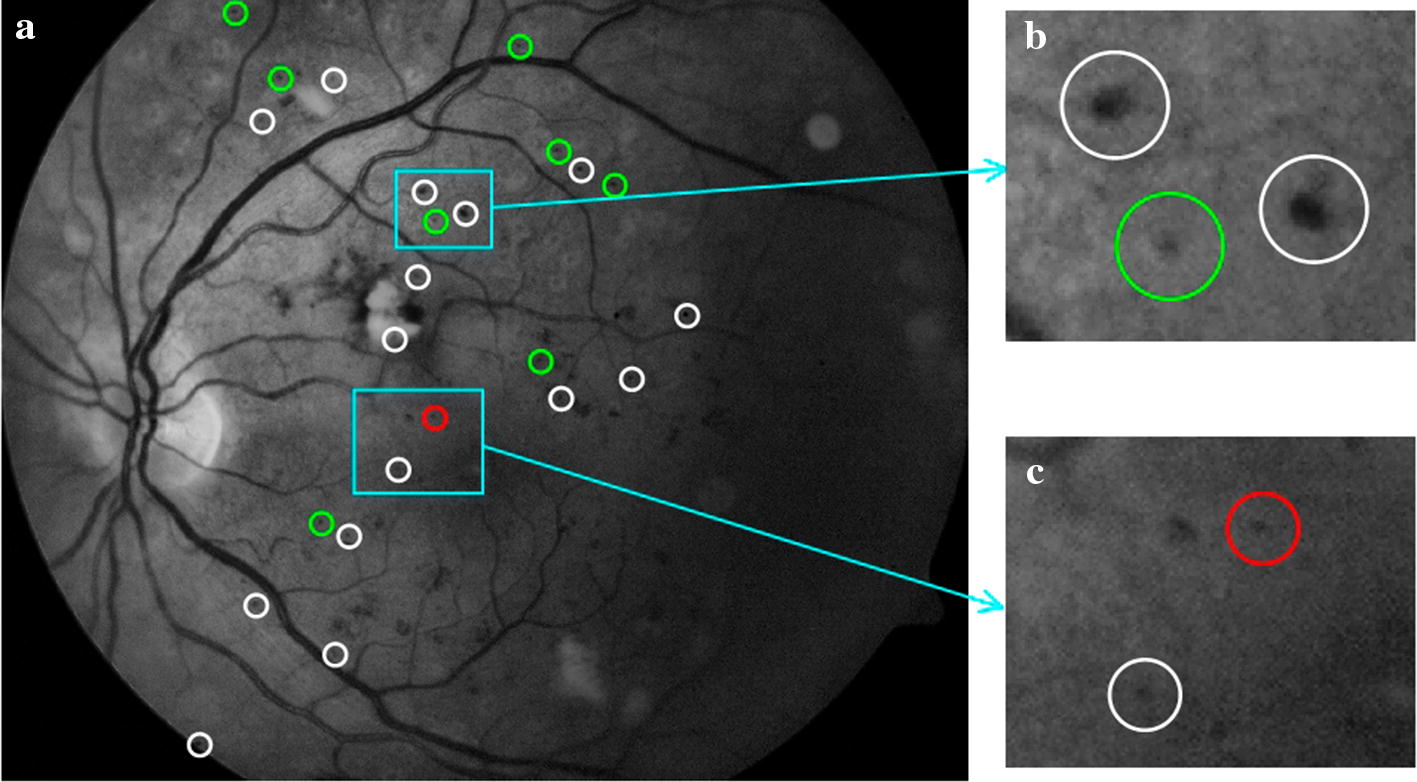
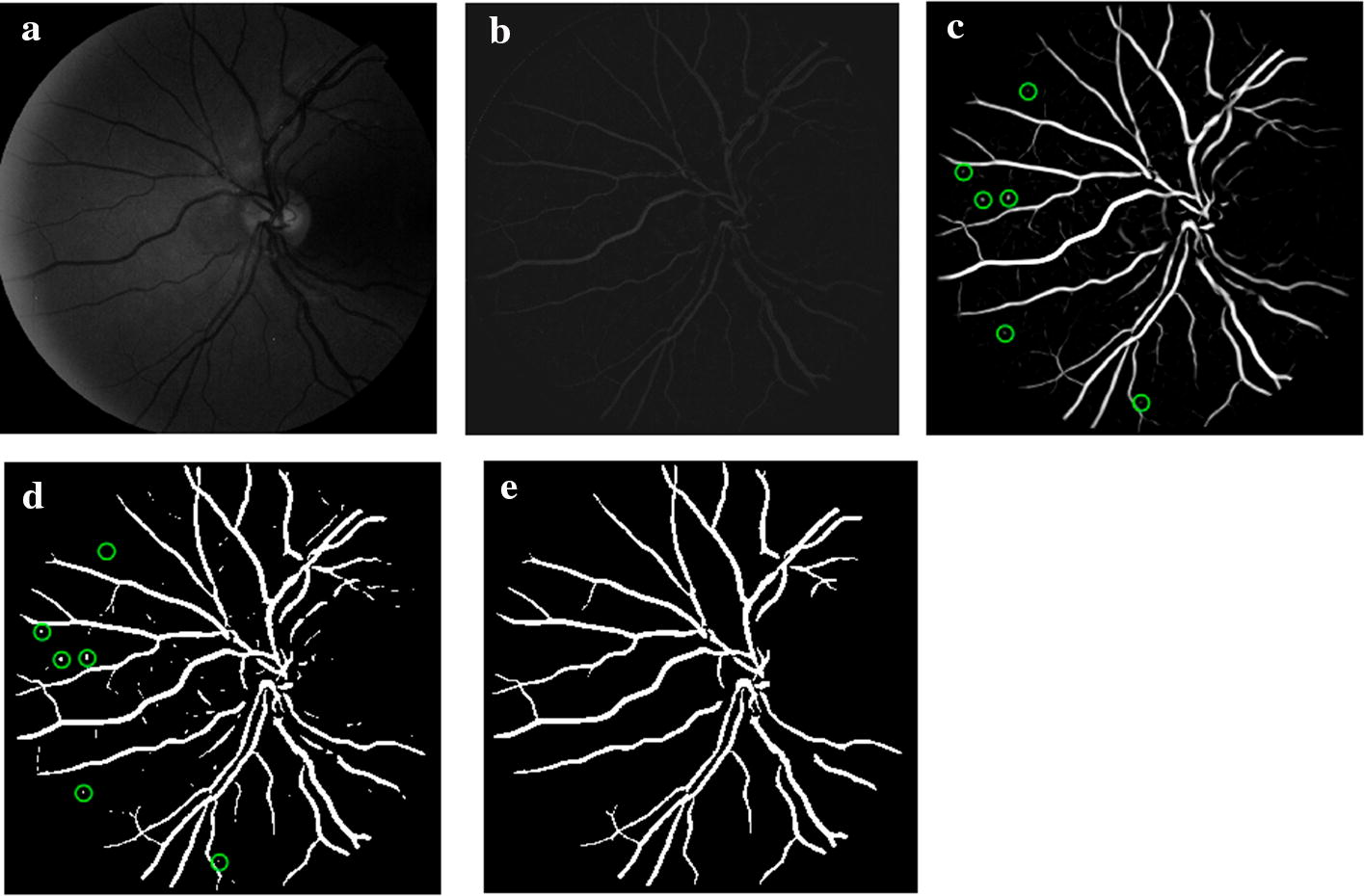
A microaneurysms' detection method using machine learning based on directional local contrast (DLC) is proposed for the early diagnosis of DR. First, blood vessels were enhanced and segmented using improved enhancement function based on analyzing eigenvalues of Hessian matrix. Next, with blood vessels excluded, microaneurysm candidate regions were obtained using shape characteristics and connected components analysis. After image segmented to patches, the features of each microaneurysm candidate patch were extracted, and each candidate patch was classified into microaneurysm or non-microaneurysm. The main contributions of our study are (1) making use of directional local contrast in microaneurysms' detection for the first time, which does make sense for better microaneurysms' classification. (2) Applying three different machine learning techniques for classification and comparing their performance for microaneurysms' detection. The proposed algorithm was trained and tested on e-ophtha MA database, and further tested on another independent DIARETDB1 database. Results of microaneurysms' detection on the two databases were evaluated on lesion level and compared with existing algorithms.
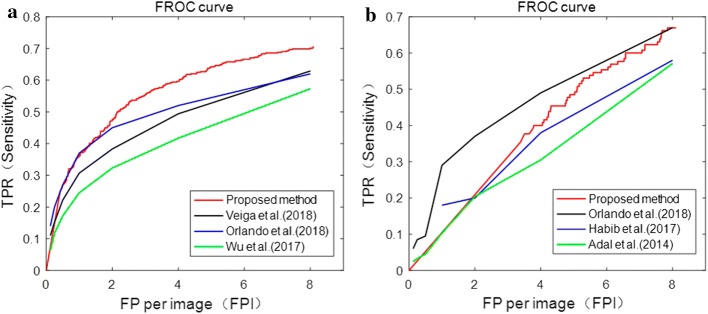
The proposed method has achieved better performance compared with existing algorithms on accuracy and computation time. On e-ophtha MA and DIARETDB1 databases, the area under curve (AUC) of receiver operating characteristic (ROC) curve was 0.87 and 0.86, respectively. The free-response ROC (FROC) score on the two databases was 0.374 and 0.210, respectively. The computation time per image with resolution of 2544×1969, 1400×960 and 1500×1152 is 29 s, 3 s and 2.6 s, respectively.
The proposed method using machine learning based on directional local contrast of image patches can effectively detect microaneurysms in color fundus images and provide an effective scientific basis for early clinical DR diagnosis.
糖尿病性视网膜病变(DR)是糖尿病的主要并发症之一,由于诊断和干预不及时,它是导致视力损害和失明的主要原因。微动脉瘤是 DR 的最早症状。准确可靠地检测彩色眼底图像中的微动脉瘤对于 DR 的筛查具有重要意义。
提出了一种基于方向局部对比度(DLC)的基于机器学习的微动脉瘤检测方法,用于 DR 的早期诊断。首先,使用基于分析 Hessian 矩阵特征值的改进增强函数增强和分割血管。接下来,在排除血管后,使用形状特征和连通分量分析获得微动脉瘤候选区域。图像分割成斑块后,提取每个微动脉瘤候选斑块的特征,并将每个候选斑块分类为微动脉瘤或非微动脉瘤。我们研究的主要贡献是:(1)首次在微动脉瘤检测中使用方向局部对比度,这对更好的微动脉瘤分类很有意义。(2)应用三种不同的机器学习技术进行分类,并比较它们在微动脉瘤检测中的性能。所提出的算法在 e-ophtha MA 数据库上进行训练和测试,并在另一个独立的 DIARETDB1 数据库上进行进一步测试。在病变水平上评估两个数据库上微动脉瘤检测的结果,并与现有算法进行比较。
与现有算法相比,该方法在准确性和计算时间上均具有更好的性能。在 e-ophtha MA 和 DIARETDB1 数据库上,接收器工作特征(ROC)曲线的曲线下面积(AUC)分别为 0.87 和 0.86。两个数据库的自由响应 ROC(FROC)得分分别为 0.374 和 0.210。分辨率为 2544×1969、1400×960 和 1500×1152 的图像的计算时间分别为 29 s、3 s 和 2.6 s。
该方法使用基于图像斑块方向局部对比度的机器学习,可以有效检测彩色眼底图像中的微动脉瘤,为临床早期 DR 诊断提供有效科学依据。