Department of Nutrition, School of Public Health, Sun Yat-sen University, Guangzhou, China.
Department of Human Nutrition, Foods and Exercise, College of Agricultural and Life Sciences, Virginia Tech, Blacksburg, VA, United States.
Front Endocrinol (Lausanne). 2020 Mar 31;11:148. doi: 10.3389/fendo.2020.00148. eCollection 2020.
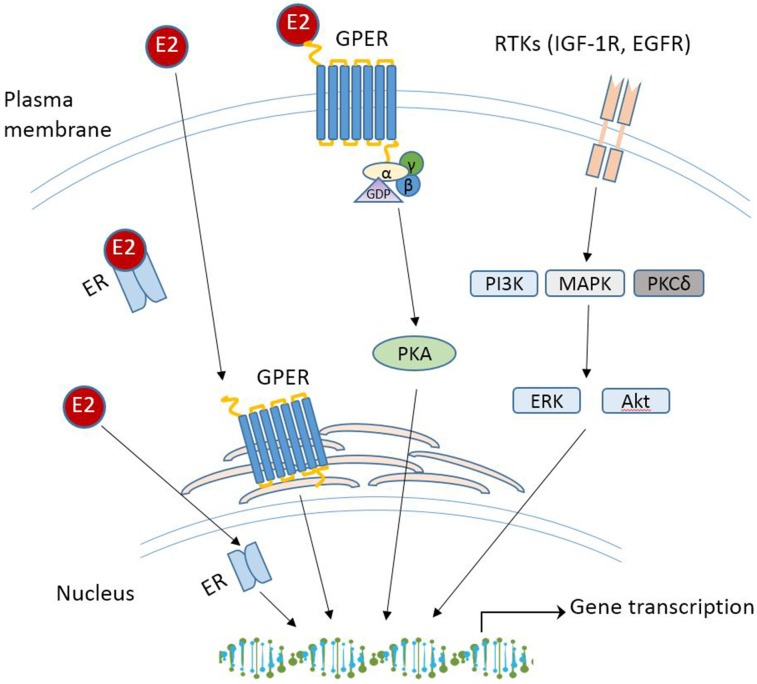
Estrogen can elicit pleiotropic cellular responses via a diversity of estrogen receptors (ERs)-mediated genomic and rapid non-genomic mechanisms. Unlike the genomic responses, where the classical nuclear ERα and ERβ act as transcriptional factors following estrogen binding to regulate gene transcription in estrogen target tissues, the non-genomic cellular responses to estrogen are believed to start at the plasma membrane, leading to rapid activation of second messengers-triggered cytoplasmic signal transduction cascades. The recently acknowledged ER, GPR30 or GPER, was discovered in human breast cancer cells two decades ago and subsequently in many other cells. Since its discovery, it has been claimed that estrogen, ER antagonist fulvestrant, as well as some estrogenic compounds can directly bind to GPER, and therefore initiate the non-genomic cellular responses. Various recently developed genetic tools as well as chemical ligands greatly facilitated research aimed at determining the physiological roles of GPER in different tissues. However, there is still lack of evidence that GPER plays a significant role in mediating endogenous estrogen action . This review summarizes current knowledge about GPER, including its tissue expression and cellular localization, with emphasis on the research findings elucidating its role in health and disease. Understanding the role of GPER in estrogen signaling will provide opportunities for the development of new therapeutic strategies to strengthen the benefits of estrogen while limiting the potential side effects.
雌激素可以通过多种雌激素受体 (ER) 介导的基因组和快速非基因组机制引发多效性细胞反应。与基因组反应不同,经典核 ERα 和 ERβ 在雌激素结合后作为转录因子发挥作用,调节雌激素靶组织中的基因转录,而雌激素对非基因组细胞的反应被认为始于质膜,导致第二信使的快速激活-触发细胞质信号转导级联。二十年前在人乳腺癌细胞中发现了最近被认可的 ER、GPR30 或 GPER,随后在许多其他细胞中也发现了这种受体。自发现以来,有人声称雌激素、ER 拮抗剂氟维司群以及一些雌激素化合物可以直接与 GPER 结合,从而引发非基因组细胞反应。最近开发的各种遗传工具和化学配体极大地促进了旨在确定 GPER 在不同组织中生理作用的研究。然而,仍然缺乏证据表明 GPER 在介导内源性雌激素作用方面发挥重要作用。本综述总结了关于 GPER 的现有知识,包括其组织表达和细胞定位,重点介绍了阐明其在健康和疾病中的作用的研究结果。了解 GPER 在雌激素信号转导中的作用将为开发新的治疗策略提供机会,以增强雌激素的益处,同时限制潜在的副作用。