Sandler Robert David, Tattersall Rachel Scarlett, Schoemans Helene, Greco Raffaella, Badoglio Manuela, Labopin Myriam, Alexander Tobias, Kirgizov Kirill, Rovira Montserrat, Saif Muhammad, Saccardi Riccardo, Delgado Julio, Peric Zinaida, Koenecke Christian, Penack Olaf, Basak Grzegorz, Snowden John Andrew
Department of Rheumatology, Sheffield Teaching Hospitals NHS Foundation Trust, Sheffield, United Kingdom.
Department of Hematology, University Hospitals Leuven, KU Leuven, Leuven, Belgium.
Front Immunol. 2020 Mar 31;11:524. doi: 10.3389/fimmu.2020.00524. eCollection 2020.
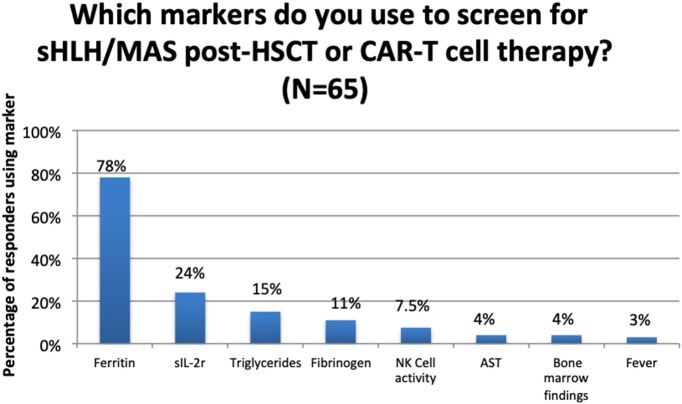
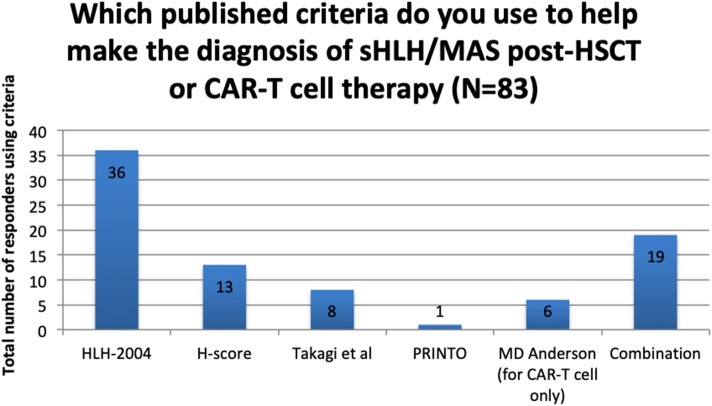
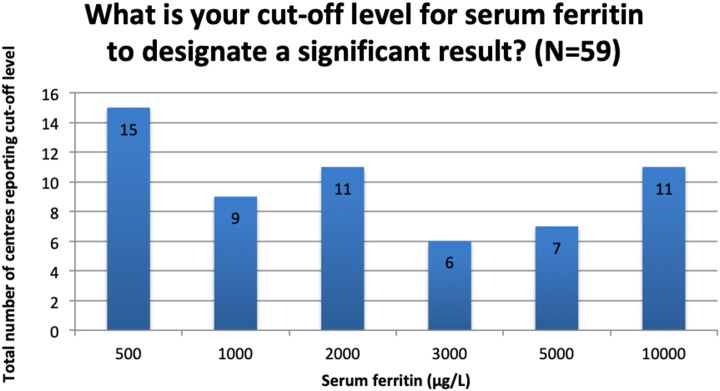
Secondary haemophagocytic lymphohistiocytosis (sHLH) or Macrophage Activation Syndrome (MAS) is a life-threatening hyperinflammatory syndrome that can occur in patients with severe infections, malignancy or autoimmune diseases. It is also a rare complication of haematopoetic stem cell transplantation (HSCT), with a high mortality. It may be associated with graft vs. host disease in the allogeneic HSCT setting. It is also reported following CAR-T cell therapy, but differentiation from cytokine release syndrome (CRS) is challenging. Here, we summarise the literature and present results of a survey of current awareness and practice in EBMT-affiliated centres of sHLH/MAS following HSCT and CAR-T cell therapy. An online questionnaire was sent to the principal investigators of all EBMT member transplant centres treating adult patients (18 years and over) inviting them to provide information regarding: number of cases of sHLH/MAS seen in their centre over 3 years (2016-2018 inclusive); screening strategies and use of existing diagnostic/classification criteria and treatment protocols. 114/472 centres from 24 different countries responded (24%). We report estimated rates of sHLH/MAS of 1.09% (95% CI = 0.89-1.30) following allogeneic HSCT, 0.15% (95% CI = 0.09-5.89) following autologous HSCT and 3.48% (95% CI = 0.95-6.01) following CAR-T cell therapy. A majority of centres (70%) did not use a standard screening protocol. Serum ferritin was the most commonly used screening marker at 78% of centres, followed by soluble IL-2 receptor (24%), triglycerides (15%), and fibrinogen (11%). There was significant variation in definition of "clinically significant" serum ferritin levels ranging from 500 to 10,000 μg/mL. The most commonly used criteria to support diagnosis were HLH-2004 (43%) and the H score (15%). Eighty percent of responders reported using no standard management protocol, but reported using combinations of corticosteroids, chemotherapeutic agents, cytokine blockade, and monoclonal antibodies. There is a remarkable lack of consistency between EBMT centres in the approach to screening, diagnosis and management. Further research in this field is needed to raise awareness of and inform harmonised, evidence-based approaches to the recognition and treatment of sHLH/MAS following HSCT/CAR-T cell therapy.
继发性噬血细胞性淋巴组织细胞增生症(sHLH)或巨噬细胞活化综合征(MAS)是一种危及生命的高炎症综合征,可发生于严重感染、恶性肿瘤或自身免疫性疾病患者。它也是造血干细胞移植(HSCT)的一种罕见并发症,死亡率很高。在异基因HSCT情况下,它可能与移植物抗宿主病有关。也有报道称CAR-T细胞治疗后会出现该病症,但与细胞因子释放综合征(CRS)进行区分具有挑战性。在此,我们总结了相关文献,并展示了一项针对EBMT附属中心在HSCT和CAR-T细胞治疗后对sHLH/MAS的当前认知和实践的调查结果。我们向所有治疗成年患者(18岁及以上)的EBMT成员移植中心的主要研究者发送了一份在线问卷,邀请他们提供以下信息:他们中心在3年(2016 - 2018年,含这三年)内见到的sHLH/MAS病例数;筛查策略以及现有诊断/分类标准和治疗方案的使用情况。来自24个不同国家的114/472个中心做出了回应(24%)。我们报告异基因HSCT后sHLH/MAS的估计发生率为1.09%(95%置信区间 = 0.89 - 1.30),自体HSCT后为0.15%(95%置信区间 = 0.09 - 5.89),CAR-T细胞治疗后为3.48%(95%置信区间 = 0.95 - 6.01)。大多数中心(70%)未使用标准筛查方案。78%的中心最常使用血清铁蛋白作为筛查标志物,其次是可溶性白细胞介素 - 2受体(24%)、甘油三酯(15%)和纤维蛋白原(11%)。“具有临床意义的”血清铁蛋白水平的定义差异很大,范围从500到10,000μg/mL。支持诊断最常用的标准是HLH - 2004(43%)和H评分(15%)。80%的受访者报告未使用标准管理方案,但报告使用了皮质类固醇、化疗药物、细胞因子阻断剂和单克隆抗体的组合。EBMT中心在筛查、诊断和管理方法上明显缺乏一致性。该领域需要进一步研究,以提高对HSCT/CAR-T细胞治疗后sHLH/MAS的认识,并为识别和治疗提供统一的、基于证据的方法。