Department of Physics and Astronomy and Institute for Lasers, Life and Biophotonics, Faculty of Sciences, De Boelelaan 1081, 1081 HV, Amsterdam, The Netherlands.
Groningen Biomolecular Sciences and Biotechnology Institute & Zernike Institute for Advanced Materials, University of Groningen, Nijenborgh 7, 9747 AG, Groningen, The Netherlands.
Photosynth Res. 2020 May;144(2):273-295. doi: 10.1007/s11120-020-00741-y. Epub 2020 Apr 15.
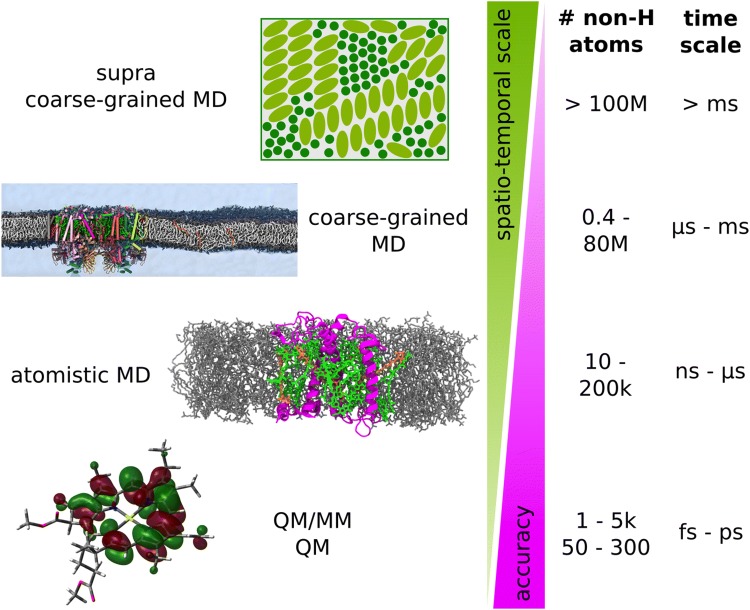
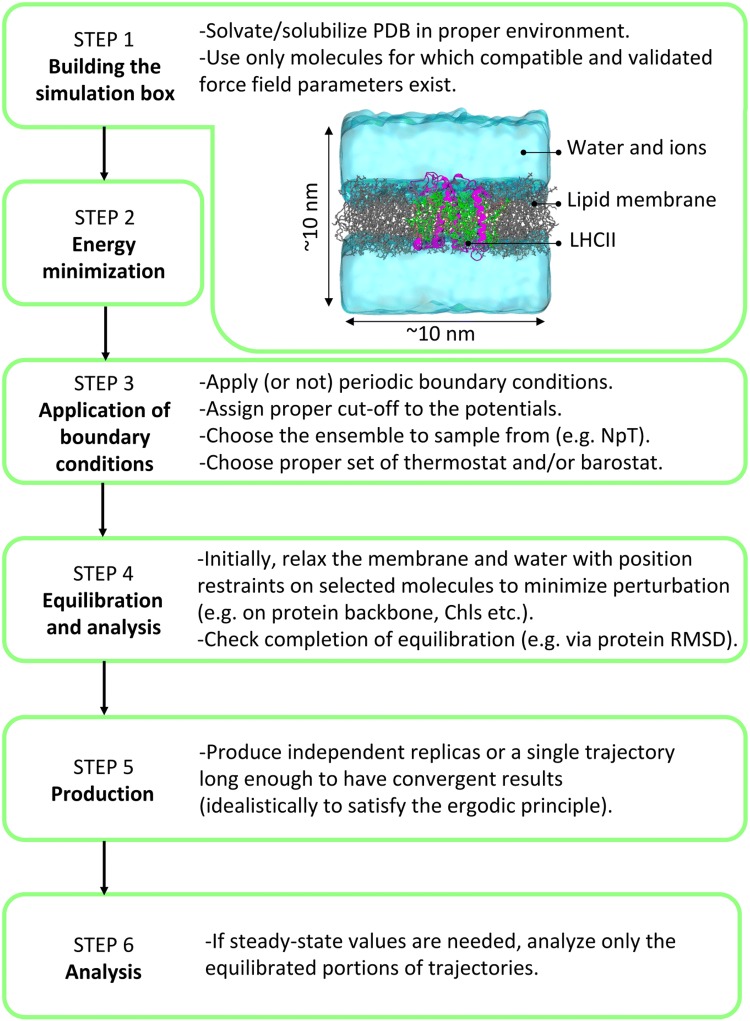
Photosynthesis is regulated by a dynamic interplay between proteins, enzymes, pigments, lipids, and cofactors that takes place on a large spatio-temporal scale. Molecular dynamics (MD) simulations provide a powerful toolkit to investigate dynamical processes in (bio)molecular ensembles from the (sub)picosecond to the (sub)millisecond regime and from the Å to hundreds of nm length scale. Therefore, MD is well suited to address a variety of questions arising in the field of photosynthesis research. In this review, we provide an introduction to the basic concepts of MD simulations, at atomistic and coarse-grained level of resolution. Furthermore, we discuss applications of MD simulations to model photosynthetic systems of different sizes and complexity and their connection to experimental observables. Finally, we provide a brief glance on which methods provide opportunities to capture phenomena beyond the applicability of classical MD.
光合作用是由蛋白质、酶、色素、脂质和辅助因子之间的动态相互作用调节的,这种作用发生在大的时空尺度上。分子动力学(MD)模拟为研究(生物)分子聚集体从(亚)皮秒到(亚)毫秒时间范围以及从Å到数百纳米长度范围的动力学过程提供了一个强大的工具包。因此,MD 非常适合解决光合作用研究领域中出现的各种问题。在这篇综述中,我们提供了原子和粗粒分辨率水平的 MD 模拟基本概念的介绍。此外,我们讨论了 MD 模拟在模拟不同大小和复杂性的光合作用系统及其与实验可观测值的联系方面的应用。最后,我们简要介绍了哪些方法提供了捕捉超出经典 MD 适用性的现象的机会。