Zhang Rong-Ping, Lin Yan-Jun, Yu Hao-Fei, Chen Si-Ying, Zhou Jun
Yunnan University of Chinese Medicine, Kunming, China.
Kunming Medical University, Kunming, China.
Nat Prod Bioprospect. 2020 Apr;10(2):105-108. doi: 10.1007/s13659-020-00238-0. Epub 2020 Apr 15.
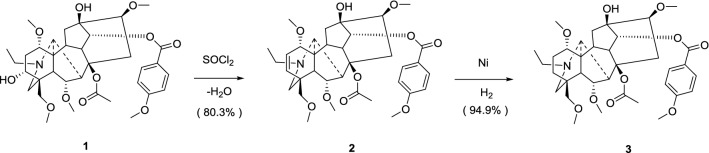
Both Aconitum hemsleyanum and Aconitum geniculatun have abundant contents of yunaconitine (1). Yunaconitine (1) has similar skeleton to crassicauline A (3); the only difference between them is that 1 contains a α-hydroxyl group at C-3. Our team attempts to convert 1 into 3 because 3 owns pharmacological activity. There are two steps to achieve the transformation above: firstly, use dehydration reaction to transform yunaconitine (1) into dehydroyunaconitine (2); secondly, use hydrogen reduction to acquire crassicauline A (3). Compared with other methods, this one below is more suitable for production application and more concise; moreover, the cost is lower with higher yield.
滇西乌头和膝瓣乌头均含有丰富的云乌头碱(1)。云乌头碱(1)与粗茎乌头碱A(3)具有相似的骨架;它们之间唯一的区别在于1在C-3位含有一个α-羟基。我们团队试图将1转化为3,因为3具有药理活性。实现上述转化有两个步骤:首先,通过脱水反应将云乌头碱(1)转化为去氢云乌头碱(2);其次,通过加氢还原得到粗茎乌头碱A(3)。与其他方法相比,以下这种方法更适合生产应用且更简洁;此外,成本更低且产率更高。