Internal Medicine III, Wakayama Medical University, Wakayama City, Wakayama, Japan.
Clinical Trial Management Department, Shizuoka Cancer Center, Shizuoka, Japan.
Oncologist. 2020 Apr;25(4):e679-e683. doi: 10.1634/theoncologist.2019-0299. Epub 2019 Nov 19.
Although predictive value of immune-related adverse events (irAEs) induced by immune checkpoint inhibitors (ICIs) have been suggested by several studies, their assessments were insufficient because patients were categorized only by the occurrence of irAEs. It has not been elucidated whether irAEs also play a significant role even in responders.
Between December 2015 and September 2018, 106 patients with advanced non-small cell lung cancer treated with ICIs were enrolled in our prospective biomarker study. Twenty-three of these were responders, defined as those with complete or partial response. We investigated the proportion of irAEs among overall and responders. For responders, progression-free survival (PFS) and overall survival of ICIs were compared between those with and without irAEs. As an exploratory analysis, we measured 41 proteins from peripheral blood before and after ICI treatment.
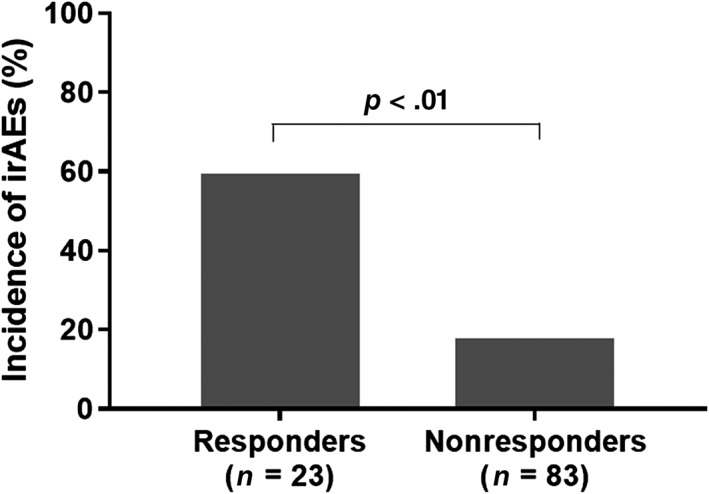
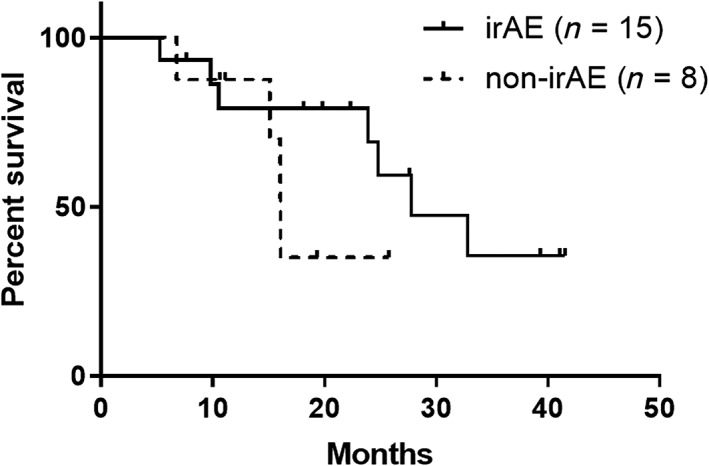
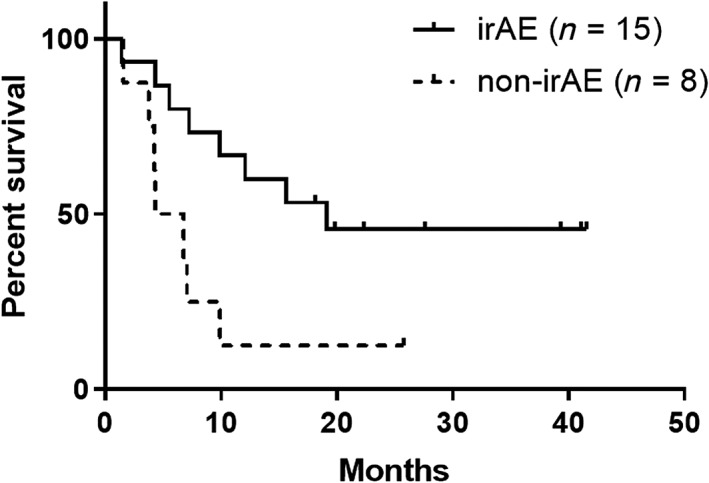
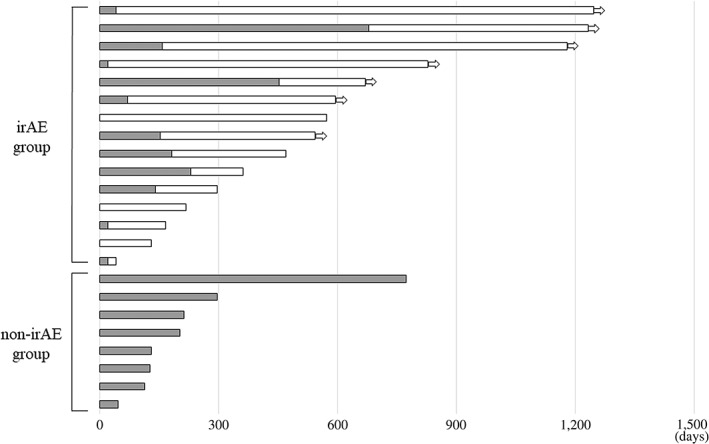
The proportion of irAEs was significantly higher in responders than nonresponders (65.2% vs. 19.3%, p < .01). Among responders, clinical characteristics did not differ regardless of the occurrence of irAEs. However, there was a significant difference in PFS among responders (irAE group 19.1 months vs. non-irAE group 5.6 months; hazard ratio: 0.30 [95% confidence interval: 0.10-0.85]; p = .02). Of 41 protein analyses, fibroblast growth factor-2 at baseline and monocyte chemoattractant protein fold change showed significant differences between them (p < .04).
Although this is a small sample-sized study, irAE might be a predictive factor of durable efficacy, even in patients who responded to ICIs. Investigation into the significance of irAEs in responders will contribute to the establishment of optimal administration of ICI.
Although the predictive value of immune-related adverse events (irAEs) induced by immune checkpoint inhibitors (ICIs) has been suggested by several studies, it has not been elucidated whether irAEs also play a significant role even in responders. This study showed that more than 60% of responders had irAEs. It demonstrated the strong correlation between irAEs and efficacy even in responders. Investigation into the significance of irAEs in responders will contribute to the establishment of optimal administration of ICI.
尽管几项研究已经提出了免疫检查点抑制剂(ICI)引起的免疫相关不良事件(irAEs)的预测价值,但由于仅根据 irAEs 的发生对患者进行分类,因此评估并不充分。irAEs 即使在应答者中是否也发挥重要作用尚未阐明。
在 2015 年 12 月至 2018 年 9 月期间,我们前瞻性的生物标志物研究纳入了 106 例接受 ICI 治疗的晚期非小细胞肺癌患者。其中 23 例为应答者,定义为完全或部分缓解者。我们调查了 irAEs 在所有患者和应答者中的比例。对于应答者,比较了有无 irAEs 患者的无进展生存期(PFS)和总生存期。作为探索性分析,我们在 ICI 治疗前后测量了外周血中的 41 种蛋白。
应答者中 irAEs 的比例明显高于无应答者(65.2%比 19.3%,p<0.01)。在应答者中,无论 irAEs 是否发生,临床特征均无差异。然而,应答者的 PFS 存在显著差异(irAE 组 19.1 个月 vs. 非 irAE 组 5.6 个月;风险比:0.30[95%置信区间:0.10-0.85];p=0.02)。在 41 种蛋白分析中,基线时的成纤维细胞生长因子-2和单核细胞趋化蛋白的倍数变化之间存在显著差异(p<0.04)。
尽管这是一项小样本量的研究,但 irAE 可能是 ICI 持久疗效的预测因素,即使在应答者中也是如此。研究 irAEs 在应答者中的意义将有助于建立 ICI 的最佳给药方案。
尽管几项研究已经提出了免疫检查点抑制剂(ICI)引起的免疫相关不良事件(irAEs)的预测价值,但尚未阐明 irAEs 即使在应答者中是否也发挥重要作用。本研究显示,60%以上的应答者发生 irAEs。它证明了 irAEs 与疗效之间的强相关性,即使在应答者中也是如此。研究 irAEs 在应答者中的意义将有助于建立 ICI 的最佳给药方案。